

Source: The Conversation – UK
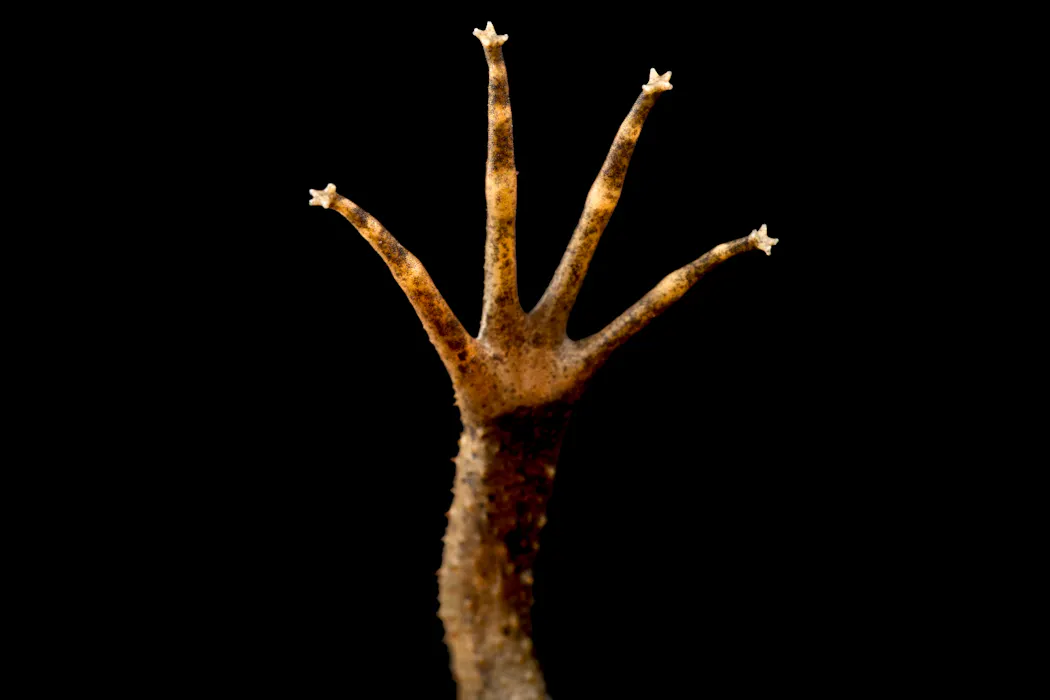
The Surinam toad is one of the strangest frogs on Earth. Flat-bodied, tiny-eyed and adapted to the murky waters of the Amazon basin, it hunts well despite having very poor vision. When a fish swims close, the frog suddenly opens its mouth and sucks the prey inside in a fraction of a second.
Researchers from the University of California have recently discovered that the secret lies in its bizarre fingertips. Each finger ends in a cluster of 16 tiny lobes, giving the frog 128 miniature sensory structures. These lobes are packed with touch-sensitive nerve endings and can detect even the smallest movements in the surrounding water. Even in complete darkness, the frog can sense a fish approaching, by holding its long front legs outstretched, with its fingers spread wide.
Despite being frogs, Surinam toads are so named because of their brown and warty skin which helps them blend into their murky environments.
The animal kingdom is full of examples of where the senses have been tuned to solve a complicated problem.
We tend to think of the familiar five senses as a complete package. However, biology is much more imaginative than that. Amphibians and reptiles are particularly good at reminding us that there is far more to sensing the environment than simply seeing, hearing, smelling, tasting and touching it.
Marine animals (including reptiles) have a greater need for innovative senses due to the differences caused by the physical properties of water compared to air.
Some of their sensory abilities are modifications of familiar senses. Others detect things that humans cannot perceive at all, and some blur the boundaries between senses.
One of the most spectacular examples of an unusual sense is found in several groups of snakes, particularly pit vipers, boas and pythons. These snakes have specialised organs called pit organs on the sides of their heads, which can detect infrared radiation.
To understand how extraordinary this is, imagine a mouse sitting in a dark room. To us, the mouse might be almost invisible. To a snake equipped with these infrared-sensitive pits, however, the warm-blooded mouse produces a thermal image against the cooler surroundings.
Pit vipers have a pair of obvious facial pits, located between the eye and nostril. Boas and pythons have multiple smaller labial pits around the mouth. These structures contain highly sensitive nerve endings capable of detecting tiny changes in infrared radiation.
Infrared information is integrated with their other senses, particularly vision, to help them locate and strike prey. The system is astonishingly sensitive. A snake can detect tiny temperature differences across its surroundings, allowing it to identify warm prey even when visual information is poor. For a nocturnal predator, this is enormously useful – a mouse cannot simply switch off its body heat and hide.
Snakes integrate their senses in other ways that can be hard for humans to imagine. For example, all snakes use their forked tongue to sense the world around them and to taste the air, searching for prey or for mates.
Amphibians take the idea of chemical sensing in a different direction. Amphibians can breathe and drink through their skin, which also excretes toxins to defend them from predators as well as well as sensation. Water, dissolved chemicals and other environmental information are constantly interacting with the body.
Amphibian sensory biology becomes even stranger when we consider cutaneous mechanoreception – the ability to detect mechanical stimulation through the skin. A frog does not need to see everything happening around it. Its body is covered with sensory receptors which can detect touch, pressure and vibration similarly to ourselves.
Rather than continuously scanning its surroundings like a mammal, a frog can remain still while its sensory systems monitor the environment with some species only reacting when a moving predator gets within 15 to 30 inches away.
Frogs use more acute versions of our familiar senses to understand what is going on within their surroundings, instead of listening or watching for danger as most mammals do. This is particularly valuable for an animal that may spend much of its life sitting almost motionless. A toad that moves unnecessarily may attract the attention of a predator or scare away prey.
Perhaps the most mysterious sensory ability of all is magnetoreception, the ability to detect Earth’s magnetic field. Evidence for magnetic sensing exists in a variety of amphibians and reptiles. Salamanders, frogs, turtles, crocodilians and some lizards can respond to magnetic fields under experimental conditions, although the exact mechanisms and ecological importance vary between species.
For migratory animals, magnetic information can provide a directional reference over surprisingly large distances. Sea turtles are among the most famous examples. Young turtles entering the ocean undertake extraordinary journeys of up to 8,000 miles (13,000 km), and experiments have demonstrated that they can respond to magnetic fields associated with different geographic locations.
The Earth’s magnetic field varies across the planet, and so an animal capable of detecting these variations can use them as part of a natural map. A young turtle entering the ocean does not have a smartphone, GPS receiver or compass. Yet its nervous system contains mechanisms that allow it to extract information from a force that humans cannot consciously perceive. The planet itself becomes part of the animal’s sensory environment.
Amphibians and reptiles are a reminder that there is no single universal way of experiencing the natural world. Evolution has produced animals capable of detecting heat, magnetic fields, vibrations and chemical traces that humans simply cannot perceive.
So, the next time you see a snake flicking its tongue, a frog sitting motionless beside a pond or a turtle disappearing beneath the surface, remember that the animal may be experiencing a world that is almost unimaginably different from our own.

Steven Allain does not work for, consult, own shares in or receive funding from any company or organisation that would benefit from this article, and has disclosed no relevant affiliations beyond their academic appointment.
Original source: https://analysis1.mil-osi.com/2026/10/05/unusual-senses-the-secret-superpowers-of-amphibians-and-reptiles/