

Source: The Conversation – Canada
American interest in Alberta separatism over the last 18 months has ranged from overt statements of support from cabinet officials and congressional allies to backing of the sovereignty movement by the wider MAGA media ecosystem online.
In late January, Republican political operatives from Michigan were reportedly in Alberta meeting with separatist organizers about get-out-the-vote software.
A few weeks later, prominent separatist organizers in Alberta admitted to meeting with American officials in Washington about the prospect of the province leaving Canada, but quickly distanced themselves from United States President Donald Trump himself.
Our new research explains why: Trump isn’t popular in Alberta, Albertans know that, and connecting Trump to the separatist movement reduces intentions to vote for separatism.
Call it the “Trump Effect” on Alberta separatism.
Why separatists steer clear of Trump
Backing away from Trump himself while meeting with Republicans might mean that separatist organizers know that Albertans, like most Canadians, disapprove of Trump, especially as the Canada-U.S. relationship deteriorates.
If Albertans believe their fellow citizens disapprove of Trump, and they associate the Alberta separatism movement with Trump, they may expect similar disapproval for supporting separatism. Anticipating this social backlash could discourage them from voting for it.
This expected disapproval is the product of a social norm against Trump and his administration. Social norms are rules for how to act as a member of a group because we see, and expect, most people in the group act that way — and we expect most in the group believe we should act that way.
Social norms can be instrumental in determining how we act politically. When clear and identifiable, norms can influence the political party we support, political donations, beliefs about what policy is best and decisions about whether to turn out to vote.
We follow these norms because they are connected to group identities — like partisanship, nationality or even being a fan of a sports team — that make up part of who we think we are.
Following the expectations of the groups we identify with can boost our self-esteem by being a good group member. Violating those expectations can make us feel guilty and anticipate punishment by others in our group.
Trump’s ties to Alberta separatism
In late May 2026, seeing that some separatists were backing away from Trump and knowing that social norms influence political behaviour, we fielded a survey in Alberta through Vox Pop Labs.
Our sample included 1,260 Albertans, mostly concentrated in Calgary, Edmonton and along the Highway 2 corridor. Compared to the 2021 census, the sample was more educated, slightly more male and had higher incomes than the province overall.
In our survey, we randomly assigned participants to receive different sets of information (or no information) before asking them:
“If there was a referendum question on whether Alberta should separate and become independent from Canada, how would you vote?”
We did not ask the Alberta government’s referendum question because its phrasing is confusing. To measure general support for separatism, we also asked participants how strongly they agreed or disagreed “that Alberta should separate and become independent from Canada.”
One group of participants was given information about how some
senior American officials are supportive of Alberta’s separation from Canada.
Another group received information about how Trump is regarded as being supportive of Alberta’s separation from Canada.
A third group received the same information about Trump while being asked to answer how most other Albertans feel about Trump. In other words, they were asked to contemplate if a group consensus (a norm) about Trump existed among Albertans. Everyone else received this question about the norm later in the survey, along with a question asking their personal views on Trump.
Trump erodes separatist vote intention
Our results show that Albertans correctly identified a norm of disapproving of Trump. Albertans widely disapprove of Trump and know that most other Albertans do too.
In our control group, who received no information, a small minority said they’d vote to separate. Compared to the control group, those who were provided with information that connected Alberta separatism to the U.S., Trump, and/or the Trump norm were less likely to say they intended to vote for separatism.
The sharpest decline occurred when Albertans were asked to think about other Albertans’ feelings about Trump and shown a link between Trump and separatism. As the figure below shows, this lowered separatist vote intention by 5.4 percentage points.
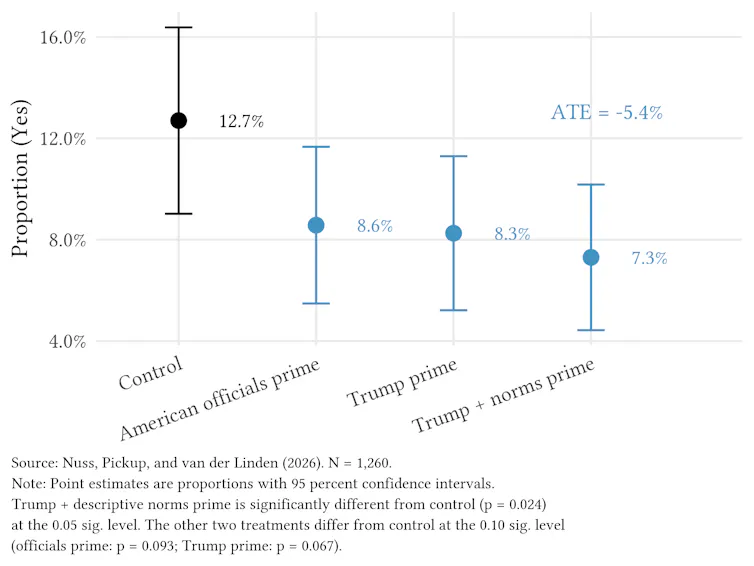
(Authors), CC BY
The Trump disapproval norm seems to move voter intention, but when we examine answers to the question about whether respondents agree that Alberta should leave Canada, we find that most Albertans strongly disagree.
That baseline opposition is already so strong that tying separatism to the U.S., Trump or anti-Trump norms doesn’t make people disagree any more than they already do — even though it does change how they intend to vote.
Looking ahead
So what’s the key takeaway from our research?
Connecting Trump to the separatist movement — and reminding voters how unpopular he is among Albertans — could reduce support for Alberta separatism.
This tactic would become even more effective if Trump becomes more involved in the days leading to the referendum, or if the “remain” campaign uses his image to discourage voters.

Steven Nuss receives funding from the Social Sciences and Humanities Research Council.
Clifton van der Linden receives funding from the Social Sciences and Humanities Research Council. He is also the founder and chief executive officer of Vox Pop Labs.
Mark Pickup receives funding from the Social Sciences and Humanities Research Council.
Original source: https://analysis1.mil-osi.com/2026/10/05/albertans-disapprove-of-donald-trump-and-his-brand-is-weakening-separatism-too/