

Source: The Conversation – Canada
For decades, the relationship between Canadians and Americans was defined by proximity, economic interdependence and a shared sense of partnership.
Millions of jobs in both countries depended on bilateral trade, and the two countries have supported each other as key allies and defence partners. Despite occasional disagreements, the relationship was treated as a stable feature of North American life.
Since Donald Trump returned to office as president of the United States in January 2025, that assumption has changed. Trade disputes and escalating political tensions have transformed how many Canadians view their southern neighbour.
Today, 48 per cent of Canadians have an unfavourable view of Americans, with many saying that Canada should approach the U.S. with caution (29 per cent), as a potential threat (36 per cent) or as an enemy (six per cent).
How did a relationship built on decades of partnership reach this point, and where does it go from here?
The cycle of hate
The 10-reason cycle of hate, developed by our team of researchers at the Canadian Institute for Advanced Research BMB Program, helps explain why hostility toward Americans flared so quickly in Canada, and why it has the potential to become long lasting.
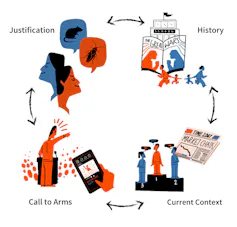
(Canadian Institute for Advanced Research BMB Program), CC BY-NC
Hate is not simply a spontaneous emotion that emerges within individuals. It develops through a combination of social, political and historical conditions. These conditions can be created, fuelled and mobilized by people and institutions.
The cycle has four interconnected components: the current context, a call to arms, justification and history. Once the cycle of hate is initiated, the four components continually reinforce each other, making hostility more difficult to reverse.
The current context
The current state of Canada-U.S. relations contains many of the conditions that can fuel hostility: perceived threats to identity and shared norms, competition and loss, a lack of control and uncertainty.
U.S. President Donald Trump has repeatedly suggested that Canada should become the 51st U.S. state and circulated maps showing Canada covered by the American flag. He has also referred to the Canadian prime minister as “governor.”
These actions challenge Canada’s status as a sovereign nation and Carney’s position as leader of an independent country. Many Canadians have interpreted these statements as threats to Canadian identity and as violations of diplomatic norms between neighbouring allies.
At the same time, American tariffs have intensified feelings of economic competition and vulnerability. Surveys show Canadians are feeling frustration and anger, as well as anxiety, fear and uncertainty. These feelings can reliably accelerate hatred toward Americans.
A call to arms
When a threatening context emerges, the next stage in the cycle is often a “call to arms.” This occurs when leaders and groups mobilize people around the need to defend themselves against a perceived threat.
In Canada, political leaders have responded to these tensions with the U.S. using language that emphasizes resistance to competition and threat.
Carney has stated that Canada is in a trade war with the United States that was not our choice. “You’re at war when you get attacked. We got attacked.”
The hockey phrase “Elbows Up” was introduced by comedian Mike Myers and taken up by Carney as an expression of the need to defend Canada against the American enemy. It was a political strategy that reinforced themes of resilience and resistance.
There have been other examples of resistance, including boycotts of American products and cancellations of travel to the U.S.
Justifying hostility
Once a call to arms is in place, the next stage in the cycle involves justifying the hostility. Hostility becomes easier to sustain when it is framed as necessary.
Current justifications for anti-American sentiment increasingly rely on moral arguments. Hatred is seen as justified because Canada is defending its sovereignty, values and dignity. The “Buy Canadian” and “Don’t Travel to the U.S.” movements have taken on a patriotic dimension, with resistance framed by some as a civic responsibility.
Canadians have not broadly engaged in dehumanizing Americans. However, the same cannot be said for Americans. U.S. Treasury Secretary Scott Bessent, for example, recently compared Canada to a little yippy dachshund trying to fight with a German Shepherd.
Such comparisons can reinforce perceptions of disrespect and deepen antagonism between groups.
History
The fourth stage of the cycle is history: the process by which present conflicts become part of a group’s shared identity and collective memory.
Current tensions could become part of a Canadian historical narrative in which the country sees itself as having resisted American pressure.
As former MP and activist Charlie Angus has written:
“We are making history right now. And our grandchildren will hear the stories of how we handled ourselves. They will learn how we stood our ground and defended our lands. They will know what it means to be elbows up in the face of injustice.”
When conflicts become part of collective memory, they can continue shaping attitudes long after the original events have passed.
Breaking the cycle of hate
Some commentators suggest that Canada and the U.S. are now “dug in,” and that worsening public attitudes could prevent a return to the bargaining table.
If the cycle of hate continues, the Canadian public may prefer this outcome. However, being trapped in the cycle and seeing Americans as permanent adversaries is not inevitable.
An important strategy that can help break the cycle of hate is focusing on a shared identity that includes both Canadians and Americans as North American partners who depend on each other for well-being.
This was the dominant way in which many Canadians and Americans viewed their relationship before tariffs and diplomatic tensions changed the conversation.
That shared identity and respect may yet be recovered in the years ahead. But political leaders and the media will need to communicate this inclusive identity and justify the value of Canadian-American co-operation when relations return to a context in which Canada is no longer under attack.

Victoria Esses receives funding from The Canadian Institute for Advanced Research (CIFAR) and Immigration, Refugees and Citizenship Canada (IRCC).
Allison Harell receives funding from the Canadian Institue for Advanced Research (CIFAR) and the Social Science and Humanities Research Council (SSHRC).
Hazel Rose Markus receives funding from the Canadian Institute for Advanced Research (CIFAR) and the Robert Wood Johnson Foundation.
Prerna Singh receives funding from the Canadian Institution of Advanced Research and the Max Planck-Humboldt Research Award in Germany.
Original source: https://analysis1.mil-osi.com/2026/09/29/the-cycle-of-hate-how-canada-and-the-u-s-entered-a-cycle-of-hostility-and-how-they-can-break-it/