

Source: The Conversation (Au and NZ)
The Reserve Bank this week lifted the cash rate another 0.25 percentage points to 4.6% – its fourth increase this year and the highest it has been since 2011.
The bank pointed to stronger-than-expected inflation at home, alongside much higher global energy prices as conflict in the Middle East has broadened.
But 4.6% today is not the same proposition for Australian households as a similar cash rate was 15 years ago. The reason is simple. We now borrow much more to buy a home – average mortgages have doubled in size, meaning borrowers are far more sensitive to every move in rates.
Read more:
RBA lifts rates to highest level in 15 years – risking a sharper slowdown of the economy
Bigger mortgages, lagging incomes
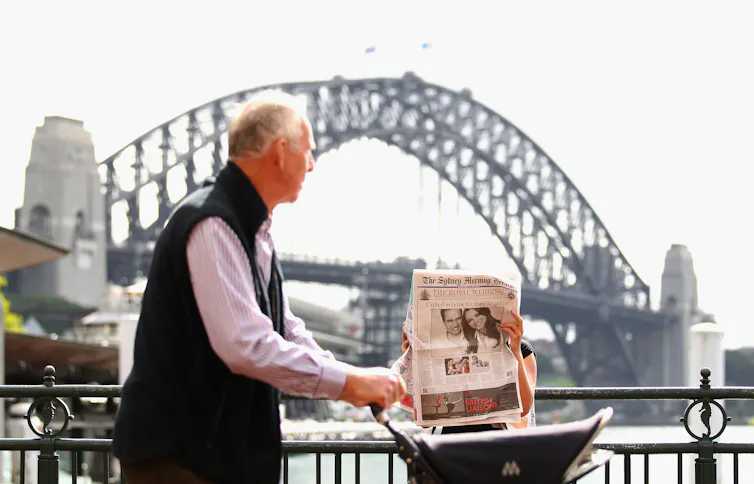
Let’s go back in time to the year the iPhone 4S was cutting-edge, Will and Kate got married, and the final episode of The Oprah Winfrey Show aired on TV.
In June 2011, the average new owner-occupier home loan was about A$363,000. The average first-home buyer borrowed around $318,000.
In the June quarter this year, the equivalent owner-occupier loan averaged $731,000 and the average first-home buyer loan was about $610,000.
Incomes have also risen over this period, but nowhere near as quickly. Average weekly ordinary earnings for a full-time adult increased by around 60% from about $1,305 in May 2011 to $2,084 in May this year.
But the average new owner-occupier loan has roughly doubled over the same period. Put another way, the average mortgage in 2011 was equivalent to around 5.4 years of average full-time earnings. Today it is closer to 6.7 years.
These are big numbers. If income multiples had stayed at 2011 levels, the average mortgage would be $150,000 less than the current data are showing.
This is not a measure of mortgage affordability. Mortgages are usually serviced by households, often with two incomes. But it gives a sense of how much faster housing debt has grown than wages.
An interesting twist
Though the official cash rate may now be the same as it was in 2011, mortgage rates paid by borrowers were actually higher back then.
At the end of October that year, the average discounted variable housing rate from the major banks was just over 7%. If we fast forward to July this year, before the latest increase, the average rate on a new owner-occupier loan was 6.24%.
Still, a lower mortgage rate applied to a much bigger loan can still produce a much larger household bill.
For a first-home buyer carrying today’s average $610,000 mortgage over 30 years, a 0.25 percentage point increase adds $100 a month if passed through in full. That is around $1,200 a year – on top of the three earlier rate rises in 2026.
Ryan Pierse/Getty Images
Higher rates make it harder to build buffers
Repayments are only part of the story. Higher rates also change how quickly homeowners build financial buffers. More of each mortgage payment goes to interest, leaving less to reduce the loan or build balances in offset or redraw accounts.
Scheduled mortgage payments have risen to just under 10% of household disposable income in the June quarter, close to their 2024 peak.
Averages can hide very different experiences
The same increase in borrowing costs can have markedly different effects across households. Recent first-home buyers are particularly exposed.
Compared with someone who bought 15 years ago, a recent first-home buyer is likely to have taken out a much larger loan (especially if they used the government’s 5% deposit scheme) and have a much larger outstanding balance.
They haven’t benefited from years of rising house prices and accumulated savings in an offset or redraw account.
And for these new homeowners, even relatively small movements in house prices can have a large effect on their equity.
What if this isn’t the last rate rise?
The bigger concern is that 4.6% may not be the end of the story. The Iran war has dragged on much longer than was once predicted. The longer energy prices remain elevated as a result, the greater the risk higher costs spread through the economy and keep inflation above target.
That creates a difficult problem for the Reserve Bank. Higher interest rates cannot produce more oil or resolve disruptions to global energy supplies. They can restrain demand and prevent an initial price shock becoming embedded in broader inflation – but at the cost of weaker household spending and economic growth.
If inflation remains high while growth weakens, Australia moves closer to the uncomfortable territory of stagflation.
Read more:
Inflation lifts to 4.0% in August, keeping pressure on the RBA for another rate rise
And another rate rise would not be felt evenly. Recent borrowers are carrying much larger mortgages, have had less time to build equity and savings buffers, and are already being squeezed by higher living costs.
None of this means every Australian with a mortgage is in financial trouble. Many established borrowers have paid down substantial amounts of their loan and have other financial buffers.
In a recent interview, RBA Assistant Governor Sarah Hunter noted that just over two-fifths of mortgage holders are two years or more ahead on repayments.
And at this week’s press conference, RBA Governor Michele Bullock said the amount of money in offset accounts had “grown quite a lot over the last decade or so”.
Bullock acknowledged that at an individual level, “there are households that are hurting”. But she said at an aggregate level, key measures watched by the bank were “not suggesting that there’s any massive stress in the household sector as a whole”.
But averages can hide very different experiences. The 4.6% cash rate may look familiar. The Australian households exposed to it are not.

Alan Duncan receives funding from the Australian Housing and Urban Research Institute (AHURI). The Bankwest Curtin Economics Centre is an independent economic and social research organisation located within Curtin Business School at Curtin University. The centre was established in 2012 with support from Bankwest (a division of Commonwealth Bank of Australia) and Curtin University. The views in this article are those of the authors and do not represent the views of Curtin University and/or Bankwest or any of their affiliates.
Original source: https://analysis1.mil-osi.com/2026/09/30/interest-rates-have-hit-their-highest-level-since-2011-the-pain-will-feel-different-in-2026/