

Source: The Conversation – Canada
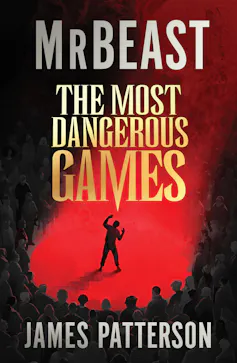
The recently published thriller The Most Dangerous Games is a collaboration between James Stephen “Jimmy” Donaldson, better known as MrBeast, and popular author James Patterson. It tells the story of 100 contestants competing for US$1 billion while enduring an escalation of increasingly brutal challenges.
The publisher explicitly markets the book as an extension of his Prime Original program Beast Games: “the games are more dangerous than ever.” Each book purchase gets the buyer a chance to enter an online game and potentially compete for US$1 million.
The book is the latest extension of a format MrBeast developed on YouTube years before Beast Games reached television. Beginning with challenges such as “Last To Leave Circle Wins $10,000” in 2018, his videos increasingly centred on contestants competing for large cash prizes.
The promotional language for Beast Games puts it bluntly: what wouldn’t you do for $5 million?
When money becomes the spectacle
The idea of making people confront their fears for money is not new to reality television. Joe Rogan hosted Fear Factor from 2001 to 2006, putting groups of contestants through three stunts for a chance to win US$50,000.
The program opens with the words: “imagine a world where your greatest fears become reality.” But contestants were not forced to confront common fears such as public speaking or cold-calling strangers. Instead, the program traded in shock, disgust and spectacle.
Despite being revived twice after its initial cancellation, Fear Factor did not acquire the longevity of other reality formats in which contestants compete for cash. Survivor, for example, has just celebrated its 50th season, while The Amazing Race has produced nearly 40.
Unlike these programs, Fear Factor was gimmicky and vulnerable to a shrinking audience once the novelty wore off. There was no real way for the show to evolve beyond its basic format. Even Joe Rogan admitted he expected it to be cancelled quickly and mainly took the job to gather material for his stand-up comedy career.
Long-running reality competition programs like Survivor and Big Brother clearly demonstrate that viewers are fascinated by watching people compete for financial gain. The reason for this is obvious. We like money; it facilitates survival and we all wish we had more of it. But not all competitions are equal, and neither are the reasons people watch them.
While Fear Factor is now mainly a footnote in reality TV history (it did get rebooted again in January 2026), it was notable in part for making money itself the spectacle. For contemporary viewers, no one does this more obviously than MrBeast.
Competition or ordeal?
The level of spectacle in Beast Games is very different from competition shows where the money is structurally important but narratively sidelined. While the ostensible objective in Survivor is to win US$1 million, the format converts that goal into something more complicated for the audience.
Viewers become invested in strategy, social relationships, general competence, travel, personality and questions of deservingness. The pleasure of watching goes far beyond “look what this person will do for this money.”
(William Morrow and Company)
Beast Games does not provoke debates about who can or should win and how. Rather, it stages a demonstration of what money can make people agree to.
This helps explain to what extent Beast Games is inspired by the Korean drama Squid Game, which depicts desperate people submitting themselves to degrading and dangerous conditions to win money.
The willingness of the Squid Game contestants to return to the games, even once they realize that the outcome could be deadly, is an indictment of the pervasive economic precarity that is sadly familiar to many viewers.
This functions as a profound, and at times even moving, critique. Beast Games, however, exploits this precarity and turns it back into mere entertainment.
While traditional reality competition shows ask, “Can you out-game the other players and win the money?”, Beast Games explores how much you will endure – or subject someone else to – for a transformative financial sum.
This distinction between competition and ordeal can be deepened when we consider the roles played by precarity, humiliation and spectatorship.
Humiliation as entertainment
The spectacle of humiliation is hardly new. In entertainment it is an ancient practice, tracing as far back as slaves in the Roman Colosseum engaging in deadly competition while spectators placed bets on the outcome.
Early reality programs were frequently accused of being exploitative. American Idol showcased terrible auditions and mocking judges, while Big Brother confined and surveilled contestants.
Survivor continues to foreground deprivation as part of the journey to becoming sole survivor. In its early years, it featured its own share of Fear Factor-style food challenges. Yet over time, the pleasure of watching many of these legacy programs has shifted from schadenfreude to inspiration.

(Amazon MGM Studios)
The key to this transformation is in the different ways these experiences are organized and made productively legible to viewers. Big Brother turns confinement into social observation. Survivor builds a mythology of adventure and strategic gameplay on top of deprivation and personality conflicts.
The popular social deduction game, The Traitors, is a relative newcomer to the world of reality competition shows, but it has quickly established itself as an international favourite. Traitors stages a theatrical parlour game in which everyone is actively “pretending.” Building the prize pot is secondary to the often conflicting goals of finding traitors and getting to the end.
The MrBeast approach strips away much of this genre’s camouflage and positions the enormous pile of money as central to the mise-en-scène.
The business of desperation
This is where Squid Game offers an uncomfortable comparison. The drama was supposed to make us uneasy with watching desperate people endure unsavoury ordeals for transformative wealth. Yet it has helped establish the aesthetic vocabulary for unironic real competitions like Beast Games.
Read more:
‘Squid Game’ highlights plight of South Korean workers sacrificed for nation’s economic gain
The class distinction is particularly apparent when the money on offer is framed as coming directly from MrBeast himself, as an altruistic gesture for which he is celebrated.
In reality, this money comes primarily from sponsors. Even if we take the premise at face value, it remains uncomfortably reminiscent of a familiar scenario in which people in financial need become fodder for the entertainment of the wealthy.
Not unlike the infamous Bumfights series, it asks: What can someone with relative wealth induce needy people to do by dangling enough money in front of them?
The more difficult question, however, might be: why are humiliation, fear and economic need seen as entertainment?

Tiara Sukhan does not work for, consult, own shares in or receive funding from any company or organisation that would benefit from this article, and has disclosed no relevant affiliations beyond their academic appointment.
Original source: https://analysis1.mil-osi.com/2026/09/27/from-fear-factor-to-beast-games-why-watching-people-suffer-for-money-still-makes-compelling-tv/