

Source: The Conversation – USA (3)
With deepfakes on the rise, forgery and deception are often viewed as distinctly modern problems – a new era of misinformation made possible by artificial intelligence. One of the first alarming cases occurred at the start of the war in Ukraine when a doctored video appeared to show President Volodymyr Zelenskyy telling his soldiers to lay down their weapons.
Yet the impulse to deceive people by fabricating evidence far predates the digital age. And in some cases, the consequences of these deceptions set off enormous ramifications for centuries thereafter.
As a scholar of medieval history, I’m interested in how the forerunners of today’s deepfakes perplexed and captivated scholars in early modern Europe and how they were debunked. Searching for truth amid falsified documents is not limited to our current era; a skeptical eye about sources’ authenticity was just as important in the 15th century as it is today.
Gift of gratitude
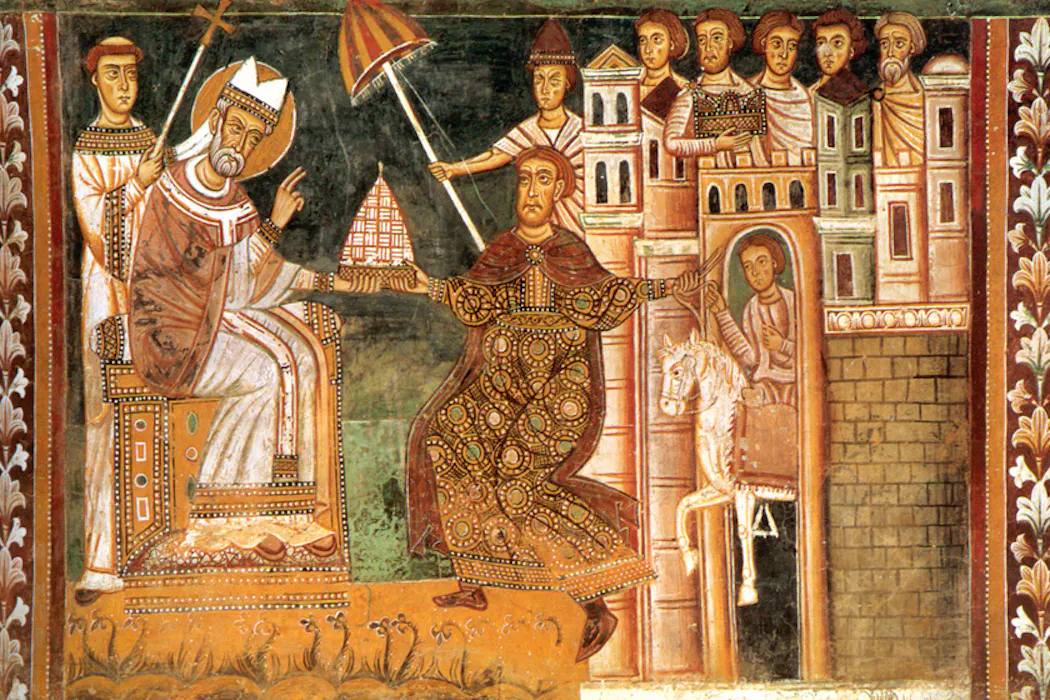
Throughout the Middle Ages, at least 10 popes cited the same fraudulent claim, which asserted that Emperor Constantine I had transferred authority over Rome and the Western part of the Roman Empire to Pope Sylvester I in the early 300s. Eventually referred to as the “Donation of Constantine,” this forged imperial degree was used to try to justify expanding papal control throughout the Italian peninsula.
The text describes Constantine, the first Roman emperor to convert to Christianity, falling ill from leprosy. In a dream, he was instructed to seek baptism from Sylvester, and he recovered. The story is also found in the “Acts of Sylvester,” a fifth-century collection about the pope’s life.
In gratitude, Constantine supposedly granted the pope and his successors “power, and dignity of glory, vigor, and imperial honor,” over “the city of Rome, and all the provinces, places and cities of Italy and the western regions.” The Donation also gave the church properties to control “in Judea, Greece, Asia, Thrace, Africa, Italy and the various islands.”

Vatican Museums via Wikimedia Commons
Leverage over kings
To be clear, there are no references that even allude to the existence of this document until the eighth century. In 778, Pope Adrian I wrote to Charlemagne, king of the Franks, who was quickly gaining control over parts of Western Europe. Charlemagne’s father, Pepin the Short, had granted the church sovereignty over what became known as the Papal States, a group of territories on the Italian peninsula.
According to this letter, Adrian, who hoped to assert territorial and spiritual dominion over the Franks, urged Charlemagne to offer land as well. Some scholars have argued that the letter suggests familiarity with the Donation.
In 1054, as the church split into two branches – the Eastern Orthodox and Western Roman Catholic Church – Pope Leo IX wrote a letter where he invoked the Donation by name for the first time. Rulers in the Byzantine Empire lamented the Donation, deriding it as a power grab by the Western church. Mentions also appeared in other church documents over the next few centuries.
Much of the confusion regarding this alleged “donation” stems from attempts to determine how territorial control changed as a result. Ultimately, popes used it to try to leverage control over Frankish kings and Byzantine emperors, and gain governance over central Italy.
Poetic condemnation
By the 14th century, the Donation of Constantine was so widely known that Dante Alighieri referenced it within his “Divine Comedy,” the epic poem describing a journey through hell, purgatory and heaven.
The “Divine Comedy” places Pope Nicholas III in the eighth circle of hell for the sin of simony: the condemned practice of selling church offices. To Dante, Nicholas had been too concerned with acquiring temporal power and influence, when the focus should have been on his pastoral duties.
Simony, in the poet’s view, was a consequence of the Donation of Constantine, in that it skewed the priorities of the church away from its spiritual domain. Dante lamented:
Ah, Constantine, how many evils grew –
Not from thy change of faith, but from the gift
Wherewith thou didst the first rich Pope endue!
Renaissance role model
By the time Dante was writing, Scholasticism had taken hold: the intellectual movement of the later Middle Ages, which attempted to reconcile Christian theology with Greek philosophy. This gave way to the Italian Renaissance, which embraced textual criticism and a revival of classical learning. During this change in how scholarship was conducted, speculation arose as to whether the Donation had any legitimacy or historical bearing.
In 1433, Cardinal Nicholas of Cusa became the first person to publicly speculate that the Donation was a forgery. In “De concordantia catholica,” or “The Catholic Concordance,” Nicholas calls attention to the fact that no fourth-century documents speak specifically about the transfer of temporal power to the pope.

Rijksmuseum via Wikimedia Commons
Building on that premise a few years later, Lorenzo Valla, an Italian humanist and Catholic priest, wrote the essay “Discourse on the Forgery of the Alleged Donation of Constantine.” Valla honed his argument around three distinct reasons. First, the Donation of Constantine includes anachronistic terms that would not have been used in the fourth century. He also pointed to the lack of contemporary sources referencing the Donation, and that Constantine was not in a position to legally bestow this temporal authority upon Pope Sylvester.
Valla condemns the Donation as “spurious and forged” and accused the church of maintaining this “deceit” for centuries by arguing for its authenticity. He argued that the document was likely created by a Roman cleric between 750 and 850.
A priest himself, Valla was willing to offer a critical view of church practices that he found to be lacking concrete evidence. His approach to analyzing both theology and language led some admirers to say Valla’s work was one of the great accomplishments of the Italian Renaissance. Fellow humanist Desiderius Erasmus praised Valla’s “energy, zeal and labor” in his scholarship, saying that his work “forced even the learned to express themselves henceforth with more circumspection.”
Admiration for Valla’s work made it more acceptable for other scholars to question the Donation. Around 1450, English Bishop Reginald Pecocke made a similar case to discredit it, arguing that the word “fief” was anachronistic. Before becoming pope himself, Pius II wrote an unpublished text in 1453 acknowledging that the Donation was likely a forgery. Not until the turn of the 17th century, however, after the work of cardinal and historian Caesar Baronius, was it universally acknowledged to be a falsified text.
Bringing a critical eye to his own institution, the church, Valla’s diligent research showed a willingness to not accept long-standing claims as absolute without concrete evidence – a model of thoughtful analysis that can still be used today.
The Donation of Constantine is a reminder that this is not the first era when societies are forced to wrestle with whether or not information is real. Like Valla, we too must rely on our human faculties to discern the veracity of what is in front of our eyes.

Vanessa Corcoran does not work for, consult, own shares in or receive funding from any company or organization that would benefit from this article, and has disclosed no relevant affiliations beyond their academic appointment.
Original source: https://analysis1.mil-osi.com/2026/09/24/the-medieval-world-had-its-own-deepfakes-church-officials-cited-a-fake-imperial-decree-for-centuries/