

Source: The Conversation – UK
Pelicans have resided in St James’s Park, London for 360 years. But the current flock have been a summer sensation due to the first hatching of chicks in the park’s history.
Pelican breeding in zoos is demanding for these birds, because the right environmental and social conditions need to come together. Rather than simply being comfortable, the birds need to encounter and respond to cues that stimulate courtship, nesting and reproduction.
This unusual nesting at St James’s Park provides an interesting example of how responding to biologically relevant stressors is a positive part of an animal’s life. Multiple factors are likely to have contributed to the pelican nesting. The heatwave, the flock’s dynamics and the compatibility of the individual birds seem to have created the right conditions for the first time in centuries.
In my recent research, I evaluated the importance of positive stress to zoo and aquarium animal welfare and found it is crucial for the wellbeing of captive animals.
Researchers call the beneficial response to a stressor, “eustress” – eu being the Greek prefix for good.
Courtship, reproduction and chick-rearing are all natural stressors. Priorities change, energetic and physical needs alter, and adults spend more time on offspring. This stress, however, is not necessarily bad. For example it can provide learning opportunities and enhance the animals’ behavioural repertoire.
As we learn more about what good animal welfare is, it is becoming clear that meaningful challenges which reflect an animal’s natural ecology help them have more autonomy over how they live. Eustress also helps animals cope better with averse situations.
Zoos do not need dramatic changes to provide these experiences. Small challenges can be built into everyday care: food can be hidden in different locations, or new scents and natural materials introduced. Animals can encounter new ground materials and surfaces (such as soil, bark and sand), changes to ropes or branches, or vegetation that naturally changes with the seasons. Enrichment can also encourage animals to explore different parts of their existing enclosure or use familiar resources in new ways.
Variation is key. If food always appears in the same place, at the same time and in the same way, there is little need for an animal to make decisions or adapt.
Many zoos already provide these opportunities. The next step is to think more deliberately about the challenge itself: is it meaningful, does the animal have a choice about engaging, and can it successfully overcome it? The aim is not to make life unnecessarily difficult but for animals encounter novelty or problems they can solve.
Rather than simply giving an animal what it needs to survive, we should provide opportunities for the animal to use their skills and make decisions.
What might this look like at your local zoo then? Meerkats (Suricata suricatta) are one example. Wild meerkats do not encounter their food neatly presented in a bowl. They need to sniff, dig and investigate their surroundings, while members of the mob keeps watch for danger.
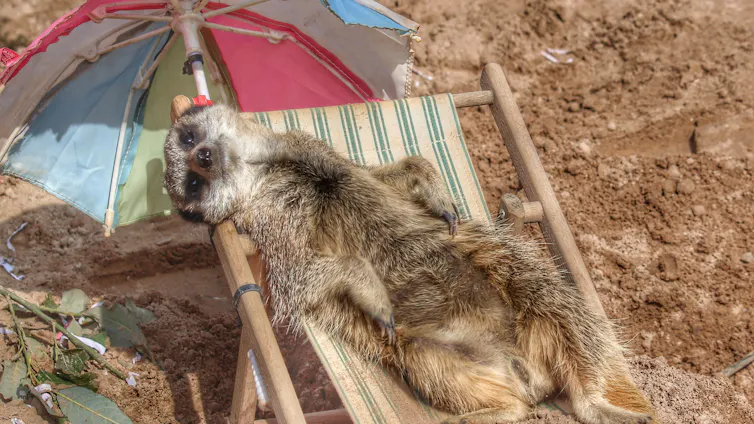
Cookie Photos/Shutterstock
Finding food is also a social challenge for these animals. Young meerkats learn about unfamiliar foods by observing and interacting with more experienced adults. Older meerkats help youngsters acquire important food handling skills.
Zoos can recreate elements of these challenges by scattering or hiding food, providing a sandy floor that encourages digging and creating elevated lookout points. Likewise, zoos can encourage social opportunities by providing complex feeding experiences where animals forage together. A 2021 study found that zoo meerkats retain the sentinel behaviour seen in their wild counterparts, suggesting that opportunities to perform these sort of activity remains important even when predators are absent.
The same principles apply underwater. Common clownfish (Amphiprion ocellaris) also encounter environmental and social challenges. On coral reefs, clownfish forage in a complex three-dimensional environment and depend on a host anemone for protection. They live in a strict social hierarchy. The largest fish is the dominant female, followed by the breeding male and then smaller, non-breeding fish. This social group is known as as a “queue”, as subordinate fish can move up through the hierarchy. In the aquarium, recreating this social group by housing a shoal of clownfish around the correct host anemone species allows for more choice and for fish to express a richer behavioural repertoire.
This brings us back to St James’s Park’s pelicans. Successful breeding has introduced perhaps the most natural challenge of all. Finding a partner and rearing young to maturity requires animals to change how they spend their time and respond to altered demands. When animals work for a reward, scientists call this contrafreeloading.
However, zoo animals can experience negative stress when a stressor is prolonged, overwhelming, unnatural or beyond their control. Examples can be excessive noise, incorrect climate conditions or being unable to retreat from something they find threatening.
The lesson for zoos is a good life should not necessarily be an entirely effortless one. Welfare is enhanced when animals can express behaviour their evolutionary history has equipped them to perform. Eustress is not giving every zoo animal the same kind of “challenging enrichment”. The challenge needs to make biological sense for that particular species.

Paul Rose works for WWT.
Original source: https://analysis1.mil-osi.com/2026/09/09/how-positive-stress-could-improve-the-welfare-of-zoo-animals/