

Source: The Conversation (Au and NZ)
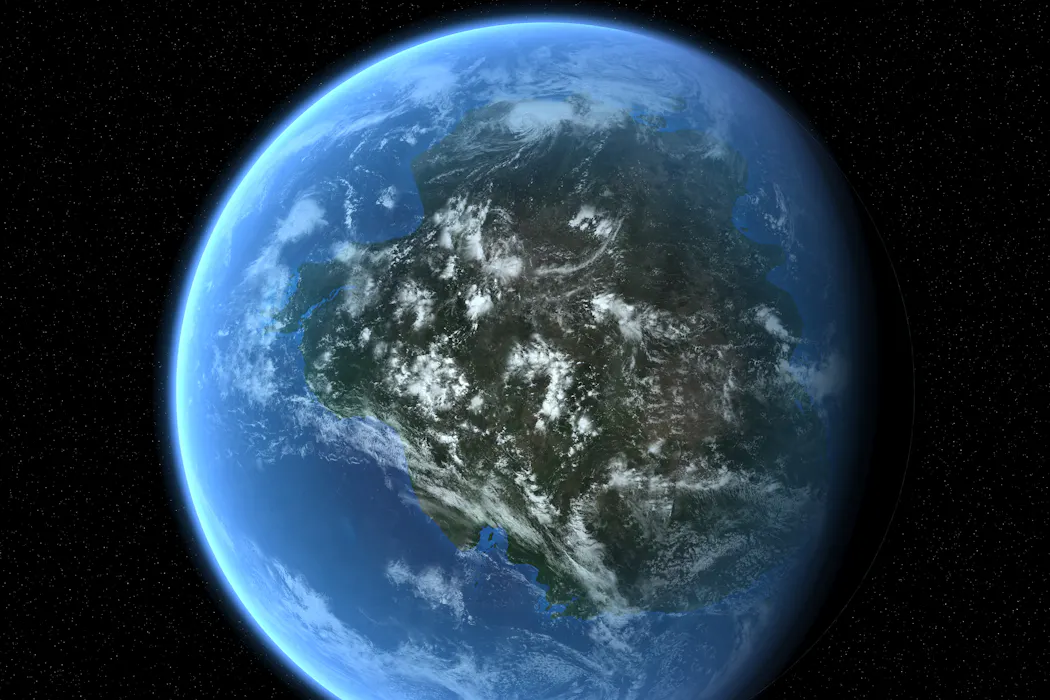
Some 550 million years ago, the Earth looked very different to what it does today. The Southern Hemisphere was dominated by an enormous, single continent known as Gondwana.
This continent was first recognised by Austrian geologist Eduard Seuss in 1885 based on the presence of a unique plant fossil that was first discovered in the Gondwana Province of India. The fossils were then found in Australia, Africa, Antarctica and South America, demonstrating these land masses were once connected.
But whether Gondwana was an actual “supercontinent” has been a subject of intense scientific debate in recent years.
A new paper I coauthored, published today in Science Advances, helps settle the debate. Our team found a previously hidden part of the Gondwanan landmass that’s now buried under mountains, which shows it was much bigger than previously thought.
What exactly is a supercontinent?
The concept of supercontinents and supercontinental cycles came about in the mid-1980s when geologists first recognised cyclic, global-scale sea level changes in the geological record. These cycles dated back at least 2 billion years.
Since the 1980s, at least four supercontinents have been recognised. The youngest is Pangea which formed 300–250 million years ago. Gondwana is the second youngest at 550–500 million years. Rodinia formed about 1 billion years ago and the oldest verified is called Columbia or Nuna, which formed between 2–1.6 billion years ago.
However, the supercontinent status of Gondwana has been questioned in the 21st century. This was because an arbitrary value of 75% of continental landmass was considered necessary to attain supercontinent status and Gondwana was initially measured at 64%.
The initial measurement of Gondwana was based on five core continental fragments: India, South America, Africa, Australia and Antarctica. Subsequent measurements included landmasses extending from the Appalachian mountains in the United States, through southern Europe, to Turkey, Iran and Pakistan, then connecting to India.
Even so, the additional landmass was insufficient to increase the status of Gondwana.

Osvaldocangaspadilla/Wikipedia
Gondwana’s true scale
As is often the case in science, our team’s discovery of Gondwana’s buried bits was serendipitous.
We were compiling a global dataset of granite samples from around the world to understand how deep crustal processes relate to mineral formation. Part of that deep Earth understanding was to determine the age of the rocks from which the exposed granites – now at surface – came from.
Most granites are formed by melting older continental rocks. We used a special technique which measures the amount of radioactive isotopes in rocks. This technique has existed for several decades, but the individual datapoints from rock samples is rarely plotted at a continental scale. We did this at global-scale to generate an age-map of the deep Earth.
To give an example, even though some granites formed in the Himalayas only 20 million years ago, others formed at 50 million years. Still others formed at 120 million years ago. But our analysis showed that all the Himalayan granites were derived from a common continental block.
That block formed approximately 700–550 million years ago and was part of Gondwana.
We have traced the original Gondwanan fragments from India and southeast Asia, through most of China into Kazakhstan. Previously, much of this region was thought to be ancient ocean floor containing volcanic island chains like in the Pacific Ocean today.
It turns out that most of this region, which is now mountainous and covered by younger rocks, was originally part of Gondwana.
This finding expands Gondwana’s continental landmass to roughly 80%. In other words, it really was a supercontinent.
So what if Gondwana was a supercontinent?
It matters that greater Gondwana was a true supercontinent because the world changed immediately after it formed.
The formation of supercontinents can impact global dynamics, such as global climate and biological change, including the explosion of life on Earth between 550 and 500 million years ago.
Many models have invoked specific environmental effects for the Cambrian explosion, as this event is known. But the profound changes required a global cause-and-effect relation.
Even then, linking global climate, biology and geology is daunting. However, other isotopes found in carbon, oxygen and seawater were recording the same change. So here was a paradox to evaluate with our new information.
When greater Gondwana was forming between 750 and 550 million years ago, Himalayan-sized mountain ranges criss-crossed the supercontinent. Gondwana was an entirely frozen, arid landmass.
However, once the continental fragments amalgamated, Earth had to reconfigure its plate tectonics. A volcanic arc chain formed that encircled the supercontinent, extending from Russia, via China, Australia, Antarctica, South Africa to the Andes of South America.
This volcanic arc around Gondwana was the precursor of today’s Ring of Fire around the Pacific Ocean. It was also similar in length, almost 35,000km.
Like the present day, this ancient ring of fire was associated with constant volcanic eruptions. It released huge amounts of volcanic gases, especially water vapour and carbon dioxide. Present-day gas emissions from volcanoes are estimated at 1–4 million metric tonnes of water vapour and 150–370,000 tonnes of carbon dioxide daily – most coming from the Ring of Fire.
Once the Cambrian ring of fire formed, the huge amount of gas emitted each day over 50 million years helped change Earth’s climate from icehouse to greenhouse. And in doing so, it was the catalyst for life to proliferate for the first time on planet Earth.

Bill Collins is affiliated with the Chinese Academy of Geological Sciences.
Original source: https://analysis1.mil-osi.com/2026/09/09/gondwana-really-was-a-supercontinent-and-it-helped-kick-start-life-on-earth/