

Source: The Conversation – UK
For decades, Sweden was known as one of Europe’s most welcoming countries for refugees. It took pride in pursuing one of Europe’s most generous asylum policies, and often presented itself as a humanitarian role model.
But today it has one of the continent’s most restrictive migration policies. That transformation has taken little more than a decade.
The turning point came during the 2015 refugee crisis. Sweden received more than 160,000 asylum applications, more than 12% of all applications in the European Union. Around 35,000 were unaccompanied minors, more than one third of the EU total that year. The scale of the inflow exposed strains on the country’s system and fundamentally changed the political debate around migration.
The immediate response was a broad cross-party agreement introducing stricter asylum and family migration rules. This was followed by temporary border controls, and the replacement of permanent residence permits with temporary ones for most refugees.
We think we know Sweden – a peaceful nation grounded in social democracy, natural beauty, IKEA and Abba. But in 2026, is this still the real Sweden? Ahead of the country’s general election on September 13, The Conversation UK has teamed up with its Swedish partner universities for a series of articles examining why this small nation remains so fascinating.
These measures, introduced by a leftwing Social Democratic government, were more than a response to an exceptional situation. They signalled the emergence of a new political consensus: that Sweden should pursue a substantially more restrictive migration policy.
The next decisive step came after the 2022 election. A centre-right coalition led by Prime Minister Ulf Kristersson took office, with parliamentary support from the anti-immigration party the Sweden Democrats under the so-called Tidö Agreement. Although the Sweden Democrats remained outside the government, the agreement gave them substantial influence over migration policy and provided the political foundation for the most far-reaching package of migration reforms in modern Swedish history.
Drastic restriction of all migration policies
Once in office, the new government embarked on the most comprehensive overhaul of Swedish migration policy in modern history. Since 2022, reforms have been introduced across virtually every area of migration policy, including asylum reception, refugee policy, family migration, labour migration, citizenship, return policy, detention and access to social benefits.
The government’s stated ambition has been to make Swedish asylum policy as restrictive as possible, while continuing to comply with the minimum standards required under EU law and international refugee law. This restrictive policy direction also extends to other categories of non-EU migration, including family and labour migration, while highly skilled labour migration constitutes an important exception.
The first reforms, including tighter rules on family reunification and humanitarian residence permits, entered into force in late 2023. At the same time, the refugee resettlement quota was reduced from 5,000 to 900 places annually.
Lena Chert/Shutterstock
Most of the broader reforms, however, were adopted only in 2025 and 2026. Access to social benefits such as parental leave and child support will become conditional on residence and employment requirements. Obtaining Swedish citizenship will be subject to stricter requirements relating to length of residence, conduct, language and civic knowledge, as well as self-sufficiency. The government has also substantially lowered the threshold for deporting non-citizens convicted of crimes.
This concentration of reforms towards the end of the parliamentary term reflects the Swedish legislative process rather than a late political shift. Major legislation is normally preceded by government inquiries, public consultations and parliamentary scrutiny, meaning that comprehensive reforms often take years to move from proposal to implementation.
Migration ahead of the 2026 election
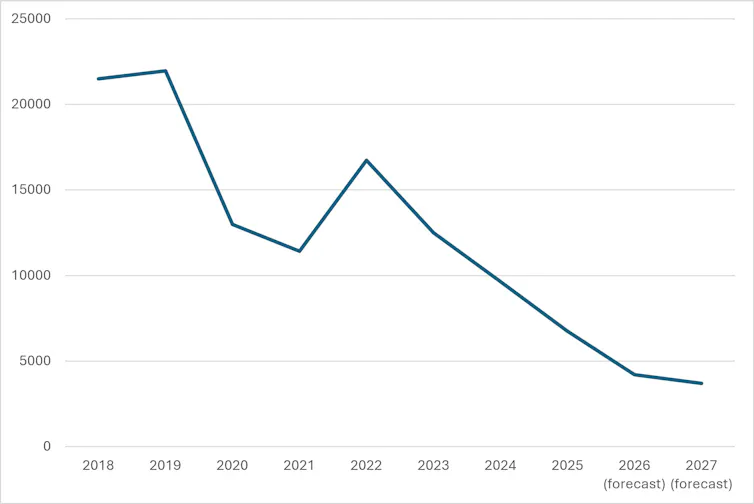
The reforms have coincided with a dramatic decline in asylum applications. In 2025, Sweden registered around 6,700 first-time asylum applications, with an approval rate of 23%. On a per capita basis, this was less than half the EU average.
Sweden has therefore gone from receiving one of Europe’s highest numbers of asylum seekers per capita in 2015 to one of the lower a decade later. According to the Swedish Migration Agency, asylum applications are expected to fall further, to around 4,200 in 2026 and 3,700 in 2027.
Asylum applications in Sweden 2018-27
Henrik Emilsson, data via Migration Agency (2026)
Equally striking is the wider political change. There is now broad consensus among Sweden’s major political parties in favour of maintaining a restrictive migration policy.
The Social Democratic Party, which governed during the 2015 refugee crisis, has actively or tacitly supported most of the current government’s reforms. The party has made clear that the restrictive direction of Swedish migration policy will remain in place if they return to government.
Public opinion has also shifted, alongside policy. After the 2015 refugee crisis, a growing share of Swedes now favour lower levels of immigration, especially refugees.
The Social Democrats have been inspired by the electoral strategy of the Danish Social Democrats, who before the 2019 election pledged to maintain the restrictive migration policies introduced by previous governments. Their aim was to reduce the importance of migration as an election issue and shift the political debate towards welfare, employment and the economy.
The Swedish Social Democrats appear to be pursuing a similar strategy ahead of the 2026 election, signalling that they will not reverse the government’s main migration reforms.
The governing parties, by contrast, have every incentive to keep migration at the centre of the election campaign. They argue that a Social Democratic government would depend on parliamentary support from the Green Party and the Left Party, both of which favour a more liberal migration policy.
The election is therefore likely to focus less on whether Sweden should maintain a restrictive migration policy, than on whether a future government can be trusted to do so.

Henrik Emilsson does not work for, consult, own shares in or receive funding from any company or organisation that would benefit from this article, and has disclosed no relevant affiliations beyond their academic appointment.
Original source: https://analysis1.mil-osi.com/2026/09/07/immigration-in-sweden-how-the-country-went-from-one-of-europes-most-welcoming-to-one-of-its-most-restrictive/