

Source: The Conversation – UK
Picture a cosy Danish living room. Candles flicker, soft music plays and friends and family gather around a table laden with pastries – flaky, buttery and gloriously calorific. This is hygge in action, and it seems almost tailor made to give any health conscious Briton a mild panic attack.
While Britons have spent decades being told that sugar and fat are dietary villains, the Danes appear to be cheerfully ignoring the memo and somehow remaining one of the slimmest nations in Europe, even though they consume 57kg of sugar annually per capita compared to the UK’s 44kg. We could call it “the pastry paradox”.
The very pastry that bears their name – the Danish – is a staple of British bakeries, airport lounges and sad desk breakfasts the nation over. And yet Danes are much less likely to be obese, with one in five having a body mass index (BMI) higher than 30, when one in three of their British counterparts are obese.
So what is going on? Let’s take a deeper look into trends in Britain, where obesity has steadily risen from around 15% in 1993, to around 29% in England, 32% in Scotland, and 26% in Wales in recent estimates.
Health Gap / Sundhedskløften is a collaborative series from The Conversation UK and Denmark’s Videnskab.dk exploring what the two countries can learn from each other when it comes to health and wellbeing.
From cycling and alcohol to inequality, healthcare and everyday habits, the series looks beyond hospitals and medical treatment to explore how culture, politics and society shape the way people live – and how healthy they are.
The older you are in Britain, the more likely you are to be obese. If you are aged between 55 to 74 you are at the highest risk of obesity. You’re much less likely to be obese if you’re older than 74, which is probably related to the fact that obese people, on average, die earlier. You’re also more likely to be obese if you live in a poor neighbourhood, if you’re disabled, if you’re black British, and the fewer educational qualifications you hold.
Denmark still has health inequalities, but they tend to be smaller than in many other countries. This is largely thanks to strong government policies around prevention, diet and alcohol, as well as a reliable healthcare system that serves people across different income levels and backgrounds.
In truth, there’s no reason why Britain cannot emulate Denmark in this respect. Both are wealthy countries, and both provide their citizens with universal, tax-funded public health coverage. They both share a cold northern European climate, a fishing culture since they’re surrounded by sea, and a similar tradition of simple and hearty cooking with a love for potatoes, bread and porridge, dairy products, fish and pork.
Common ancestors, uncommon diets
The original Angles who settled Britain, and after whom England was named, came from Denmark, only to be invaded by Danish Vikings a couple of centuries later. But that’s where the similarities stop.
While Danes indulge in modern dietary pleasures – like their famous pastries – they also consume many traditional foods that are high in protein and fibre. This helps people feel fuller for longer compared with processed carbs and fats, while also providing essential vitamins and minerals.
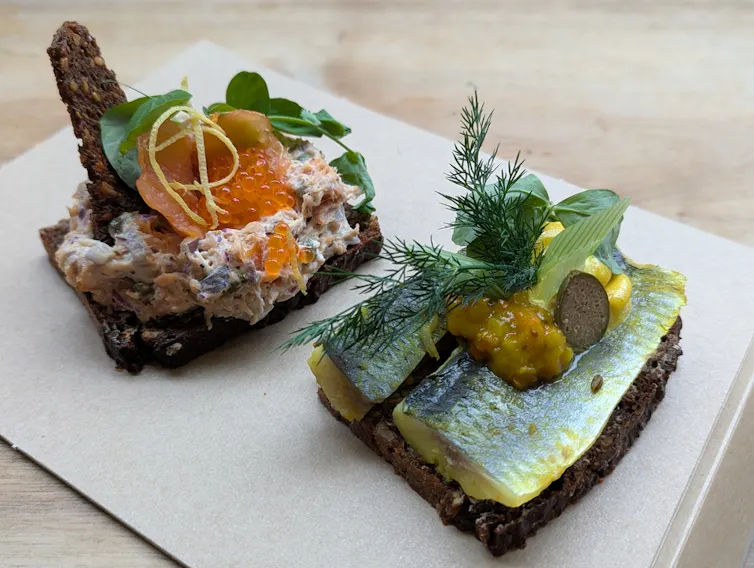
Smørrebrød, the traditional open-faced, rye-bread sandwich often topped with fish and vegetables, is a cultural touchstone and Denmark’s daily lunch. Traditionally fermented and baked whole rye bread, often enriched with whole grains and seeds, and freshly sold in neighbourhood bakeries, is the basis of the national dietary strategy and guidelines. Local fruits like berries are regularly consumed. Cabbage, carrots, beets and parsnips are also staples.
seewhybee/Shutterstock.com
The Danish diet gives a special emphasis to seasonality and sustainability, home-cooking and a low amount of highly processed meals. Danes are some of the most eco-conscious people in the world, with low levels of smoking, declining alcohol intake and policies for alcohol reduction, and a high level of participation in sports.
No wonder the Nordic diet and lifestyle is recommended both for its healthy properties, but has also topped the world of high gastronomy, proving that healthy food can also be extremely delicious, creative and even mind blowing.
In contrast, the diet most Britons follow today would be unrecognisable a few decades ago and resembles more what the US has exported to the rest of the world since the emergence of the modern retail system, which fully took over the UK in the 1980s. The US, where nearly one in two people is obese, is the world leader in obesity among major nations.
In Britain, 44% of daily energy comes from ultra-processed foods and drinks, the highest in Europe. This is one of the main drivers for obesity. By comparison, in Denmark the figure is 25%.
Ultra-processed foods and drinks are characterised by high salt and sugar content, unhealthy fats, low fibre, protein, vitamins and minerals. They are highly appetising and low in satiety, bad for gut health and they promote inflammation. They are manufactured for easy appeal, high profit, long shelf-life, convenience and minimal preparation.
A typical morning in Copenhagen, where people commute to work and school on their bikes after having their hygge blueberry and yogurt or rye bread and toppings breakfast, looks very different to a morning in a typical UK city where most people drive to work and the fast-food chains are full of kids grabbing something to eat on their way to school.
Smørrebrød, Denmark’s traditional open-faced rye-bread lunch, might be the equivalent of a UK high street meal deal. Dinner in Britain is more likely to be a prepared meal than a home-cooked meal like in Denmark. This is possibly stereotypical, and there are significant variations based on income and lifestyle differences, but it paints a picture of the main differences between Britain and Denmark.
Do Danes indulge in a daily pastry? Possibly. But they do a lot of other things that offset that and keep their obesity levels to a low rate compared to the rest of Europe. Britain, take heed.
This series was commissioned as part of a partnership between Videnskab.dk and The Conversation, where articles are published in English and Danish.

Vassiliki Sinopoulou does not work for, consult, own shares in or receive funding from any company or organisation that would benefit from this article, and has disclosed no relevant affiliations beyond their academic appointment.
Original source: https://analysis1.mil-osi.com/2026/09/04/the-pastry-paradox-why-are-the-danes-slimmer-than-britons/