

Source: The Conversation – France
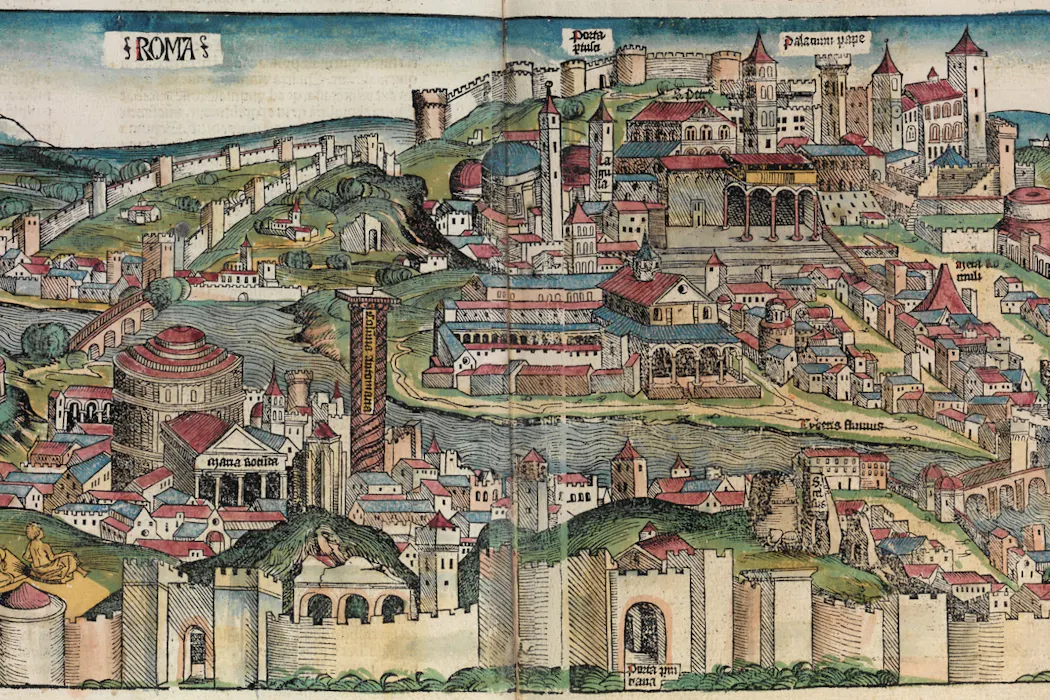
Nearly 31% of Rome’s palaces were built between 1378 and 1599, after a century of economic stagnation. What were the origins of this striking urban revival? Drawing on a newly compiled dataset linking palace construction to the identity of their patrons, a study shows that Romans began building palaces only once they were confident the popes would not leave the Eternal City again.
Rome, in the 14th and 15th centuries, was in ruins. Contemporaries described it as a “cadaver”. A “great stable for sheep”. Artists depicted Rome as a widow, clad in black, pleading with passersby.

Gallica
Then, in the late 15th century, came an economic revolution. A new era of palace-building dawned in Rome. A city that had been suffering from dereliction and decay transformed into a flourishing metropolis: of all historically significant palazzi erected in Rome from antiquity to the 21st century, 31% were built between 1378 and 1599.
How did Rome recover? What was the origin of its palace-building boom, nearly a century after the Renaissance had come to the rest of Italy?
Turning scattered traces of the past into a coherent whole
Answering this question quantitatively required constructing an original, comprehensive database, combining archives, historians’ work, and old maps. The data-collection effort began with Giambattista Nolli’s map (1701–1756), digitised and populated with sites’ architectural histories by a wonderful team of historians. I then classified and further enriched each construction project by hand – especially to hunt down the identities of furtive patrons.

Fourni par l’auteur
Turning scattered traces of the past into a coherent set of usable data is a challenging and creative process, and captures the richness – and the deep pleasure – of empirical research in Economic history. I built a database covering the 146 palaces whose construction projects were active between 1378 and 1599, more than 43% of which required additional research to classify.
The puzzle of Rome’s revival
Rome was, in many ways, a company town. Its economy was very much dependent on the papacy. So, when Pope Gregory XI returned the papacy to Rome in 1377, ending nearly seven decades of exile in Avignon, one might have expected an immediate economic revival. But for nearly a century thereafter, little changed. Palace-building – the hallmark of urban prosperity in Renaissance Italy – remained stagnant.
This presents a fascinating puzzle. Florence and Venice had already experienced their palace-building booms much earlier, beginning in the 14th century. Why did Roman palace-building remain stagnant in the century following the pope’s return? And what finally triggered its spectacular transformation in the late 15th century?
My research reveals that the answer to both questions lies in the notion of permanence.

Fourni par l’auteur
While the pope’s presence is important, what truly mattered to Romans is whether the pope intended to remain in Rome in the long-term. Even more importantly, would the next pope stay? Would the one after? In the absence of a credible, self-sustaining promise to this effect, investing in illiquid and costly real estate was prohibitively risky. I argue that the eventual rise in palace-building can be linked to a change in Romans’ beliefs in this regard.
An almost 300% rise in palace-building

In 1475, Pope Sixtus IV issued a papal bull, Etsi universis, that fundamentally altered the incentives of the ecclesiastical elite. Before this reform, high-ranking ecclesiastical officials – cardinals – could not bequeath their property to heirs. When they died, their real estate reverted back to the Church. The reform allowed prelates who built in Rome and its surroundings to leave their properties to appointed heirs. Effectively, it dropped their inheritance tax from 100% to 0%.
The results were dramatic. Using a novel hand-coded dataset linking palace construction to patron identities, I found that the reform increased palace-building among prelates by roughly 300% relative to pre-reform levels.
A self-perpetuating promise to stay in Rome
The reform’s impact went far beyond a simple tax cut. It created a self-reinforcing commitment mechanism that bound the papacy to Rome permanently.
Cardinals elect popes; popes appoint cardinals. Once cardinals began investing heavily in Roman real estate, they developed a personal financial stake in the papacy remaining in Rome. A cardinal with substantial property holdings in the city would not vote for a candidate who might leave. Future popes, elected on the promise to remain in Rome, would, in turn, have no interest in appointing cardinals averse to that agenda. Each generation became bound to the city by the same incentive structure. This was enough to cultivate substantial trust in the papacy’s long-term presence in Rome.
Laymen learn to trust
Lay patrons remained cautious at first. But as they observed prelates investing heavily in the city, they gradually updated their beliefs about the papacy’s long-term commitment.
My analysis shows that in the crucial first 50 years after the reform, every 10 additional prelate projects in one decade led to roughly six additional lay projects citywide in the next decade. This learning effect was strictly transitory: after about half a century, the commitment mechanism was fully established. Past prelate investment stopped predicting future lay investment – there was no longer any uncertainty to resolve.
The increased confidence had tangible manifestations: newer, more ambitious constructions began to emerge, funded primarily by lay patrons. The Renaissance skyline began to take shape.
Why the Pope’s presence wasn’t enough
One might wonder: why wasn’t the pope’s physical return to Rome in 1377 sufficient? Why did it take another century for the boom to begin?
The answer reveals something fundamental about institutional credibility. My analysis of papal absences from Rome shows that the Pope’s contemporaneous presence mattered little for long-term investment decisions. Given an unstable political environment, marked by contested rule and occasional papal departures, what mattered was the credible guarantee of permanent presence.
Indeed, before the reform, popes occasionally left Rome, sometimes for years at a time. Pope Eugene IV, for instance, spent over nine years in quasi-exile during his 16-year papacy (1431–1447). After the reform, papal absences decreased by 81.5%, and discretionary absences disappeared entirely. But even more importantly, the few absences that did occur post-reform had no negative impact on investment. Patrons understood these to be temporary because the underlying commitment mechanism guaranteed the papacy would always return.
Lessons from Rome which we can learn from today
This historical episode offers insights that extend far beyond Renaissance Rome. It demonstrates that the irreversibility of institutional change is a necessary condition for successful economic intervention – a longstanding proposition in economic theory, advanced by economists, including Daron Acemoğlu (a recent “Nobel Prize in Economics” laureate for his work on institutions), Avner Greif, and Gérard Roland, but rarely tested empirically.
Modern economies face similar credibility challenges. A government might announce favourable policies, but if those policies could easily be reversed by the next administration, investors may remain wary. What Rome teaches us is that truly transformative reforms are those that create self-perpetuating mechanisms, where the interests of key decision-makers become aligned with maintaining the new arrangement.

Wikimedia.
The Roman case also shows how elite investment can transform unenforceable promises into self-enforcing commitments. When powerful stakeholders put their own interests and their own wealth on the line, they create the conditions for long-term stability and growth.
Nearly a century after the papacy’s return, Rome was finally rebuilt. Not by decree, but through the choices of individual patrons, now confident in the city’s future. The palace-building boom reshaped Rome’s economy and left a physical legacy that endures today: 84% of the palaces built in this period still stand. They shape Rome’s cityscape and serve as a reminder of the importance of credible, long-term institutional commitment.

A weekly e-mail in English featuring expertise from scholars and researchers. It provides an introduction to the diversity of research coming out of the continent and considers some of the key issues facing European countries. Get the newsletter!

Alyssa Rusonik received funding from France’s National Research Agency (ANR-18-EURE-0005 / EUR DATA EFM).
Original source: https://analysis1.mil-osi.com/2026/09/02/palaces-and-the-pope-the-fascinating-story-of-how-renaissance-rome-was-rebuilt/