

Source: The Conversation – UK
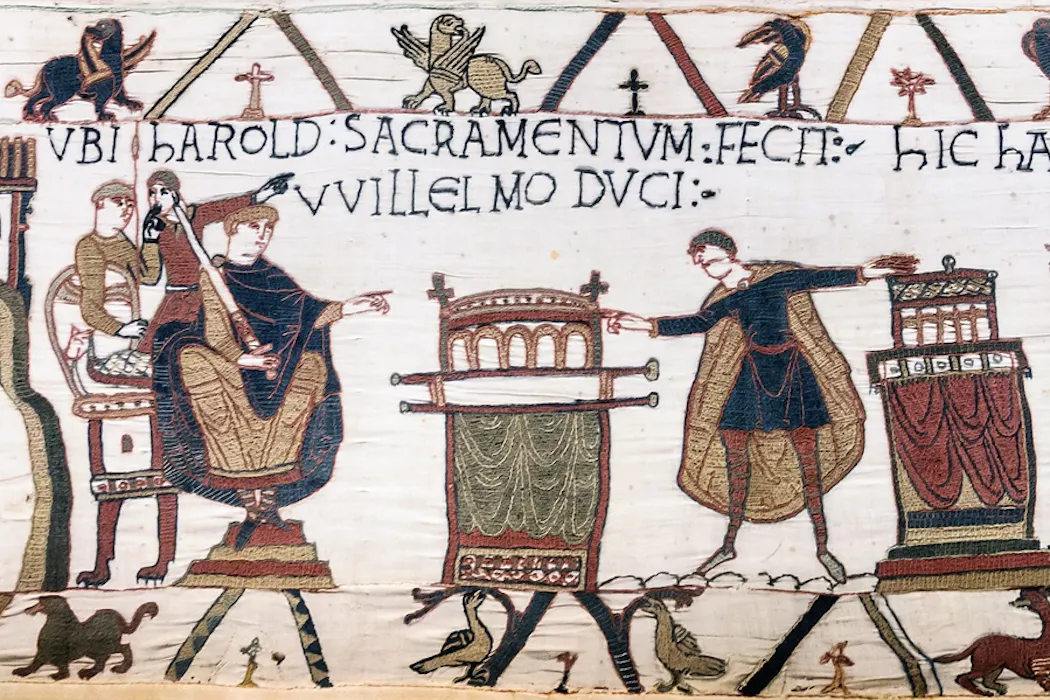
They weren’t always enemies. Before William of Normandy and Harold Godwinson were deadly adversaries on the battlefield at Hastings in 1066, vying for the throne of England, they were comrades and brothers in arms.
It’s a tragic journey from unlikely allies to mortal enemies. And it’s one of the lesser-known stories in the Bayeux tapestry, which opens for viewing at the British Museum in London this September.
As a medieval historian, I’ve seen the tapestry several times in Bayeux, and this is the often-overlooked story that brings me to tears. At its heart, there’s an extraordinary episode near Mont Saint-Michel in Normandy, where Harold and William once stood shoulder to shoulder.
The year is 1064 and Harold Godwinson, one of the most powerful nobles in early medieval England, is shipwrecked at Ponthieu in northern France. William, Duke of Normandy, immediately demands that Harold is handed over to him.
There’s already a dispute about who will take the English crown after the death of the reigning King Edward, who has no children of his own. William’s motives, no doubt, are bound up with his ambitions for the throne.
But then the story takes a surprising turn.
William and his warriors ride out on a military campaign against Duke Conan of Brittany, taking Harold with them. It’s an uneasy position for Harold: a tense and complicated mix of hostage, guest and fellow fighter.
Near Mont Saint-Michel, William and Harold reach the border between Normandy and Brittany. The Bayeux tapestry depicts Mont Saint-Michel as a stylised abbey on top of a craggy hill. The river Couesnon itself is the border – notorious for its treacherous, shifting mud and quicksands.
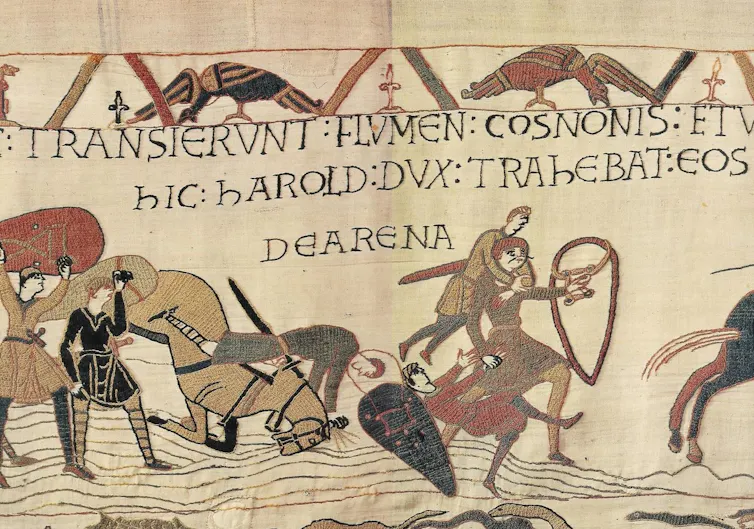
Next, disaster. The tapestry shows the Norman army floundering in the quicksand. Men wading through the stream, their shields hoisted over their heads, then stumbling into the water and mud. A horse sinking, throwing its rider. Panic and chaos.
Astonishingly, it’s Harold who comes to the rescue. “Here, Duke Harold dragged them out of the sand” (“hic Harold dux trahebat eos de arena”), the tapestry tells us. Harold – distinguished from William’s men by his luxuriant moustache (the Normans preferred to be clean-shaven) – grips his shield with one hand, with the other pulling a wretched soldier out of the quicksand. Another Norman foot-soldier clings to Harold’s back as he’s carried to safety. Harold is the hero of the hour.
This summer, I followed in the footsteps of William and Harold, retracing their journey across the Bay of Mont Saint-Michel at the mouth of the river Couesnon, from the mudflats to the quicksand. Even today, it’s too risky to walk without an expert guide: the tides and sands are capricious and deadly.
Our guide told us to “dance” or paddle our feet to awaken the quicksand. As it began to shift and open, swallowing my legs and tugging me down, I understood how the tramping feet of the Norman soldiers would have been exactly what it took to set the “sables mouvants” (quicksands) in motion. All too fast, the quicksand has you in its grip, and you can’t get out.
The British Museum
The Norman chronicler Orderic Vitalis later wrote that Harold was “very tall and handsome, remarkable for his physical strength, his courage and eloquence, his ready humour and acts of bravery”. But it’s not all praise. Orderic adds: “But what were all these gifts to him without honour, which is the root of all good?”
If you want to know what’s really going on in the Bayeux tapestry, always look at the borders. These decorative edges, at the top and bottom, include bird and animal motifs, details from moral fables, narrative sub-plots, and symbols that offer wry and pointed comment on the action in the main embroidered panel.
In the borders of the quicksand scene, there are birds and fish – just like the rich natural life of the Bay of Mont Saint-Michel that I saw this summer. But there’s something more. The edges are alive with writhing, twisting eels. The figure of a man reaches out, trying to grasp them, but they slip through his fingers. Is this a comment on Harold Godwinson? Charismatic and charming, but as slippery as an eel? Next to the eels, eagles and a wolf hint at violence and predation. In the midst of Harold’s heroism, there’s a chilling premonition.
The Bayeux tapestry tells the quicksand story with the benefit of hindsight. All that conflict is still to come. On the Brittany campaign, Harold helps William defeat Duke Conan, chasing him from the fortified town of Dol to the clifftop citadel of Dinan, where Conan surrenders the keys to the city, held out on the tip of a lance (another wonderful detail in the tapestry).
Harold is rewarded richly for his bravery and service: the tapestry shows the two men in a near embrace as William gifts him arms. But that’s not all. William brings Harold back to Normandy (Bayeux) to celebrate – and to extract that momentous oath of loyalty. The tapestry shows Harold swearing on holy relics (though there’s still controversy about whether he knew exactly what he was promising, or what he was swearing on). It’s the moment that seals the future conflict between the two men, and sows the seeds for the Battle of Hastings.
The brutal aftermath of the Battle of Hastings is what I focused on in my book A History of England in 25 Poems. But don’t forget this tale of surprising friendship, courage and shared endeavour. When you reach the end of the Bayeux tapestry – the arrow in the eye, the stripped and mutilated corpses, the English fleeing in defeat – remember the remarkable backstory and that lost comradeship between William and Harold: once, two brothers in arms.
This article features references to books that have been included for editorial reasons, and may contain links to bookshop.org. If you click on one of the links and go on to buy something, The Conversation UK may earn a commission.

Catherine Clarke does not work for, consult, own shares in or receive funding from any company or organisation that would benefit from this article, and has disclosed no relevant affiliations beyond their academic appointment.
Original source: https://analysis1.mil-osi.com/2026/08/26/the-bayeux-tapestrys-lesser-known-tale-of-bromance-william-and-harold-were-friends-before-they-were-enemies/