

Source: The Conversation – UK
Andy Burnham has placed housing inequality, council house building and eradicating rough sleeping at the top of his priority list as prime minister. He has now announced plans to get rough sleepers in England into accommodation by Christmas.
While this is a worthy goal, homelessness is not just about rough sleepers. It also includes households in temporary accommodation. Many end up being placed in accommodation many miles from where they are settled and have established connections.
For vulnerable households, such as those with pregnant people, young children, those escaping domestic abuse, or people with disabilities, the law states that local authorities must provide accommodation. However, if a local authority struggles to find appropriate and affordable housing, the local authority is permitted to place households in other areas. Approximately 43,000 households per year are consequently placed “out of area”.
While many households find themselves placed hundreds of miles from the place they call home, most remain within their region, though they still face the disruption of moving away from home to other local authority areas. Nationally, this practice is most pronounced in Greater London, the West Midlands, and Greater Manchester.
Government reporting on out of area housing is improving, but there is still much we do not know about the demographics most affected and the journeys undertaken.
From our research, we were able to identify and map the journeys being undertaken by these households. This showed that many local authorities are exchanging comparable amounts of households. There are also instances of chains of similar numbers of households moving from one local authority area to the neighbouring area. In some cases, we found a single local authority acting as a focal point, dispersing households throughout the region.
The cost of moving
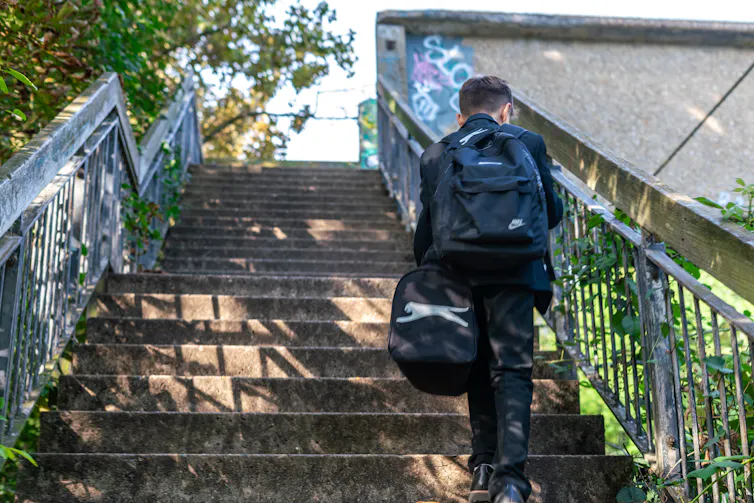
Being moved out of area can have profound effects on households. People lose touch with families, communities and support networks. Children are forced to change schools, leading to educational disruption and loss of friendship groups.
Interviews with out of area households carried out as part of our research reveal the personal impacts.
Interviewees spoke of losing touch with families, deteriorating mental health and the anxiety of being so far from home. Other experiences included being confined to hotels next to motorways with no internet, and schools refusing to take children. Some reported running out of essential medication and not being able to receive a new prescription, and of having no religious or culturally appropriate facilities.
On an economic level, some households gave up employment as distances made work unsustainable. This has the effect of taking an employed household in one area and making them an unemployed household in the new area.
Additionally, increased demand for health interventions due to relapsed recoveries and higher accommodation prices make out of area housing an expensive option.
Increased demand for social security and health interventions, while clearly having personal impacts, will also increase government spending in these areas. This does not show up as a housing cost despite being caused by housing policies, and should be added to the £3 billion per year spent by local authorities on temporary accommodation.
Mounir Taha/Shutterstock
At the same time that house buying has become increasingly unaffordable, there are over 1.3 million households on local authority housing waiting lists. The housing charity Shelter estimates that at the current rate of social house building, it will take 119 years to clear the waiting list. In some areas of London, the waiting time for three-bedroom social housing is over 100 years.
Households in stable employment, who 20 years ago would have bought a house, are now trapped in the private rented sector as wages have not kept pace with house prices. Then there are the poorest and most vulnerable who cannot access social housing. Demand for affordable housing outstrips supply, leaving more people on the lowest rung of the ladder.
Against this backdrop, it is tempting to think that increased house building will make housing more affordable. Evidence shows that between 2011 and 2021 the UK housing stock grew at a faster rate than the population. This means that house price increases have not solely been caused by demand for relatively scarce resources. Instead, property has become a safe investment commodity, which has contributed to higher prices. At the same time, there has been an increase in insecure work, which makes it harder for would-be buyers to get a mortgage.
The challenge therefore rests not just with increasing supply, but with increasing people’s ability to access housing. Potentially, building more houses while reducing the number that are affordable will benefit those who already have money to buy. The risk is that this could worsen housing inequality if there are not greater numbers of affordable homes rather than those that only the wealthy can afford.
Solutions and risks
Between the potential house-buyers and the accommodated rough sleepers lie the “hidden homeless”, in temporary accommodation and those living out of area. The housing crisis cannot be fixed overnight. But in the meantime, more can be done to address some of the worst outcomes for the most vulnerable households.
First, the exchange of out of area households between local authorities could be reduced through greater regional oversight and coordination. Second, spending money to reduce the impacts of the housing crisis through construction of more council houses should be seen as an investment. Third, households placed out of area should receive a minimum standard guarantee that includes a school place, medical registrations, discounted transport costs, wifi access and details of local services.
In the longer term, government goals will only be achieved by rebalancing housing provision to emphasise social housing and social benefits, rather than relying on market forces.

The authors do not work for, consult, own shares in or receive funding from any company or organisation that would benefit from this article, and have disclosed no relevant affiliations beyond their academic appointment.
Original source: https://analysis1.mil-osi.com/2026/08/26/its-not-just-rough-sleeping-andy-burnhams-housing-plans-need-to-include-the-hidden-homeless/