

Source: The Conversation – UK
In 1804, William Blake wrote in his poem Jerusalem of England’s “green and pleasant” land. This idealised vision of English pastoral has resonated through two centuries, fusing the character of the nation with its landscape – those “mountains green” and “pleasant pastures”.
Turned into a hymn by Sir Hubert Parry in 1916, Jerusalem is sung annually at the Last Night of the Proms. It has been adopted by various English sports as an unofficial anthem, including at the Commonwealth Games. It’s invoked regularly by politicians of all persuasions. The “green and pleasant land” has become a powerful emblem for England.
In my book, A History of England in 25 Poems, I’ve traced that “green and pleasant” ideal over a millennium of English writing, as it forges ideas of English identity.
But now, a scorching summer has left this green and pleasant land in flames and we’re warned that this is only the beginning. What could climate crisis mean for our self-image as a nation, and for the stories we tell about ourselves?
Shared experience over 1,300 years
The idea of England as the green and pleasant land doesn’t begin with Blake. It’s part of 1,300 years of tradition in poetry and prose that goes back at least to the writing of the English monk, author and scholar, the Venerable Bede in the eighth century. Bede describes Britain as “an island of the ocean”, filled with green – trees, crops, pasture – filigreed with rivers and springs, and stocked with natural resources.
Since then, English poetry has been steeped in imagery of England’s green.
The 13th-century round-song Sumer Is Icumen In celebrates the arrival of spring.
The seed grows
and the meadow blossoms
and the wood springs (into leaf) now
(Groweþ sed
and bloweþ med
and springþ þe wde nu)
The two-tone call of the cuckoo echoes through the song – a joyful expression of shared experience as the familiar green of seasonal renewal returns.
The climate crisis has a communications problem. How do we tell stories that move people – not just to fear the future, but to imagine and build a better one? This article is part of Climate Storytelling, a series exploring how arts and science can join forces to spark understanding, hope and action.
England’s green is there in the flower-carpeted arbour (a leafy, flower-filled garden) of the 14th-century poem Pearl, where a father lays his head to grieve for his lost daughter, possibly killed by the plague. The arbour is “shaded with plants bright and beautiful” (“schadowed þis worteȝ ful schyre and schene”). It’s the perfect English summer’s day, recognisable to any reader – at odds with the father’s desolation at the loss of his little child.
And there’s the famous springtime of Chaucer’s pilgrims, as they ride out through “April, with its sweet showers” (“Aprill with his shoures soote”) on their way to Canterbury in The Canterbury Tales. All the familiar signs of spring – rain, sunshine, flowers and crops flourishing – inspire these pilgrims to set out on their journey.
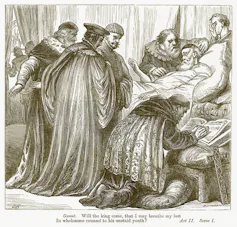
H C. Selous
In the late 16th century, Shakespeare gives us another evocation of England in Richard II. Here, the dying John of Gaunt describes England as a “blessed plot” and an “other Eden” – an “other Eden” that is delightful and perfect. Yet it’s often forgotten today that Gaunt is actually warning that of losing this “dear, dear land” to rot and ruin.
In search of England
Later, poets celebrate the delightful parkland of great country estates. Ben Jonson’s To Penshurst, first published in 1611, sets the model for the “country house poem”, idealising the perfect pastoral of a country estate as a microcosm of England itself, with “garden flowers”, fertile woods and meadows, and contented, obedient inhabitants under their benevolent master.
In his prose, Edward Thomas wrestled with ideas of what England is or could be.
On the eve of the Great War, Thomas experiences an unexpected moment of stillness in a halt at Adlestrop railway station. In this quiet moment, he seems to get close to it, in the misty, elegiac song “of all the birds / Of Oxfordshire and Gloucestershire”. Thomas writes elsewhere that he finds England only in “the little things”: in trees, birdsong, nature, green.
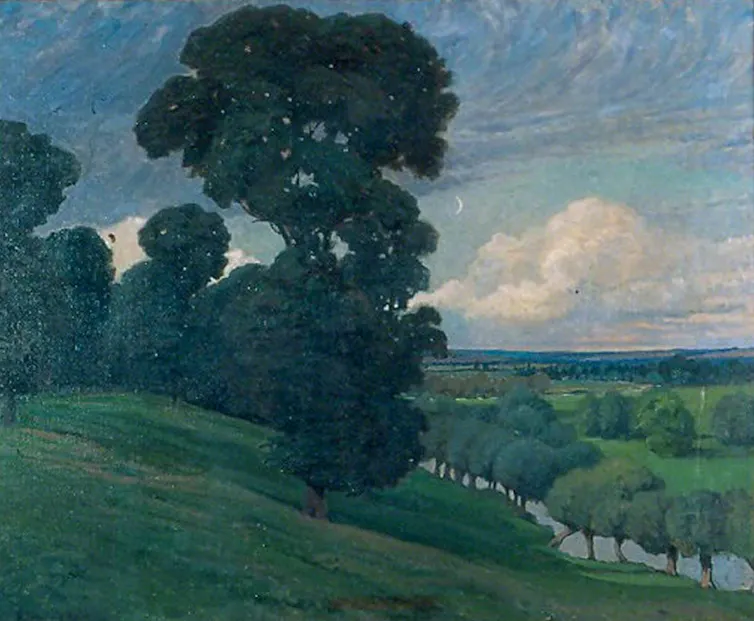
Reading Museum, CC BY-ND
This tradition of English pastoral continues right up to today. In the selection of 25 poems in my book, the last words go to contemporary poet Zaffar Kunial, in his poem The Groundsman from his 2022 collection, England’s Green. The Groundsman stands us at the edge of a cricket pitch, by its overgrown boundary in the height of summer. Grasses and wildflowers wave and tangle. A butterfly flutters. The poem sweeps through time and history in the names and stories of flora and fauna, as light as skimming your fingers through summer grasses. Through his green imagery, Kunial is in conversation with William Wordsworth, John Clare, Edmund Spenser – a pantheon of English pastoral through the centuries.
But our climate is changing. This summer’s heat is a harbinger of the new normal. Green fields are yellow and parched. Plants in the UK flower around a month earlier than they did hundreds of years ago, because of global heating. Those singing cuckoos are now on the red conservation list. We’re facing future ecosystem collapse – and it’s already happening now.
If the future of England’s green and pleasant land is precarious, then so might be the stories we tell about ourselves.
Are we ready to let go of a formative national mythology? A verdant, pleasant, temperate and moderate land. A land that begets people of mildness and clemency, not extremes. A green and generative earth that brings forth flourishing and fruitfulness. Will these old emblems still hold? Without our green and pleasant land, do we know who we are?
I hope we’ll save our green England before it’s too late. I want my children to listen to birdsong in spring woodland, just as others have done centuries before them. Today, “green and pleasant” still shapes how people think and talk about England, 1,300 years after Bede. But this is about more than political arguments. Politicians, conservationists, activists – and poets – all have a part to play in helping us write this new map for our country, in a world poised at an environmental turning point.
This article features references to books that have been included for editorial reasons, and may contain links to bookshop.org. If you click on one of the links and go on to buy something, The Conversation UK may earn a commission.

Catherine Clarke wrote A History of England in 25 Poems.
Original source: https://analysis1.mil-osi.com/2026/08/19/climate-change-is-rewriting-englands-green-and-pleasant-story/