

Source: The Conversation – UK
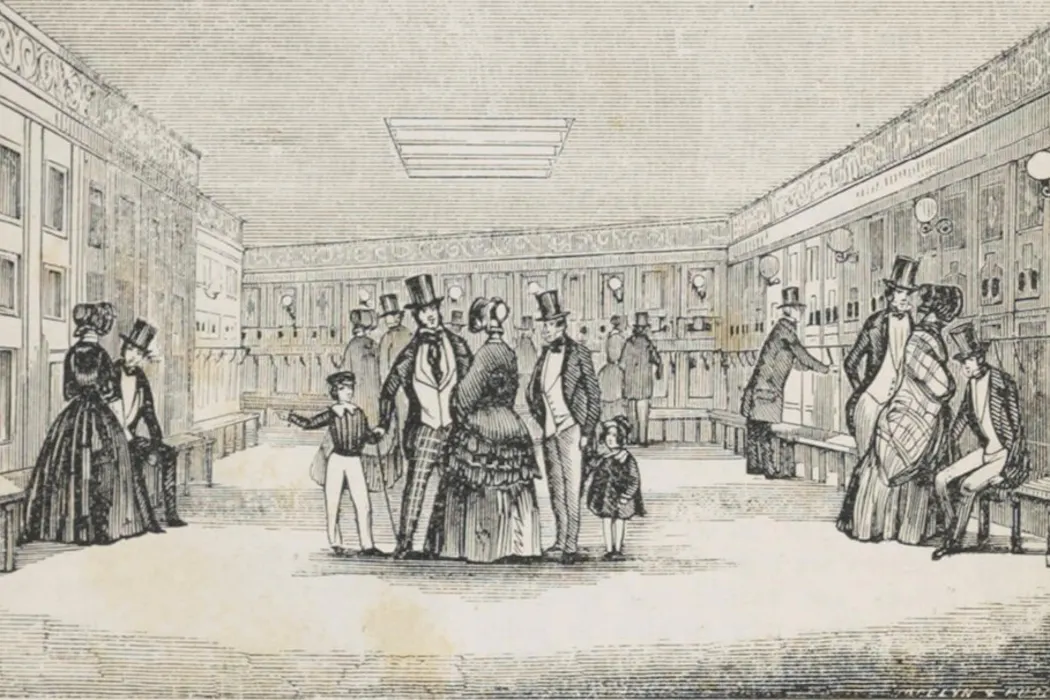
Illustration from the museum’s official guidebook.
If you’re thinking about moving house or just feeling nosy about your neighbours, your first port of call may be an online property marketing site: Rightmove and Zoopla in the UK, Zillow in the US or Magic Bricks in India.
They offer 3D plans of their properties and a video walkthrough, sometimes with added interactive tools. It all seems very modern – yet it turns out, at least one pioneering London estate agent was offering its clients 3D visual walkthroughs long before the advent of commercial photography.
In the UK, estate agents came into being as a specialised profession in the mid-19th century, as rapid urbanisation and greater social and geographic mobility led to a dramatic increase in the demand for housing.
But in this pre-photography era, how did the Victorian era’s newly monied see what they could buy with their gains from trade or industry? One high-end London estate agent, Brooks & Green, came up with a novel answer.

From The Boy’s Own Book: A Complete Encyclopedia (1849)
In 1838, the year of Queen Victoria’s coronation, this Old Bond Street estate agent began advertising an early form of immersive visual technology called a “cosmorama”, to offer prospective buyers a virtual tour of the properties it was selling.
A cosmorama involved looking at paintings or artists’ prints through a large convex lens, which magnified the image and enhanced the perspectival depth, creating a basic 3D effect.
A blackened square frame between the lens and picture hid the edges – enhancing the viewer’s sense of looking at a large scene through an extended opening. Clever lighting effects further enhanced the depth and immersive effects.
To create this cosmoramic view, a skilled artist would have had to visit the estate to prepare the sketches. For 20 years, Brooks & Green promoted its “cosmoramic gallery” as a proto-version of a digital walkthrough. This was nearly 50 years before photography was widely used to advertise property.

The Patriot newspaper, April 1842.
The estate agent advertised heavily in the London press. An 1842 advert claimed its office property gallery included “several hundred views of different estates”. Prospective buyers of one property were promised an “aerial perspective, the site and architectural elevation of a mansion, the local scenery and features of a park [and] ornamental grounds”.
The viewing experience of the cosmorama supposedly offered much more realism and detail than a written prospectus – without rich London buyers having to travel miles to inspect the property in question.
But this service was definitely not available to ordinary families. Only high-value mansions and estates were valuable enough to be visualised in this way. Entrance to the Brooks & Green gallery was supposedly free, but you needed an admission card – probably granted only to those who looked like they had suitably deep pockets.

C. Blunt for La Belle Assemblée, nº155, vol. 24.
Exhibits around the world
For the first half of the 19th century, the cosmorama was one of the most common forms of visual show across Europe and the Americas. It was first revealed at a Paris exhibition in 1808 by the French showman Abbot Constant Gazzera. His success led to many more exhibitions throughout Europe during the 1820s and ‘30s.
In London, the Cosmorama Rooms opened in 1821 at 29 St James’s Street, moving to Regent Street in 1823. The gallery became one of the established London attractions for over 30 years. With Regent Street only a mile from Old Bond Street, it may have prompted an ambitious Brooks & Green employee to have the idea of using this innovation to market its property.
Also shown across Europe in pleasure gardens, popular science institutions, retail bazaars and fairgrounds, the cosmorama was successful because urbanisation and population growth had created a critical mass of middle-class audiences. It offered a new kind of immersive visual exhibition, reaching audiences who would never visit a fine-art gallery.
Cosmorama means “views of the world” in Greek. It was mainly used to display picturesque landscapes, renowned European sites and striking architectural interiors – such as the eruption of Mount Vesuvius, the canals of Venice or the interior of Saint Peter’s Basilica in Rome. The interest in this device reflected the public’s growing desire to be cultivated, and to learn about the wonders of the wider world.
Fascination with 3D worlds
But the cosmorama is just part of the story of immersive pictorial entertainment from the early 19th century. Other popular technologies included peepshows, panoramas and dioramas, all of which offered users a sense of virtual travel.
Panoramas were large circular paintings – the Imax cinema of the age – and dioramas were illusionistic spectacles created from 3D models. At the same time, itinerant exhibitors of peepshow boxes travelled the country’s fairgrounds displaying scenes of national events and sensational murders. Picturegoing had become part of everyday life.
I came across the Brooks & Green adverts for its cosmorama in my research for a historical project led by the Universidade Lusófona in Lisbon, which has mapped cosmorama exhibits across Europe and beyond. In all, Curiositas: Peeping Before Virtual Reality has catalogued more than 650 cosmoramas in Portugal, Spain and the UK.
Many more of these devices were exhibited in countries as far apart as North America, Brazil, Cuba and Australia. The famous US showman P.T. Barnum installed a cosmoramic gallery in his American Museum in New York.
The cosmorama was ultimately superseded by the stereoscope, which also created a 3D photographic experience by looking through lenses. Thus, the cosmorama was an early part of the story of our fascination with virtual worlds – of being taken outside and beyond ourselves, and immersed in another environment.

John Plunkett does not work for, consult, own shares in or receive funding from any company or organisation that would benefit from this article, and has disclosed no relevant affiliations beyond their academic appointment. He is the co-author of Popular Visual Shows 1800-1914: Picturegoing from Peep Shows to Film (Oxford University Press, 2025)
Original source: https://analysis1.mil-osi.com/2026/08/17/how-a-19th-century-estate-agent-offered-3d-property-walkthroughs-before-the-dawn-of-the-photography-age/