

Source: The Conversation – USA
You may have heard the phrase “we are made of star-stuff.” This statement by the astronomer Carl Sagan refers to the fact that elements heavier than hydrogen and helium were forged in the centers of the first stars. But how does this star-stuff evolve into the chemistry of rocks, plants and people?
As an astrochemist and radio astronomer, I study the places in the universe where stars are born as interstellar laboratories. I’m interested in how simple ingredients come together to form bigger and bigger molecules, including those that are building blocks of life. One way I do this is by mapping molecules in space and finding patterns between how abundant they are and the conditions around them.
Astronomers have mapped the distribution of molecules in interstellar space for several decades. From these maps, astronomers typically describe molecules’ abundances, temperatures and how fast they’re moving in each region.
Technology and techniques have improved over time, and now scientists are able to map these metrics at even more precise scales. My research team and I recently compared the findings from these newer methods against previous maps to make sure the earlier maps are consistent with our new maps.
A lab you can’t visit
Stars form in molecular clouds: clumps of gas and dust that act as cosmic nurseries. These nurseries start out at extremely cold temperatures of about minus 442 degrees Fahrenheit (minus 263 degrees Celsius). The material in them is also really spread out, with densities of about 100 molecules per cubic centimeter. By comparison, the air you are breathing right now has about 1019 — or 10 quintillion — molecules per cubic centimeter.
As infant stars form, temperatures rise to between minus 279 F and minus 100 F (between minus 173 C and minus 73 C), and the density increases to 10 million molecules or more per cubic centimeter.
In those conditions, the most fundamental chemical reactions in the universe take place. Unfortunately, these are interstellar laboratories too far away for scientists to visit.
I study the chemistry of high-mass, star-forming regions – nebulae that will give birth to stars much larger than the Sun. Nebulae are the visible clouds of dust and gas that star in many pretty pictures of space, but I am interested in the invisible aspects of nebulae: the molecules they produce as stars form.
The closest such region – and my interstellar laboratory of choice – is the Orion Kleinmann-Low nebula, or Orion KL. Orion KL is a smaller part of the Great Orion Nebula, which can be seen, even without a telescope, as a reddish blob below the belt of the Orion constellation.
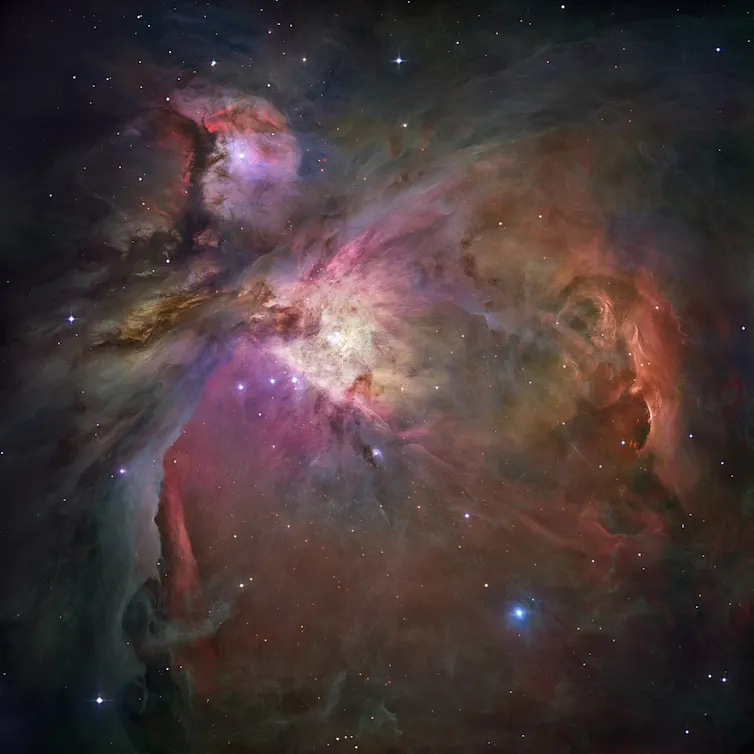
NASA, ESA, M. Robberto (Space Telescope Science Institute/ESA) and the Hubble Space Telescope Orion Treasury Project Team
Even though it is the closest high-mass, star-forming region to Earth, Orion KL is still about 1,300 light-years from the solar system. Unless I could hitch a ride on Star Trek’s USS Enterprise and travel to Orion KL at Warp 9 – or 729 times the speed of light – in which case it would take me about two years to get there, there is no way I could visit the nebula myself and collect samples to study the chemistry.
Even if I could travel at warp speed, I couldn’t watch what happens to Orion KL’s chemistry in real time. Stars – and the molecules that come with them – form over hundreds of thousands or even millions of years.
Instead, I observe Orion KL’s chemistry from Earth with radio telescopes.
Using radio telescopes
Astronomers can use radio telescopes to match the distribution of molecules to astrophysical characteristics such as temperature and density. This process provides a snapshot of the conditions during a specific time in the universe’s history and allows astrochemists to study the chemical processes that take place in the far reaches of the universe.
Molecular clouds emit radio waves, which allow astronomers to observe the signatures of the cold chemistry of interstellar space. Radio waves have wavelengths much longer than what human eyes can see. Fortunately, radio telescopes, many of which look like giant satellite dishes, are equipped to capture radio light so that astronomers can observe interstellar laboratories.
The photons, or light particles, that a molecule releases as it rotates and tumbles in space have frequencies unique to that molecule. In that way, a collection of radio signals at different frequencies – called a spectrum – serves as a sort of molecule fingerprint. The relative sizes of the different signals depend on how much of that molecule is in the nebula as well as its temperature. This means that molecules’ radio signals can be compared to calculate those quantities.
When mapping molecular clouds, bigger radio telescopes yield higher spatial resolution. Single-dish telescopes are as large as 1,640 feet (500 meters) across. While impressive, single-dish telescope observations of Orion KL can see structures down to about 2,600 astronomical units across, at best. An astronomical unit, or 1 au, is the average distance from the center of Earth to the center of the Sun. When trying to tease out chemical patterns on, say, solar system scales of about 200 au across, scientists need much bigger telescopes.
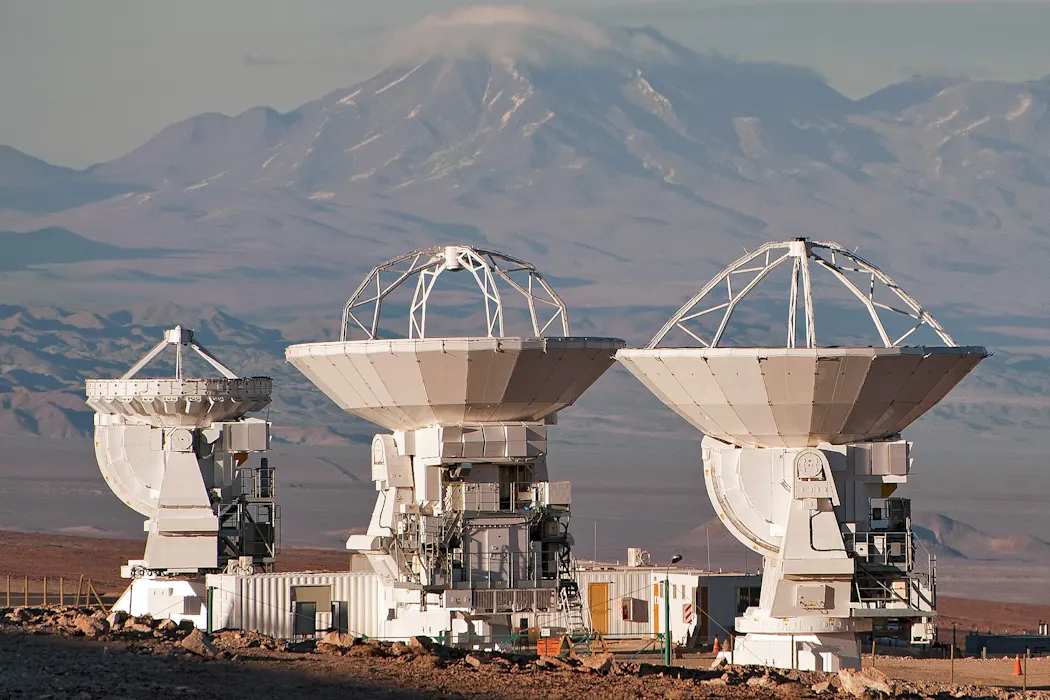
Radio interferometers are arrays of individual dishes that work together as a team, like one large telescope with lots of holes in it. This type of array allows astronomers to capture even smaller-scale phenomena that are invisible to a single-dish telescope. The radio interferometer I use is the Atacama Large Millimeter/submillimeter Array, or ALMA, located at an altitude of about 16,000 feet (4,877 meters) in northern Chile.
ALMA is made up of 66 antennas, 50 of which can be moved across the desert to make a telescope as wide as 10 miles (16 kilometers) across. In its most extended configuration, ALMA could zoom into structures only a few au across in Orion KL.
I am interested in Orion KL’s chemistry on fairly small scales of less than 300 au. At the frequencies where I can see my target molecules, ALMA needs to be in a configuration only about 1.6 miles (2.5 kilometers) across.
Mapping interstellar molecules
In my work, I map the abundance and temperature of different molecules to learn about phenomena astronomers can’t observe directly. I’ve used data from radio telescopes to suggest whether different parts of Orion KL are heated internally, as by a young, still-forming star, or externally, as by shock waves emanating from more evolved stars. I did this by using molecules as a sort of remote thermometer.
In other work, I’ve mapped different types of methanol – a molecule critical to interstellar chemical evolution – to investigate why some parts of the nebula have more of a certain type of methanol than what I expected based on their temperature. The methanol anomaly suggested that there could be a hidden baby star somewhere in the nebula, shrouded from view.
Quality assurance
A team of undergraduates and I revisited the methanol study and attempted to replicate past results using a new dataset from ALMA observations. I wanted to make sure that maps of methanol in Orion KL were consistent, even when generated from different datasets.
We were excited to see that the new maps agreed with the previously published maps. There were slight differences in the maps due to improvements in the code since the earlier works, but the conclusions remained the same. Because of this study, we are more confident in the mapping method as we continue investigating the composition and chemical processes in these regions.
While replication studies like this one may not seem quite as exciting as studies that yield groundbreaking new results, they’re an important part of the scientific process. As technologies such as radio telescopes improve, astrochemists will be able to make new discoveries, double-check existing observations and study these faraway regions in more detail than ever before.

Olivia Harper Wilkins receives funding from NASA and the National Radio Astronomy Observatory (NRAO).
Original source: https://analysis1.mil-osi.com/2026/08/14/radio-telescopes-help-scientists-map-molecules-in-space-and-uncover-where-and-how-stars-form/