

Source: The Conversation (Au and NZ)
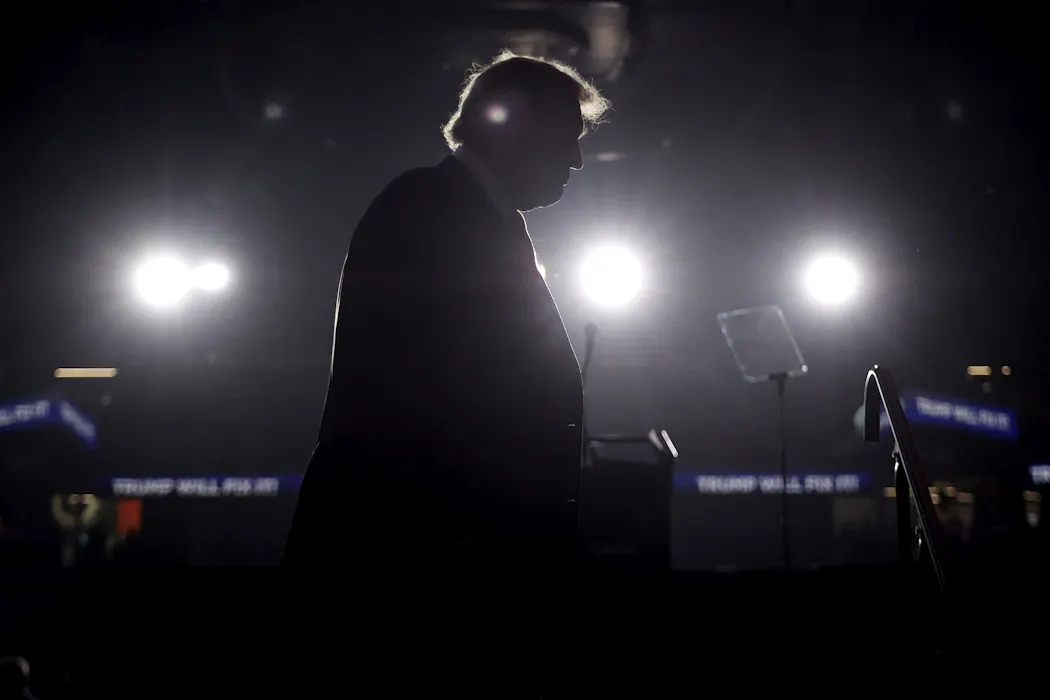
On September 5 2024, after giving a speech about his economic plans for the United States, Donald Trump was asked what he would do, if re-elected president, to make childcare more affordable.
Trump then offered a nonsensical, 374-word response:
well, I would do that, and we’re sitting down – you know, I was somebody – we had Senator Marco Rubio, and my daughter, Ivanka, was so impactful on that issue. It’s a very important issue. But I think when you talk about the kind of numbers that I’m talking about – because, look, childcare is childcare. It’s something – you have to have it. In this country, you have to have it. But when you talk about those numbers compared to the kind of numbers that I’m talking about by taxing foreign nations at levels that they’re not used to – but they’ll get used to it very quickly. And it’s not going to stop them from doing business with us, but they’ll have a very substantial tax when they send product into our country […]
Trump’s answer (or lack thereof) showed he had almost certainly not given the important topic any serious prior thought. His response also provided valuable insights into the scattered state of his own mind.
Yet, many of the subsequent news stories didn’t pay any attention to this massive fumble, and instead reported earnestly on the policy ideas put forward in the scripted parts of his speech.
The New York Times’ article about the event, for example, was headlined “Trump calls for an efficiency commission, an idea pushed by Elon Musk”.
It made reference to his “jumbled and meandering answer” only once, and not until the 24th paragraph.
For many frustrated observers, this was a prime example of what had come to be known as “sanewashing”.
What is ‘sanewashing’?
The term “sanewashing” has been used to describe the tendency of journalists – particularly when reporting on Trump – to focus their attention on the coherent and normal (or “sane”) parts of what he says, while ignoring his often weird, incoherent ramblings (about, for instance, the fictional movie character Hannibal Lecter).
Many have argued that, in doing this, journalists are giving the wider public an inaccurate picture of who Trump is. They may even be inadvertently covering up his more extreme and dangerous ideas and whether he is fit to govern.
The important context here, too, is that during the 2024 campaign, Joe Biden had received intense scrutiny over his declining physical and mental capacities, which caused the then-president to drop out of the race in August that year.
Many felt Trump was just as cognitively unfit for office (if not moreso), but that was not clear to voters because journalists were sanewashing him, and making him seem more normal and “together” than he really was.
Some commentators even suggested this revealed an underlying “bias” among journalists, which was helping Trump to win the election.
But our groundbreaking research tells a more complicated story.
Sanewashing in the 2024 election
We decided to investigate whether journalists really had sanewashed Trump in the lead-up to the 2024 presidential election.
To do so, we focused our analysis around two speeches, the coverage of which had received a lot of attention for potential sanewashing.
One was the childcare example we mentioned earlier. The other was at a rally in Latrobe, Pennsylvania, where Trump made an off-colour remark about Arnold Palmer, which was widely interpreted as a reference to the size of the late golfer’s genitals.
We took the text of those two speeches, as well as hundreds of news articles that referenced them in the weeks that followed (from both traditional newspaper sources, as well as less-traditional online news outlets), and ran them through a series of computational analyses.
Our recently-published results show there is some evidence that sanewashing was occurring around both of these speeches.
We found reporters, on the whole, tended to focus on just one or two key topics Trump talked about, and did so via substantially different language than the now-president used.
But this didn’t occur consistently.
Journalists covering Trump’s economics speech tended to focus on exactly that: themes of taxation and government spending, and largely overlooked his failed answer on childcare.
On the other hand, when covering the Latrobe rally, journalists were much more inclined to discuss the comments about Palmer.
Perhaps not surprisingly, though, this was seen more frequently in online outlets, as compared to mainstream newspapers.
We also found, in spite of the media criticism, there was substantial meta-commentary on Trump’s incoherent speaking style.
However, online news outlets tended to use more strident language when doing so (using words such as “weird” and “bizarre”), where traditional outlets typically opted for more neutral language (like “meandering” and “erratic”).
This would suggest that journalists working for outlets such as the New York Times may feel a stronger need to adhere to notions of impartiality, and thus may feel less able to call out the extraordinary aspects of Trump’s rhetoric.
Is this a problem?
A lingering question amid all of this is whether or not sanewashing is fundamentally problematic in the first place.
Obviously it’s important that journalists accurately reflect reality in their reporting.
But we also don’t want them to engage in stenography either, and just reprint everything a politician says word-for-word.
In practice, sanewashing may simply be an inevitable byproduct of journalism itself; of the natural process of filtering out information that is deemed less relevant, and focusing instead on what’s most important.
And, very often, journalists get those calls right.
To demonstrate this point, let’s return to the article we mentioned earlier: “Trump calls for an efficiency commission, an idea pushed by Elon Musk”.
The commission referenced in that headline was the agency that would later come to be known as the Department of Government Efficiency (DOGE), and which would be responsible for – among other things – the dismantling of the United States Agency for International Development (USAID).
That act alone has been forecast to result in as many as 14 million excess deaths worldwide, which is obviously much more significant than a failed answer on childcare.
So journalists do need to make sure they’re still drawing attention to Trump’s weird sidetracks, but not letting those distract from the more serious ideas buried underneath.

Stephen Harrington receives funding from the Australian Research Council, for the Discovery Project ‘Understanding and Combatting “Dark Political Communication”‘.
Ella Chorazy receives funding from the Australian Research Council (ARC), for the Discovery Project ‘Understanding and Combatting “Dark Political Communication”‘.
Timothy Graham receives funding from the Australian Research Council for the Discovery Project “Understanding and Combatting ‘Dark Political Communication’”, from the Universities Australia-German Academic Exchange Service Joint Research Cooperation Scheme, and from Meta Platforms Technologies.
Original source: https://analysis1.mil-osi.com/2026/08/13/the-media-has-made-donald-trump-look-more-coherent-than-he-is-its-called-sanewashing/