

Source: The Conversation (Au and NZ)
I AM WORK.
This handwritten phrase was found among the papers of industrialist Essington Lewis after his death in 1961. It captured the mindset shared by many Australian executives of his era.
Lewis was one of mining giant BHP’s mid-century “company men”: a salaried manager who learned the business from the ground up, and gradually progressed through the ranks.
Men like Lewis built their identity around work. In return, their loyalty and skills were rewarded with status, promotion and the proverbial gold watch.
Corporate leadership has changed dramatically over recent decades. Women now lead major companies. Lifetime employment at a single company has become rarer.
However, my new research suggests the image of the “company man” has proven resilient even as the workforce has become more gender-balanced.
Many of the qualities still associated with leadership – ambition, toughness, emotional restraint and devotion to work – were forged in mid-century companies.
This history helps shine a light on why, despite decades of progress, the ideal of the “company man” often still decides who gets ahead.
Out of the ashes of war
In Australia and across much of the West, the company man emerged during a period of economic change. In the early 20th century, many of Australia’s largest firms were controlled by founders and family members.
Owners often ran the business themselves, drawing authority from their family connections and entrepreneurial success. As the Australian economy expanded, this model began to break down.

National Library of Australia, public domain via Wikimedia Commons
By the end of the second world war, local manufacturing had grown, share ownership had spread beyond wealthy families and companies faced pressure to modernise.
These changes prompted a new type of corporate leader from the 1950s to the 1980s. Companies recruited young men with practical training as chemists, engineers, bank tellers, drapers or even journalists.
Management was also treated as a skill that could be taught, through university business education, consultants and company training programs. Their careers made leadership look like something earned through skill, patience and discipline.
Leading ‘like a man’
Corporate leadership in the mid-20th century did not only appoint (mostly) men, it was designed around men’s lives. Management careers required uninterrupted full-time work and long hours worked in the office.
A man’s devotion to work – which of course required his wife’s devotion to the home – was essential for his success.
Company men also embodied a particular type of masculinity. Gender is not a fixed biological trait, but a social process through which people learn what it means to be a “man” or a “woman”.
In corporate life, men learned a version of masculinity shaped by the demands of management and the context of post-war Australia.

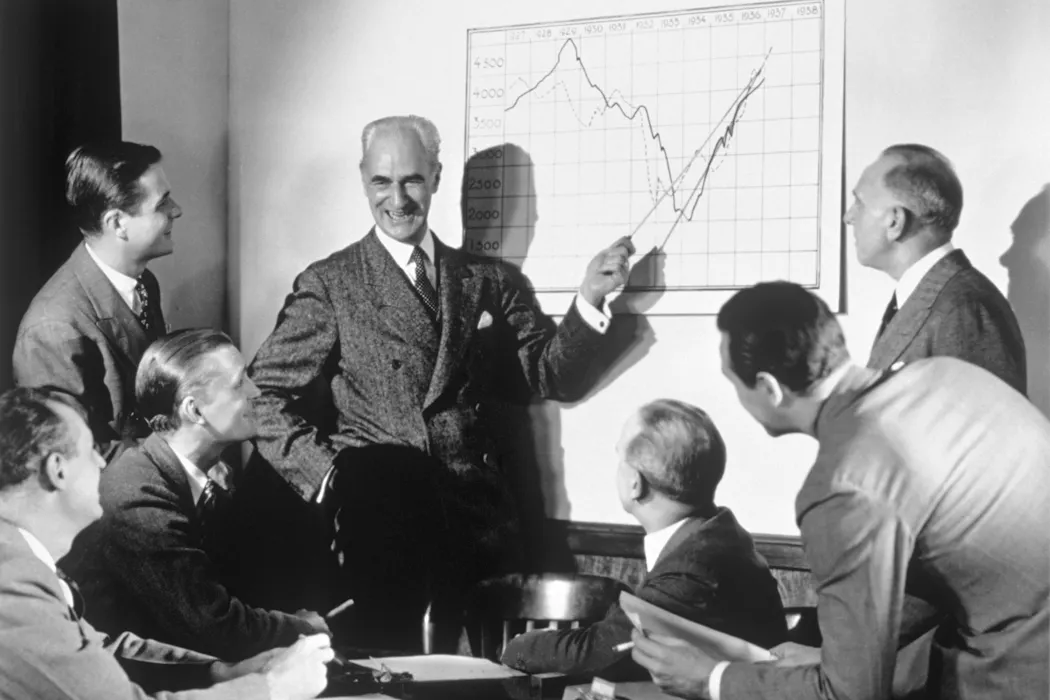
Ed Maker/Getty
Executives were expected to be ambitious and authoritative, commanding respect, exercising control, and demonstrating their worth through advancement up the corporate hierarchy.
Often having returned from wartime service, managers brought a rugged, militaristic style of command and control to corporate life.
Insurance executive James Thompson, for example, is remembered in the Australian Dictionary of Biography for his ready adoption of the “trappings of authority”.
The biography also notes his “distinctive walk peculiar to sergeant-majors on parade” and an ability to “roar like a bull” when required.
‘Seldom animated’
Yet company men were also expected to be emotionally restrained: those who remained calm during crises or continued to work despite being ill were often treated as natural leaders.
Charles Booth, of Australian Paper Manufacturers, was reportedly “seldom animated”, moved at a “leisurely and deliberate pace” and insisted on strict punctuality and formality at work.
Success became proof of both professional authority and masculinity. The corporation became a kind of gladiatorial arena where status was earned through competition between men.

DreamMedia/Getty
Beyond the company man
From the 1980s, company men were displaced by “professional” executives. Manufacturing declined, global competition intensified and companies prioritised profit and share price.
Corporate leaders were no longer expected to spend their entire careers with one firm. Instead, the new generation of executives moved between organisations and applied managerial expertise across industries.
Despite these changes, many outdated expectations have endured. Leaders are still rewarded for their ambition, individual achievements and ability to control others.
They are still expected to show devotion by working long hours, being constantly available and travelling extensively in their company’s interest.
Where we are today
This history helps explain why greater representation has not delivered equality. Although more women have entered corporate leadership in recent decades, men still dominate the total number of executive positions.
Women are often channelled into “feminine” leadership portfolios, such as human resources and legal. And all leaders are judged against a narrow range of acceptable behaviours.
Because the ideal of the “company man” is embedded in management itself, women and men are still judged against a model not designed with most of them in mind.
If organisations are serious about equality, appointing more women should be accompanied by questioning the model of leadership itself.
Rather than asking how we can get women to “lean in” to the typical corporate leader, the future of corporate leadership may well depend on leaving the company man behind.

Claire Wright does not work for, consult, own shares in or receive funding from any company or organisation that would benefit from this article, and has disclosed no relevant affiliations beyond their academic appointment.
Original source: https://analysis1.mil-osi.com/2026/08/05/the-idea-of-the-company-man-was-forged-decades-ago-its-problems-still-haunt-leaders-today/