

Source: The Conversation – Canada
For decades, female-dominated medical specialties have not received the attention and funding they deserve, and gynecology is one of the most under-served surgical fields in Canada’s health-care system.
But pressure for change is mounting. In new analysis published in Healthcare Policy, University of Calgary researchers Amity Quinn, PhD and Dr. Erin Brennand, two of the authors of this story, set out five actions that would improve gynecologic care and reduce inequities, with significant gains in both workforce and cost efficiencies.
Some of the most commonly required gynecologic surgeries are hysterectomy, pelvic floor repair, oophorectomy (removal of ovaries), dilation and curettage (removal of tissue from the uterus) and endometrial ablation (a procedure to reduce heavy bleeding).
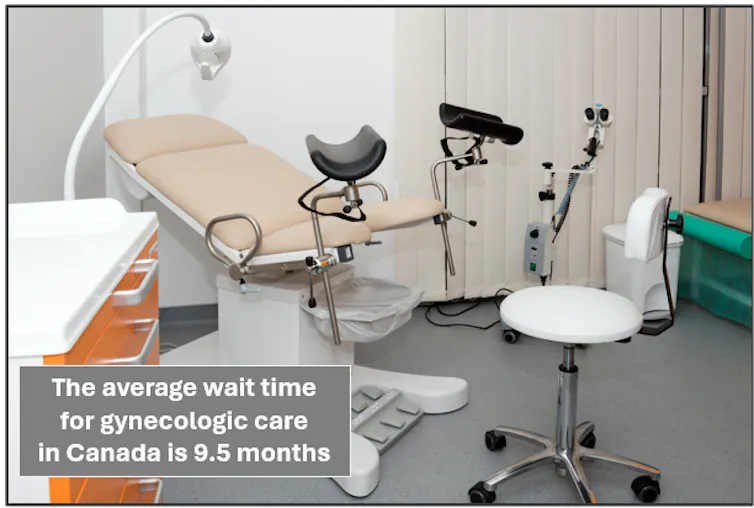
Timely treatment is important for improving and maintaining a healthy lifestyle. However, the current wait time from referral to gynecologic surgery for most Canadian women is around nine and a half months and it can be much longer, depending on the province and type of surgery.
Colourbox.com / Levgeniia Pidgorna
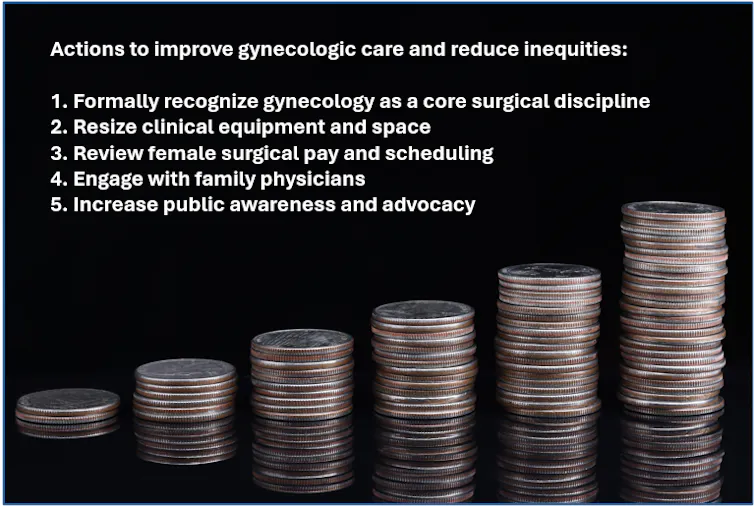
Innovative thinking and prioritizing gynecologic surgery are essential to achieve a high-performing, equitable health system, and based on Quinn and Brennand’s research, we argue that Canada can significantly improve women’s health, in both the short- and long-term, by focusing on five attainable and affordable immediate actions:
1. Formally recognize gynecology as a core surgical discipline
Gynecologic surgery needs to be its own, distinct specialty in health care, with separate provincial planning, funding and surgical spaces. To ensure the needs of this specialty are properly understood, and not neglected, gynecologic surgeons must be involved in decisions around operating room allocation, investment in technology and innovation, and recruitment.
2. Resize clinical equipment and space
Many surgical instruments do not properly fit the hands of female surgeons, which can lead to increased strain (with higher rates of musculoskeletal injuries, fatigue and discomfort) and reduced efficiency over time. These can easily be manufactured in smaller sizes.
Similarly, many gynecologic surgeries do not require large spaces, so a simple redesign or reorganization in clinics, to create smaller surgical suites, would allow more minor procedures to be staffed and completed, reducing waiting times.
3. Review female surgical pay and scheduling
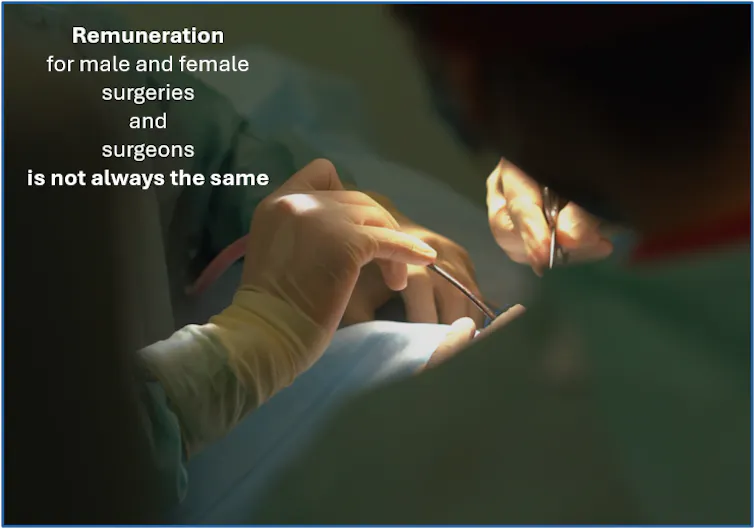
The payments that clinics receive for (equivalent) male surgeries is often higher than for female surgeries. This exacerbates the problem of surgical sexism in Canada, where female surgeons are reimbursed at lower rates than male surgeons, and their pay does not keep pace with inflation.
In just one example, eight out of 11 provinces and territories had billing fees for female reproductive tract procedures that were around 28 per cent lower than those for similar procedures on the male reproductive tract.
Colourbox.com / Tekso
Gender affects surgery scheduling, too. Recent research found that male surgeons were significantly more likely to have higher numbers of cases per day, with shorter turnover times, and for their cases to overlap or run consecutively. These scheduling patterns can increase operating room efficiency as they allow for more productive use of time and resources.
Meanwhile, female surgeons in Alberta were found to be more likely than their male colleagues to have surgeries cancelled or postponed when emergency cases arose. Since Canada’s gynecology workforce is increasingly female, this has a knock-on effect for female patients, too, whose surgeries are more prone to overscheduling and rescheduling.
Urgent reform of this multi-layered gender discrimination is needed.
4. Engage with family physicians
There are many treatments in primary care that may prevent or reduce the likelihood of needing gynecologic surgery. For example, hormone-releasing intra-uterine devices (IUDs) can be inserted by primary care doctors to help reduce heavy bleeding and improve menstruation complications and possibly delay or avoid a hysterectomy — one of the most common inpatient gynecologic surgeries.
Education is key. Providing family doctors with information and training to ensure they communicate and offer these treatments to women is a very cost-effective method of reducing surgeries and therefore, overall waiting times.
5. Increase public awareness and advocacy
Support from patient advocacy group campaigns is needed to highlight the issues affecting women’s access to gynecologic care, and to demand more from health-care providers and provincial decision-makers.
For example, they can publicize the data on waiting times and patient experiences, and seek inclusion as partners in policy-making. Patients today have the power to help shift priorities and direct funding infrastructure in ways that can directly benefit them.
Historic inequities
These are not new issues, but action to address them can be slow. In May 2024, the Women’s Health Coalition of Canada published a report that criticized differences in compensation for male and female gynecologic clinical procedures, and two years on, inequities persist.
This led to further pressure from Dr. Nicholas Leyland, the incoming president of the Society of Obstetricians and Gynaecologists of Canada, to call for an end to gender pay gaps in women’s health last month. He warned:
“Women’s health is not just underfunded in Canada; it is structurally de-prioritized. This reflects a systemic gender bias in the health-care system — women’s health issues are often seen as non-urgent or less important. This affects every province in Canada and needs national level reform.”
Colourbox.com / #257659
Dr. Brennand was involved in another recent call to action, too. In June 2025, along with colleagues in Alberta and Ontario, she highlighted the need to improve non-urban access to specialist gynecologic care in Canada, and recommended university-affiliated post-graduate training sites in rural areas.
Clinical associate professor Dr. Alana Flexman, at the University of British Columbia, and associate professor Dr. Gianni Lorello, at the University of Toronto, have written a response in support of Dr. Brennand and Quinn’s proposals for improving gynecology care, and the need for “co-ordinated, system-wide solutions.”
Dr. Flexman and Dr. Lorello’s insistence that these “historic inequities” need to be urgently addressed in contemporary practice is reminiscent of the problems outlined in Invisible Women: Data Bias in a World Designed for Men, by British journalist Caroline Criado Perez. Published in 2019, her book describes how the existence of a gender data gap in the world, including health care, creates an invisible bias that has a profound effect on women’s lives.
By addressing what are rectifiable issues in gynecology — through improved recognition, planning, equipment, schedules and remuneration, engaging with primary care doctors and promoting wider public awareness — Canada’s health system could provide women with vastly improved, and more timely, care.

Amity Quinn receives funding from the Canadian Institutes of Health Research. She is affiliated with Praxus Health.
Erin Brennand reports receiving grant funding from the Canadian Institutes of Health Research, Social Sciences and Humanities Research Council, the Calgary Health Foundation, and the MSI Foundation (all paid to institution). Dr. Brennand also reports salaried employment with Alberta Health Services for the role of Calgary Corridor Clinical Department Lead – Obstetrics & Gynecology.
Pauline McDonagh Hull does not work for, consult, own shares in or receive funding from any company or organisation that would benefit from this article, and has disclosed no relevant affiliations beyond their academic appointment.
Original source: https://analysis1.mil-osi.com/2026/08/04/5-ways-to-improve-gynecologic-care-and-womens-health-outcomes-in-canada/