

Source: The Conversation (Au and NZ)

Australia’s unique animal species are in sharp decline, with more than 40 mammal extinctions over the past 238 years. This atrocious mammal conservation record is the worst in the world.
Unfortunately, this is not simply a historic problem – almost 700 animals are currently at risk of future extinction. At least 200 of these are directly threatened by feral cats, as well as other pressures such as land-clearing, disease and invasive species.
Feral, domestic and stray cats now occupy almost the entire continent and are estimated to kill more than 1.5 billion native animals each year. These estimates are based on more than 100 cat diet studies, which identified prey animals using the traditional scientific methods of examining stomach contents and scats (droppings).
However, our new research – the first in Australia to use DNA for cat stomach analysis – shows traditional methods may greatly underestimate the true number of native animals killed by feral cats.
Stomachs, scat or DNA?
Scientists traditionally study the diet of predators such as feral cats by manually looking through their stomach contents or scat samples. Searching for hair, bones, feathers or other partial remains is an unpleasant task that can help identify a cat’s prey.
However, the bodies of animals rapidly degrade within a cat’s digestive system, and it can be difficult to identify small prey fragments. In fact, more than 50% of prey can be unidentifiable, and this only includes the remnants still visible to the naked eye.
We were curious to find out whether small or soft-bodied species, such as microbats and birds, were being missed by these traditional methods. Other research has shown soft-bodied New Zealand frogs were detected more often when DNA analysis was used on the contents of mammal stomachs. So we decided to analyse stomach contents, rather than scats, to increase the likelihood of detecting smaller or soft species.
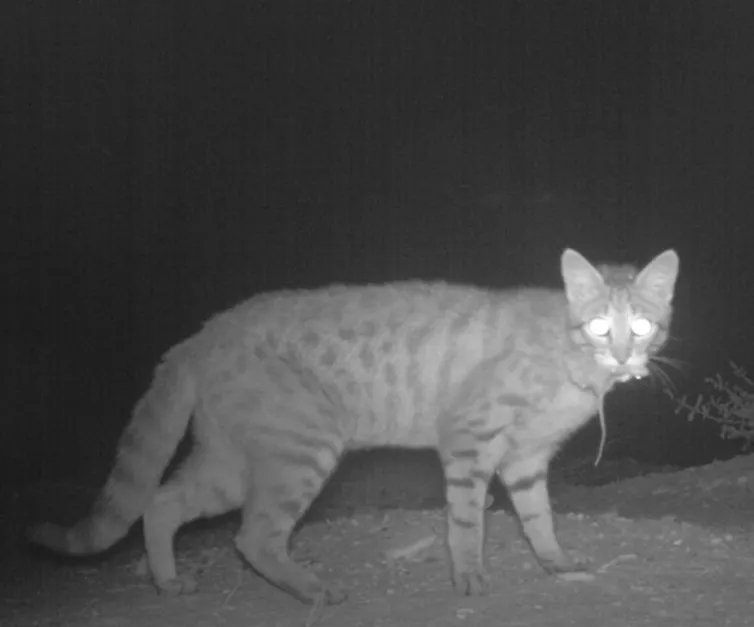
Katherine Moseby
We used both manual and DNA metabarcoding, a forensic method that allows scientists to detect even tiny remains of animals that have been eaten by predators. All organisms have a unique genetic “barcode” that can be identified from certain regions of their DNA.
These two methods were used to analyse the stomach contents of cats that had been culled around Wild Deserts, a fenced conservation reserve in New South Wales. This is the first time DNA methods have been applied to cat diet studies in Australia, and one of few globally.
The results were sobering: DNA detection identified twice as many mammal species and three times as many bird species as traditional manual detection. But it was less effective for certain reptiles.
In summary, more species were detected, and were found within more cats. This means they are being consumed at a higher rate than traditional methods estimated.
Interestingly, we did not detect any microbats, in line with previous research at these sites. This might be because cats generally eat rodents and other small mammals, and eating bats is likely a sporadic event. But we know cats are a threat to bats in other regions.
DNA findings emphasise cat threat
Building predator-free fenced reserves known as safe havens, is one way conservationists have tried to slow the extinction and severe declines of many Australian wildlife species. These reserves allow us to remove species such as cats, foxes and rabbits, enabling native species to thrive in pre-colonial conditions.
Projects such as Arid Recovery, Wild Deserts, Secret Rocks, and several others managed by conservation organisations such as Australian Wildlife Conservancy and NSW National Parks, have successfully returned species that were locally extinct to their former homes.
However, we cannot fence the whole of Australia. Therefore, we need to know which species are most at risk from cats so resources can be directed to protect them. Unfortunately, it is often the rarest and most threatened species that are of greatest risk from cats, such as small mammals. Due to their scarcity, they are difficult to detect.
Ironically, scientists have relied on cat diet analysis to confirm if very rare species are persisting (or not) in an area, and DNA methods could increase the confidence of these results.

Oli Aylen
Exciting next steps
More recently, these projects have begun releasing native animals beyond the fences into areas where cats have been suppressed to low numbers. As we move into this exciting next stage of rewilding Australia, it is vital we know how many of these pioneer animals are eaten by cats. Yet traditional methods may not detect them.
Our research complements decades of work by individuals and organisations that have
monitored the effects of invasive predators, including cats, on Australian ecosystems. It is important to incorporate this local expert knowledge with DNA analyses.
Traditional manual methods remain a practical, cost-effective approach to routine dietary analysis. However, using DNA methods alongside these techniques will help us better understand and estimate the impacts of cats and other invasive predators.

Oliver Aylen is a PhD candidate at the University of New South Wales, and works for Australian Wildlife Conservancy. He has received funding from the Foundation for Australia’s Most Endangered Species Ltd, The Bat Conservation Trust, The Ecological Society of Australia, and the NSW government. He is affiliated with the Australasian Bat Society, and Bat Conservation and Rescue Queensland.
Katherine Moseby receives funding from the Australian Research Council (ARC) to investigate the impacts of feral cats on wildlife. She also owns shares in Thylation, a company that designs and sells cat control devices such as Felixer Grooming Traps. There has been no income or dividends from this investment. She is a co-founder of three fenced safe havens (Arid Recovery, Wild Deserts, Secret Rocks) that exclude feral cats for the protection of reintroduced species. She is a co-founder of three fenced safe havens (Arid Recovery, Wild Deserts, Secret Rocks) that exclude feral cats for the protection of reintroduced species.
Kylie M. Cairns receives funding from the Australian Dingo Foundation, the Australia and Pacific Science Foundation, the NSW government, the ACT government and donations from the general public. She is a director of the Paddy Pallin Foundation and provides scientific advice to the Australian Dingo Foundation and the New Guinea Highland Wild Dog Foundation. She also serves as coordinator of the International Union for the Conservation of Nature (IUCN) dingo working group which is part of its Species Survival Commission (SSC) Canid Specialist Group.
Rebecca West is a Senior Lecturer at the University of New South Wales and works as the Principal Ecologist for the Wild Deserts project. The Wild Deserts project is funded by the NSW National Parks and Wildlife Service. She receives funding the NSW Environmental Trust, Rabbit Free Australia and philanthropic donations to research ecosystem restoration techniques.
Original source: https://analysis1.mil-osi.com/2026/08/03/feral-cats-likely-kill-far-more-australian-native-animals-than-we-thought-first-dna-analysis/