

Source: The Conversation (Au and NZ)
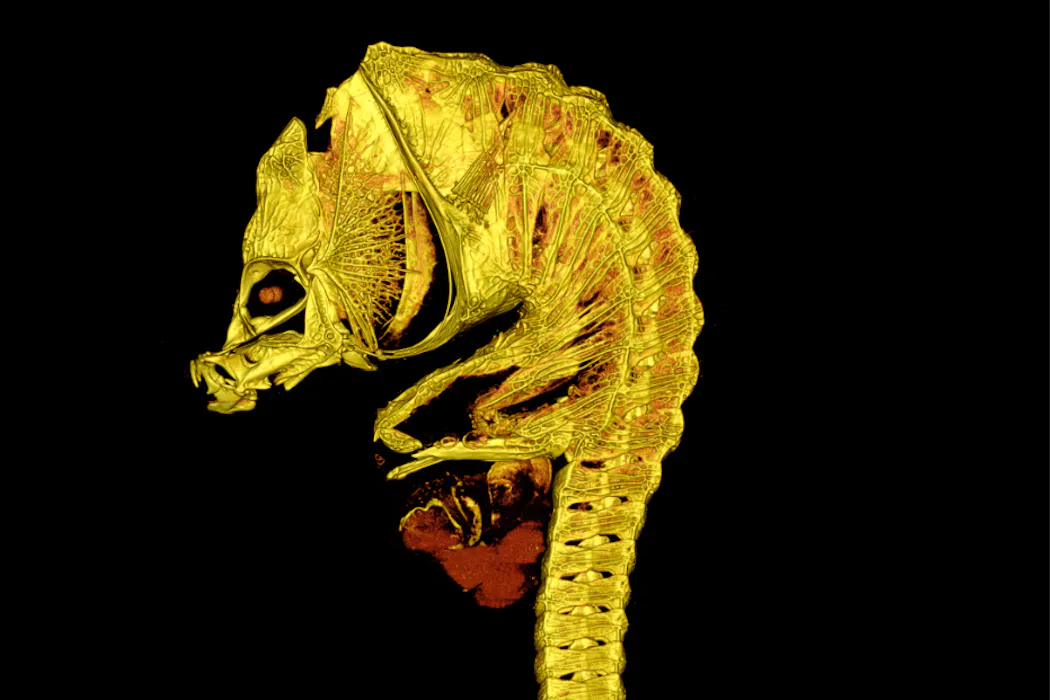
At first glance it looks exactly like a seahorse. It has the same horse-shaped head tilted down from the body, the same curled and grasping tail, and in the males a fully enclosed pouch for brooding the young.
But this little fish, no longer than your thumb, is not a seahorse, as we report in our new study published in the Journal of Lost Species. This is Australyichthys aegis, a newly described fish from the deep reefs off southern Australia. We have given it the common name helmethead sea muppet, after the domed, helmet-like crest on its head.
Its scientific name follows the same idea: in Greek mythology the aegis was a protective shield. Together with its two relatives, the bullneck sea muppet (A. minotaur) and the paradoxical sea muppet (A. paradoxus), it makes up a small group we nickname the sea muppets.
All three, we have now shown, belong on their own branch of the family tree. The seahorse look has arisen more than once, and these fish are a case of it evolving well away from the true seahorses. That evidence had been sitting in museum drawers, misfiled, for decades.
Bycatch from the deep
You will not find these fish while scuba diving.
Every known specimen was brought up by accident, caught in trawl nets or dredges working the seafloor between about 50 and 125 metres down. The single specimen of A. aegis came up in 2006 near the Gambier Islands, at the mouth of South Australia’s Spencer Gulf.
The dredge that caught it was sampling for small shelled animals known as brachiopods during a natural history expedition. Because that expedition was after invertebrates, the fish was mistakenly catalogued into the invertebrate collection of the South Australian Museum, where it sat unrecognised for years.
After each chance capture the fish were preserved, then largely forgotten. The rest are held in Australian museum collections, among them the Australian Museum, Museums Victoria and CSIRO.
The whole genus is known from just seven specimens gathered over about 65 years, scattered across more than 2,500 kilometres of coastline, and nothing has been collected in nearly two decades.

Graham Short, CC BY-NC
Irreplaceable specimens
The specimens are irreplaceable, so we could not dissect them. Instead we used micro-CT scanning, the same X-ray technology used in hospitals but fine enough to resolve tiny bones.
That let us build three-dimensional models of each fish’s skeleton and compare them bone by bone with true seahorses (Hippocampus).
Every earlier assessment had rested on external appearance, and the skeletons did not support it. Seahorses have a particular internal architecture, including a rigid cage of fused bony plates supporting the belly and a bony crown, called a coronet, on the head.
Our scans showed that Australyichthys has neither. In their place is a different arrangement of bones supporting the belly, one that appears in no seahorse.
Only one specimen could give us DNA.
A. aegis had been fixed in ethanol rather than formalin, the only member of the genus stored that way, and ethanol leaves genetic material intact. Sequencing it placed the fish well outside the seahorses, on the branch that is their closest relative. The genes said what the bones had already said.
All three species had been placed in the seahorse genus on the strength of how they look, and on that evidence they were seahorses. They are not, and they needed a genus of their own. We named it Australyichthys, from the Latin for southern and the Greek for fish.
A shared way of life
When separate lineages evolve to look alike, biologists call it convergent evolution, and it usually reflects a shared way of life rather than shared ancestry.
The whole seahorse body, with its bent head, gripping tail and brood pouch, has been built at least twice within a single fish family, the Syngnathidae, which includes seahorses, pipefishes, pipehorses and seadragons.
Working out how that happened may reveal why evolution keeps arriving at the same solution.
All this happened along the Great Southern Reef, the connected system of kelp forests and rocky reefs that rings southern Australia. Many of its species are found nowhere else, and its deeper zones are barely explored.
In fact, an entire genus of vertebrate hid there, misidentified, until a CT scanner settled the question.
No one has ever seen one of these fish alive; they have turned up only by chance in a passing net or dredge. On that record they now qualify as lost species, known from a handful of preserved animals and never from a living one.
Calling them lost is not a prediction of extinction. It marks them as a priority for targeted surveys that go looking rather than waiting for the next accidental catch. They are most likely still down there, in a part of the sea we hardly ever visit.

The authors do not work for, consult, own shares in or receive funding from any company or organisation that would benefit from this article, and have disclosed no relevant affiliations beyond their academic appointment.
Original source: https://analysis1.mil-osi.com/2026/08/03/new-museum-find-shows-nature-cant-stop-inventing-seahorses/