

Source: The Conversation (Au and NZ)
The spread of H5N1 birdflu is worsening.
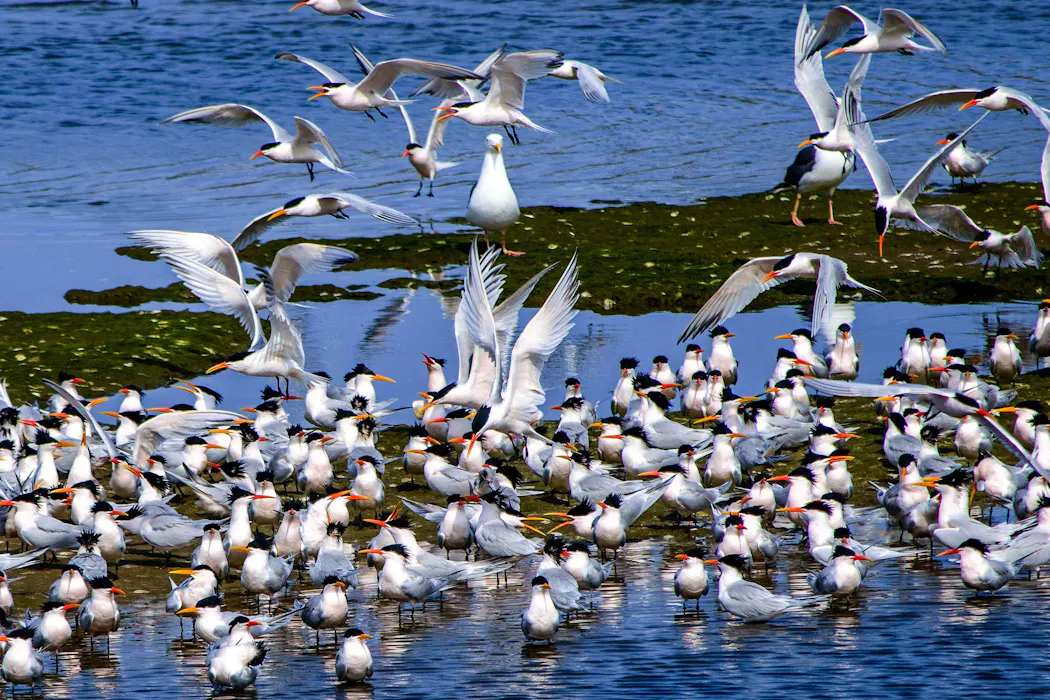
At the time of writing, Australia has 53 confirmed detections in wild seabirds across five states. In South Australia there are 39 confirmed cases, including a silver gull at Robe and 19 greater crested terns found along the Limestone Coast and Seal Bay on Kangaroo Island.
South Australian authorities are also investigating 49 dead and 35 sick greater crested terns found by aerial surveillance teams at an offshore location south of Cape Jaffa.
Samples are still being tested, but if confirmed, this would represent the first mass mortality of Australian animals associated with the virus.
Until recently, Australia’s detections were mostly isolated migratory seabirds arriving from the Southern Ocean. But these detections show this has changed, with local transmission among wildlife that live in Australia.
Which species are most at risk?
Animals that gather densely in breeding colonies face the greatest danger. Terns, gulls, gannets and albatrosses can transmit the virus rapidly through close contact and contaminated environments, with these groups experiencing devastating mortality in other parts of the world.
The silver gull infections are particularly concerning because they move between beaches, towns, rubbish tips, wetlands and inland waterways. A suspected case at Monarto, SA, does not prove H5N1 is yet established inland, but it shows infected seabirds cannot be “coastally contained”.
Seals and sea lions also require urgent surveillance. H5N1 killed more than 17,000 southern elephant seals in Argentina in 2023, with 95% pup mortality at one monitored colony. Around 13,000 elephant seal pups later died on Heard Island. While it was not possible to carry out postmortem examinations on all individuals at this remote location, H5N1 was confirmed as present and recorded as the most likely cause of death.
Five infected terns have now been confirmed at Seal Bay, a critical breeding site for the endangered Australian sea lion. Australian sea lions and fur seals breed in dense colonies where disease could spread quickly.

Phil Kirkpatrick/flickr, CC BY
Can we predict how far it will spread?
We cannot reliably predict the spread of H5N1 in Australia. The 53 confirmed detections are not the true number of infections – they are the birds found, reported and tested. Many infected animals will never be detected.
Cases from the rest of the world show this strain of H5N1 is capable of spreading huge distances, carried by migratory wildlife. Every other continent, including Antarctica, has been infected by this strain of H5N1 over the past five years, with deaths in the millions.
Hundreds of species of birds have been infected, and the virus has evolved to spread more efficiently between mammals. This pattern makes it very difficult to confidently predict how the virus will spread in Australia, but we must be prepared for a widespread and devastating outbreak.
What about poultry farms and backyard chooks?
There are still no detections of H5N1 in Australian poultry or other livestock, but the risk has increased as confirmed infections rise among resident wild birds.
Wild birds can introduce influenza to poultry through direct contact or by contaminating water, feed, footwear and equipment.
Backyard owners should prevent contact with wild birds, cover feed and water, avoid untreated surface water, and clean footwear and equipment. Sudden illness or deaths should be reported immediately.
Australia’s response now needs to evolve
Sadly, the impacts of bird flu on species and ecosystems will play out for decades to come.
Australia’s pre-outbreak preparation and coordination has been strong. Federal and state governments established response plans, increased surveillance and prepared the poultry industry before H5N1 arrived.
As wild bird infections increase, the poultry industry needs to be supported in implementing biosecurity procedures, and strategic surveillance is needed for both farms and wildlife.
Reliable mortality estimates are essential to understand the long-term impacts, and support species to recover. Australia should also assess whether vaccination could protect vulnerable marine mammals before mass deaths begin.
We cannot stop wild birds from flying. But we can decide whether this becomes an unmanaged wildlife catastrophe or a closely tracked outbreak, with farms and vulnerable species given timely protection.
Please do not touch sick or dead birds or marine mammals. Record the location, take photographs from a safe distance, keep pets away, and report the sighting to the Emergency Animal Disease Hotline on 1800 675 888.

Jane Younger receives funding from the Australian Research Council, National Geographic Society, Rolex, WIRES, the Marine Megafauna Research Fund and Lindblad-National Geographic. She is affiliated with the University of Tasmania.
Original source: https://analysis1.mil-osi.com/2026/08/01/the-warning-signs-are-over-australia-now-faces-a-devastating-bird-flu-outbreak-in-wildlife/