

Source: The Conversation (Au and NZ)
Later this year, a Queensland council will trial Australia’s first traffic light system powered by artificial intelligence (AI).
The new traffic technology will be trialled by the City of Moreton Bay at the intersection of two suburban roads in Petrie, just north of Brisbane.
At first, this might sound like a small transport story. But it raises hard questions about fairness, safety and who gets priority on public roads.
And if this trial works, similar systems may be used in other Australian towns.
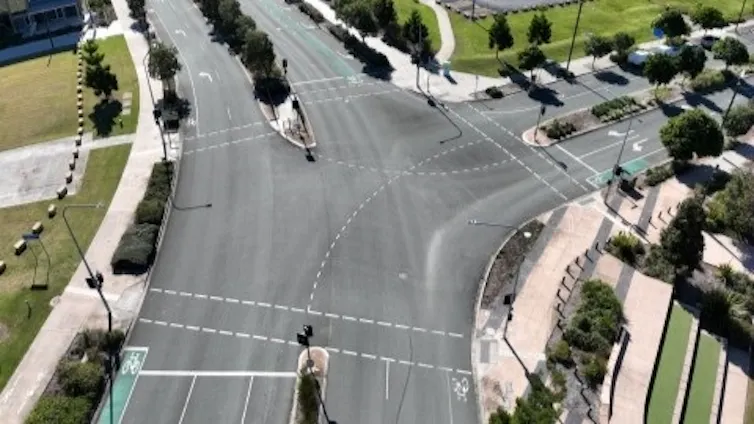
Moreton Bay City Council, CC BY
How AI traffic lights work
At every traffic intersection, cars, buses, cyclists and pedestrians compete for time.
A conventional traffic light is like a kitchen timer with a few settings. Road sensors may change some timings, but the lights still follow a set of rules. This can leave an empty road on green while a long queue waits at red. It is not always smart.
An AI traffic light is more like a referee watching the intersection and adjusting the timing.
It can use sensors and traffic data to see where cars, buses, cyclists and pedestrians are. It may also use past traffic patterns and outside data, such as weather or major events. It can then change the signal in real time based on what is happening and what may happen next. It may give more green time to a busy road, let a bus to move first, or give school children longer to cross.
These systems can bring real benefits. In the United States, for example, Pittsburgh’s pilot cut travel time by 25%, waiting by 40%, and estimated emissions by more than 20%.
Who gets priority and what could go wrong?
The hard part is not only using data and AI technology. It is deciding whose time matters most.
Imagine a school intersection at 8:30am. Cars are lining up. A bus full of children is waiting. Some students need to cross the road. A cyclist is also waiting. The AI may help reduce waiting time, but it must still choose who gets priority.
Should it move cars faster? Give children more time to cross? Let one full bus go before several private cars?
These are not just traffic questions. They are urban design questions. They show what kind of city we want to build.
Traffic lights do more than managing traffic. They shape behaviour by rewarding some ways of moving and making others wait too.
If cars always get priority, more people may keep driving. If buses, cyclists and pedestrians get better treatment, the city may slowly become less car-dependent. In this sense, an AI traffic light is not only a technical tool. It can become a quiet urban planner.
Cybersecurity is another challenge. Connected traffic lights can become targets for hackers. A bad actor could try to change signal timings, create traffic jams or make two directions move at unsafe times. This could cause confusions and accidents.
In the US, researchers studied a network of 100 traffic lights and carried out attacks at real intersections. They showed an attacker could freeze lights or change their timing.
The experiment showed how poorly protected systems could be used to disrupt an entire road network.
How can cities make AI traffic lights work for everyone?
AI traffic lights can be useful, but cities should not begin with the technology and treat it as magic. They should first decide their public goals.
Near a school, safety may be more important than speed. On a busy bus route, public transport may need priority. In a shopping area, pedestrians may need more time.
Councils should explain these choices to the public. People should know what data is collected, how the system is tested, and who is responsible if something goes wrong.
To reduce cybersecurity risks, councils should regularly test and monitor the system. Traffic lights should also have a safe backup mode that returns them to fixed timing if the AI fails or is attacked. Human operators must be able to take control during an emergency.
The best AI traffic light is not the one that only moves cars faster. It is the one that acts as a fair referee, with good data, clear rules and a human ready to step in.

Seyedali Mirjalili does not work for, consult, own shares in or receive funding from any company or organisation that would benefit from this article, and has disclosed no relevant affiliations beyond their academic appointment.
Original source: https://analysis1.mil-osi.com/2026/07/19/new-trial-of-ai-powered-traffic-lights-will-be-a-test-for-who-gets-priority-on-public-roads/