

Source: The Conversation – Canada
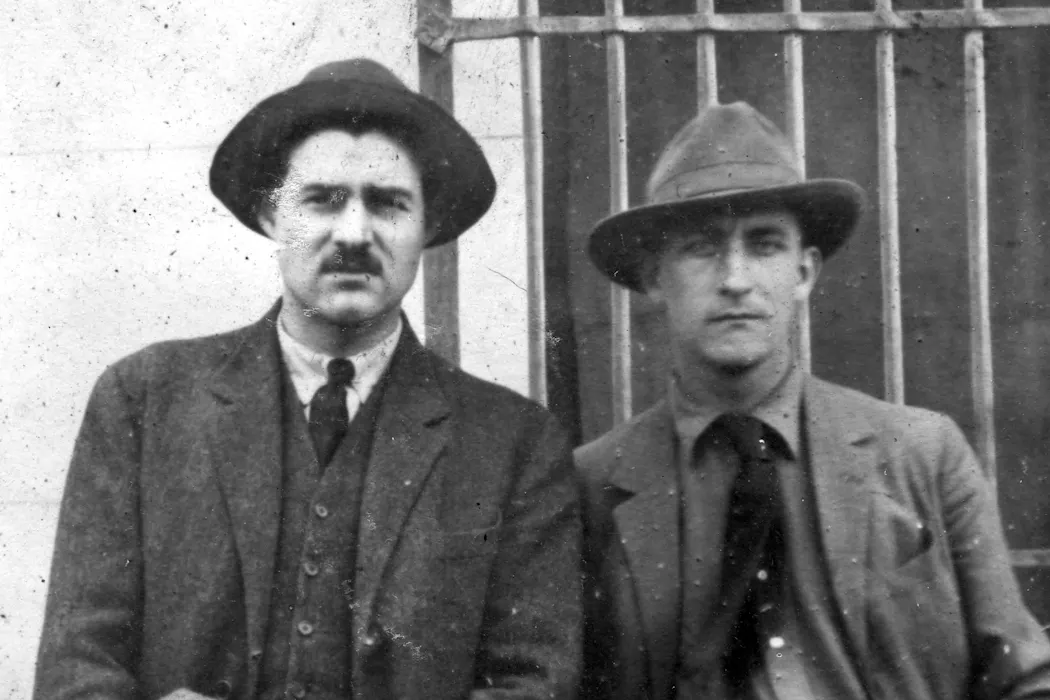
In January 1924, two young women on a Toronto Queen St. streetcar caught sight of Ernest Hemingway’s battered green hat.
They giggled among themselves that he might be Red Ryan, the city’s fugitive bank robber.

(Wikimedia)
So reported John Hadley in the Toronto Star story “The Freiburg Fedora: Must Wear Hats Like Other Folks If You Live in Toronto” on Jan. 19, 1924. Hadley was Hemingway’s wife’s name, and John, the name of their infant son.
Today, it’s clear that Hemingway wrote the story. Journalist and literary historian William White first collected many of Hemingway’s Toronto Star pieces in Dateline: Toronto (1985).
Journalist William Burrill, author of Hemingway: The Toronto Years (1994), later uncovered some 30 additional long-lost stories, including several written under pseudonyms like John Hadley or Peter Jackson. By cross-referencing Hemingway’s papers at the John F. Kennedy Presidential Library and Museum, Burrill demonstrated that “The Freiburg Fedora” was indeed Hemingway’s.
As Burrill notes, Hemingway adopted pseudonyms after reaching his quota with the Star, allowing him to sell additional stories and earn much-needed income for his young family. He first used the John Hadley signature only weeks after the birth of his first son.
With scholars gathering in Toronto in July 2026 to re-examine Hemingway’s Canadian years, “The Freiburg Fedora” offers a compelling opportunity to revisit a neglected moment in Hemingway’s literary development.

(Wikimedia)
Evolution of fiction strategies
The significance of “The Freiburg Fedora” extends beyond its authorship.
Under the guise of Hadley, Hemingway was able to explore the less appealing aspects of himself. The sketch captures him at a pivotal moment when newspaper reporting begins to evolve into literary self-fashioning, anticipating themes and narrative strategies that would later define his fiction.
Although researchers established Hemingway’s authorship of the story decades ago, it has received remarkably little literary attention. During the July 2026 Toronto Hemingway conference, visitors to the Toronto Reference Library (where the Toronto Star collections are held), can see the original newspaper story on display.
The making of an outsider
Hemingway had covered Red Ryan’s escape for the Toronto Star, making the comparison he explored in “The Freiburg Fedora” especially apt. Contemporary newspaper photographs of Ryan wearing a fedora bear a striking resemblance to the young Hemingway.

(Wikimedia)
The “Freiburg Fedora” opens with the wry observation: “There is one thing Toronto demands in clothes. That thing is conformation.” This first-person piece goes on to see “John Hadley” narrate Hemingway’s irritation in being mocked by the two women. Where another traveller might have laughed at the comparison, Hemingway’s alter ego begins to prepare a counterattack.
The story quickly becomes a satire of Toronto itself. On the eve of his return to Paris, Hemingway used the protection of a pseudonym to mock what he presents as the city’s social conformity and provincialism.
The hat is pivotal in this transformation. “John Hadley” never defends its appearance. Instead, he recounts its travels. It has weathered “the hot sun of the Thracian desert,” been worn beneath heavy snow glasses and even landed in “the sunbaked sand of the bull ring.”
The hat becomes almost a passport, bearing the marks of experience rather than fashion. What the Toronto passengers dismiss as an oddity, Hemingway presents as the visible trace of an adventurous life deliberately lived beyond convention. The battered fedora embodies the identity of a young writer consciously fashioning himself as an outsider character.
From streetcar quarrel to literary technique
Recent scholarship has increasingly emphasized the continuities between Hemingway’s journalism and fiction. Marcos Todeschin, for example, argued in his doctoral thesis that Hemingway’s newspaper writing and fiction should be understood as part of the same evolving literary practice. “The Freiburg Fedora” offers one of the clearest examples of that transition.
The fedora story reveals a characteristic that would recur throughout Hemingway’s fiction: the tendency to transform minor social encounters into contests of will. Rather than inviting sympathy, the Hemingway character steadily escalates the exchange through increasingly extravagant claims. He depicts himself as a provocateur who seems almost compelled to intensify the conflict.
He insists the hat was a gift from the late Emperor Charles of Austria, provoking fellow passengers by invoking the recently defeated First World War enemy who had died in exile. This prompts a male passenger to threaten him with “a sock on the jaw.”
At the height of the “Freiburg Fedora” confrontation, Hemingway steps off the streetcar at Queen and Bay streets, announcing that he has “an appointment with the new mayor.” Toronto readers would immediately have recognized the reference. Mayor William Wesley Hiltz had taken office only days earlier.
Whether Hemingway, as a reporter, had business at Old City Hall or simply fashioned a theatrical exit for his first-person narrator is impossible to know. Either way, he leaves the streetcar, and the argument, entirely on his own terms.
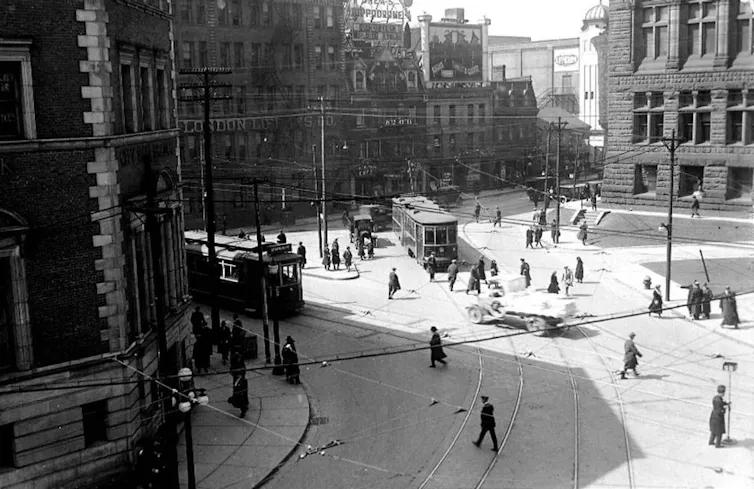
(City of Toronto Archives: Series 71, Item 1971/Wikimedia)
From journalism to fiction
“The Freiburg Fedora” introduces a narrative pattern that would become central to Hemingway’s later fiction. Social encounters become tests of will.
“The Freiburg Fedora” displays the irony, character construction and carefully controlled endings that would later distinguish Hemingway’s fiction. The newspaper story begins to assume the shape of literature while Hemingway simultaneously turns himself into an anti-hero of his own autobiographical narrative.
It also overturns the Toronto Star Weekly’s carefully cultivated public image of Hemingway. A staff profile published on May 6, 1922, presented him as a medal-decorated war veteran, who was “tall, dark, of distinguished appearance” and “a general favourite by his ability and his bonhomie.”
A strikingly different self-portrait emerges. Here, Hemingway depicts himself as quarrelsome, provocative and quick to escalate conflict rather than defuse it. Instead of reassuring readers, he leaves confusion in his wake.
Toronto’s lasting legacy
“The Freiburg Fedora” also reshapes understanding of Toronto’s place in literary development.
During his four years with the Toronto Star, Hemingway produced nearly 200 pieces, 170 under his own name plus around 30 with verified pseudonym bylines. These satirical pieces and literary reportage, including many short, character-driven autobiographical sketches, reveal a writer already experimenting with narrative voice, characterization and dramatic conflict.
On the pages of the Toronto Star Weekly, Hemingway also reflected on William Butler Yeats’s Nobel Prize in Literature. In a Nov. 24, 1923, column, he lamented that his literary hero, Joseph Conrad, had not received the honour and observed that “no American author has won the Nobel Prize.”
Three decades later, in 1954, Hemingway himself received it. The Nobel Committee praised him “for his mastery of the art of narrative” and for “the influence that he has exerted on contemporary style.”
The foundation for that mastery was laid not only in Paris but also in Toronto.
“The Freiburg Fedora” deserves to be read not simply as an amusing newspaper sketch but as one of the earliest literary examples of Hemingway beginning to invent the writer he would become.

Irene Gammel does not work for, consult, own shares in or receive funding from any company or organisation that would benefit from this article, and has disclosed no relevant affiliations beyond their academic appointment.
Original source: https://analysis1.mil-osi.com/2026/07/16/how-a-forgotten-toronto-story-shows-hemingway-beginning-to-invent-himself-as-a-fiction-writer/