

Source: The Conversation (Au and NZ) – By Clare Carolin, Senior Lecturer, Art and Public Engagement, King’s College London
I was texting a museum director friend in Asia recently. We were discussing whether a trip to this year’s “artworld Olympics”, the Venice Biennale, justified the carbon release.
I felt ambivalent. The main exhibition is curated by Koyo Kouoh, whose 2016 edition of Ireland’s Biennale, EVA International, on the 1916 Easter Rising centennial I had admired. Kouoh died of cancer earlier this year. Her posthumously realised Venice Biennale, titled In Minor Keys, seemed a final opportunity to appreciate the subtle, intelligent work of Africa’s leading curator.
Against the lure of Kouoh’s exhibition, though, was a queasy realisation that the Biennale seemed to be ideologically backsliding. Russia and Israel, both accused of war crimes, were controversially participating.
Alongside the huge guest-curated show of contemporary art, the Biennale invites countries to present exhibitions they curate themselves in national pavilions in the Giardini di Biennale and citywide venues. Following Putin’s full-scale invasion of Ukraine in 2022, Russia was excluded, its pavilion remaining shuttered throughout the 59th and 60th editions. But last year Giorgia Meloni’s government appointed rightwing ideologue Pietro Buttafuoco as Biennale director.
Buttafuoco revoked Russia’s exclusion. He also facilitated the relocation of Israel’s exhibition from its usual Giardini pavilion to a high security cul-de-sac in the Biennale’s second official venue, the massive Arsenale.
“This biennale seems cursed,” texted my friend. Despite feeling hypocritical about the environmental burden, I booked a flight to Venice.
Angry protests and violent reprisals
In the weeks leading up to the exhibition, my friend’s suggestion looked increasingly on point. A complicated choreography of war, state violence and activism began to play out. They culminated during the Bienniale preview in angry protests and violent reprisals.

The Art Not Genocide Alliance (ANGA) gathered 236 curators, artists and art workers to campaign for Israel’s exclusion and improved conditions for cultural workers.
When Kouoh’s international jury refused to consider Israel and Russia for the Biennale’s prestigious Golden Lion awards, artist Belu-Simion Fainaru, who was representing Israel, threatened them with legal action, according to the Italian news agency Adnkronos and arts publication Hyperallergic. The jury resigned. Their subsequent silence has not been explained.
Relieved of the professional all-female expert jury that Kuouh appointed, Buttafuoco instated a Eurovision-style audience prize. At the time of writing, over 70 artists have withdrawn from the awards in protest.
Like an artwork, a curse is a performative utterance at the nexus of ritual symbolism and magic. People like to believe that art, unlike curses, is a force for good. But as I argue in my book The Deployment of Art, there is a long history of state co-option of art and artists in the service of malign agendas of state violence. To me, The 61st Biennale seems one such example.
In a statement on the Biennale website, Buttafuoco amplifies the spiritual dimensions of Kouoh’s vision. “It is an exhibition permeated with spirit, with a sacredness that puts the person, the human being, back at the heart of things … looking to the sky once more.”
Much art in the main exhibition is hard to square with such whimsy. Pio Abad’s precise critical drawings of everyday objects of imperial plunder, like houseplants and chocolate, alongside stolen Benin bronzes. Walid Raad’s series of found photographs of beds slept in by Palestine Liberation Organization leader Yasser Arafat. Joana Hadjithomas and Khalil Joreige’s extraordinary sculptural excavation of the lost ancient city of Orthosia, hidden beneath a buried refugee camp in southern Lebanon.
But other works better serve Buttafuoco’s vague, obfuscating narratives of “sacredness” and “spirituality”.
In the Arsenale, an uprooted olive tree that recalls images of the desecration of Palestinian olive groves rotates on a plinth to the perverse accompaniment of tinkly ballerina music. This work by Theo Eshetu is titled Garden of the Broken Hearted, but the accompanying label doesn’t explain why the tree was uprooted, or from where, only that it “stands as a poetic reflection of impermanence”.

Alfredo Jaar’s “shrine” to base materials, a thrumming scarlet cathedral titled The End of the World meanwhile, so overwhelms the senses that I felt faint. I later saw a young woman collapsed outside it, attended by paramedics. Numerous other works draw on ritual traditions and spiritual practices from “the powerhouse of Africa” (Buttofuocco’s term).
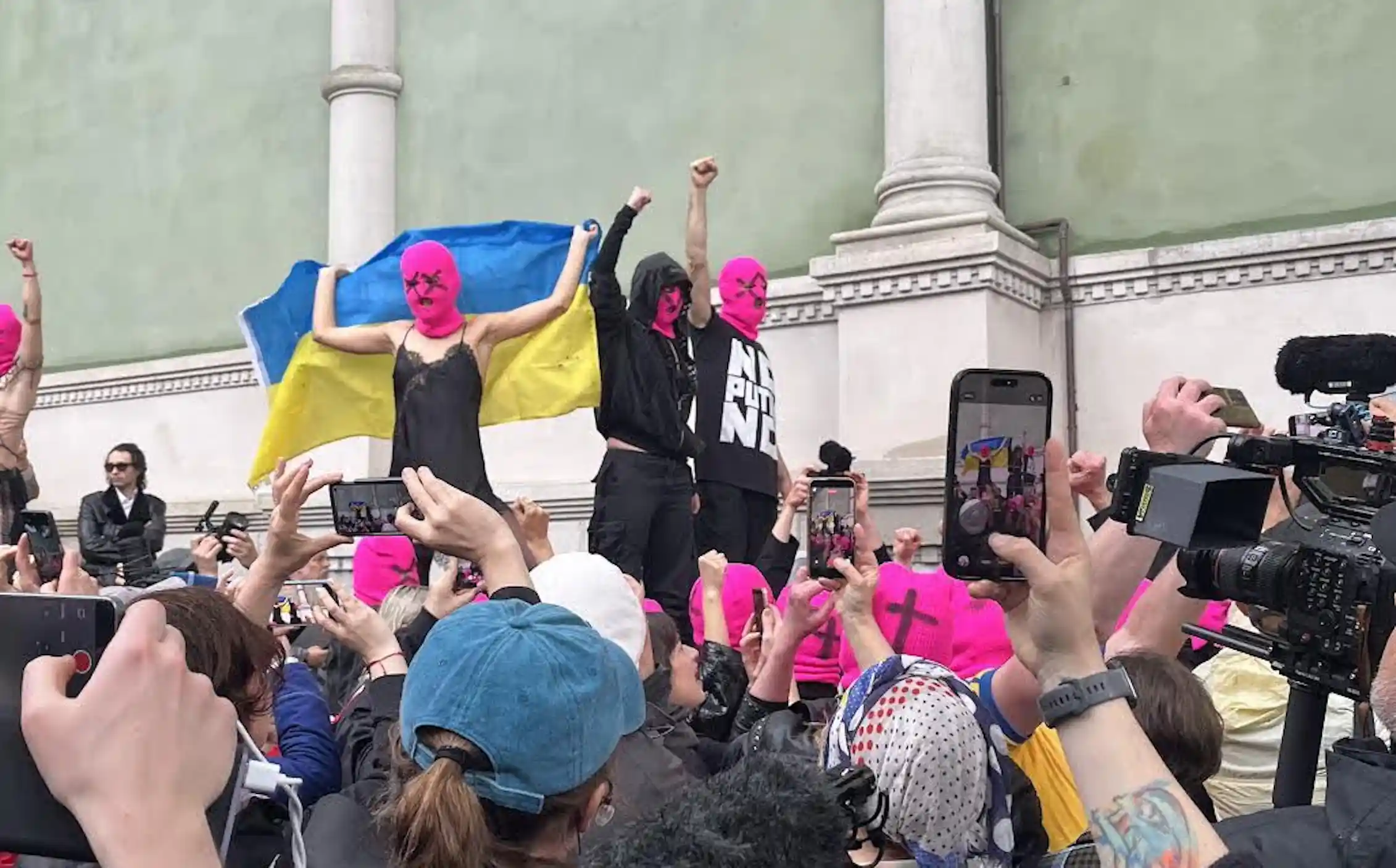
Police presence was pervasive throughout the previews. Armed, helmeted officers held a line around Pussy Riot’s demonstration at the Russian pavilion, where protesters released blue, yellow and pink smoke canisters chanting “bloody Russian art” and “curated by Putin, corpses included”.
On the final preview day, as many pavilions closed early in strike protest, police stomped through the Giardini in heavily armed groups ten or 20 strong. At 4.30pm a peaceful crowd of ANGA protesters, many with young children in pushchairs or carried on shoulders, marched from the Giardini to the Arsenale where riot police used batons to beat them back. Surveillance helicopters hovered over the city until long after midnight.
Visions of hell
When future art historians study the 61st Biennale, they may notice a poster slogan from the ANGA protest: “Palestine is the Future of the World.” Meanwhile, visitors would do well to venture beyond the Giardini and Arsenale to an unofficial collateral exhibition organised by the Museo Moderno Buenos Aires.
Taking its title from John Milton’s description of hell, Darkness Visible: The Long Shadow of the Dictatorship brings together a trans-generational group of artists. Their work has been shaped by a regime of state terror (1976-83) that implemented a systemic policy of kidnappings, torture, murder and the forced disappearance of thousands.
Darkness Visible positions art as a vehicle for understanding history, protecting memory and human rights, and engaging in activism against state violence. One photograph by Marcelo Brodsky documents a demonstration by the Madres de Plaza de Mayo demanding information about their forcibly disappeared children. Brodsky’s mother (whose son was disappeared) appears in the image holding a banner that draws connections between second world war concentration camps in Warsaw and ESMA, a clandestine torture and extermination centre used by the Argentinian junta during the dictatorship.
As I contemplated this image, the exhibition’s curator Victoria Noorthoorn explained: “We wanted to present this show in Venice now because our Argentinian artists have much to say about fear, violence, pain and trauma that remain as scars from Argentina’s repressive regime. Their work reminds us of the need to protect core values: human and civic rights, democracy, freedom of expression and artistic creation.”
The protests I witnessed in Venice were marked by real anger, solidarity but also moments of tenderness and joy. A hopeful sign of how art and artists might imaginatively reinvent future biennales, undo the cursed present and lead us away from the darkness closing in.
– ref. This year’s Venice Biennale marks a major shift in European cultural politics – https://theconversation.com/this-years-venice-biennale-marks-a-major-shift-in-european-cultural-politics-282833