
Source: The Conversation (Au and NZ) – By Trudy Meehan, Lecturer, Centre for Positive Psychology and Health, RCSI University of Medicine and Health Sciences
My ex once told me, mid-argument, that I was the most unempathetic person he’d ever met. It was a low blow. I’m a clinical psychologist. Empathy is literally my job.
What he probably didn’t know – and I was too “flooded” to explain at the time – is that when we argue with people we love, our brains can briefly turn against us.
Researchers call it emotional flooding or diffuse physiological arousal. Your heart hammers. You flush, sweat and shake. Adrenaline surges through you as though you are being chased by something that wants to eat you.
Lisa Feldman Barrett, a professor of psychology at Northeastern University in the US, describes the brain as being “locked in a dark, silent box” (your skull) with no direct access to the outside world. It can only work with signals from your senses, and it uses past experience to predict what those signals mean. So when my partner looked away during an argument – eyes down, head turned – my brain didn’t just register disconnection. It reached into my past and found my father, largely absent, largely disengaged and screamed – a threat.
If you’ve experienced a lot of conflict, rejection or trauma, your brain becomes a hair-trigger prediction machine, interpreting interpersonal friction as danger even when you’re perfectly safe. It’s trying to protect you. The problem is that once you tip into that negative emotional state, you also shift from “we” thinking to “me” thinking – fast. Empathy evaporates. You’re in survival mode, not relationship mode.
It would be convenient to blame all of this on my neurology, or on my ex for arguing in ways that made me feel threatened. But that’s not quite how it works. Our physiological states don’t exist in isolation. We regulate each other, pulling one another up or dragging each other under. Which means we carry some responsibility for what happens in each other’s nervous systems.
This gets particularly charged in the parent-child relationship. Parents are already stretched. When a child acts out, the most useful response is curiosity: what is this behaviour trying to communicate? But a flooded parent is far more likely to react harshly or defensively than with the openness a child actually needs.
So what can we do when the flood waters rise? The first thing is to get to know your own internal state in real time. Awareness alone can slow emotional reactivity. It won’t happen overnight, but learning to notice the early physical signs of flooding – the heat, the racing pulse – gives you a tiny window of choice before your brain takes over.
The second tool is what psychologists call cognitive reappraisal: consciously inserting a different story between the trigger and your response. When a colleague sighs and says: “Do we really need a meeting about this?”, your brain will offer you one interpretation immediately. Reappraisal asks: what else might be true here? This isn’t about suppressing your feelings – suppression actually increases flooding – it’s about widening the range of possible responses available to you.
When all else fails, the most powerful intervention is also the simplest: leave the room. Not by stonewalling or slamming doors, but by agreeing in advance on a word or phrase that means: “I need a break. I’m not abandoning you.”
The 20-minute rule
The break needs to be real – at least 20 minutes – long enough for your body to return to baseline, and spent doing something genuinely distracting rather than replaying the argument in your head. This works for parents too. Stepping away briefly and explaining to a child that you’re not punishing them but regrouping is a far better model than pushing through while flooded.
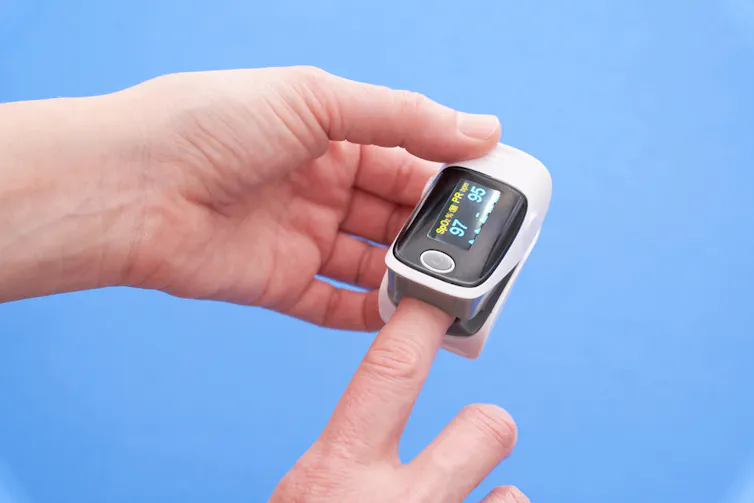
For those who find it hard to read their own physiological state, biofeedback can help. The researchers John and Julie Gottman, who have spent decades studying couples in conflict, used simple fingertip pulse oximeters (devices that measure pulse rate and blood oxygen levels) in their lab to track what was happening to people’s bodies during arguments. They went on to recommend using the same tools at home, as a concrete way of learning to self-soothe before the flooding takes hold.
None of this is about avoiding conflict. Friction is part of human relationships in every form – romantic, familial, professional – and trying to eliminate it entirely would be both exhausting and counterproductive. The goal is to stay present enough, and regulated enough, to keep hold of your empathy even when your brain is telling you to run.
My ex wasn’t entirely wrong. In that moment, flooded and frightened, I probably wasn’t empathetic. But I’d like to think I understand why, and that understanding, at least, is a start.
– ref. Why your brain turns against you during arguments – and what to do about it – https://theconversation.com/why-your-brain-turns-against-you-during-arguments-and-what-to-do-about-it-280538