
Source: The Conversation (Au and NZ) – By Jesse Kearse, Postdoctoral Research Fellow, Te Herenga Waka — Victoria University of Wellington
The magnitude of an earthquake depends on how far a rupture travels along a fault line before it stops. For the first time, we have now directly observed how a large earthquake comes to a halt.
By analysing seismic recordings taken within a few kilometres of faults, we have identified a ground motion signal we call a “stopping phase”. It records the moment the earthquake stops.
This discovery, published in Science today, provides direct seismic evidence that large ruptures stop suddenly, rather than slowing down gradually.
It also helps identify where shaking may be strongest along strike-slip faults, which could help with disaster planning and preparation.
Earthquakes grow as the rupture spreads along a fault. The further it goes, the larger the earthquake magnitude becomes. The vast majority of earthquakes stop before they grow large enough to be felt.
For example, the earthquake monitoring network GeoNet has recorded more than 20,000 earthquakes in Aotearoa New Zealand over the past year, but all stopped soon after they began.
A very small percentage of earthquakes keep on going, and can travel for many hundreds of kilometres before coming to a halt, reaching up to magnitude 9 and often causing widespread damage.
Although rupture stopping is clearly important for determining earthquake magnitude, the process itself has been extremely difficult to observe directly.
Our findings now provide planners with a new way of identifying where the most damaging ground motions are likely to happen along a fault line.
A hidden signal of reversed ground motion
Using seismic, GPS and satellite data from 12 large strike-slip earthquakes worldwide, we found consistent patterns of ground motion at the ends of the faults which was not observed at their centres.
We observed that during the final moments of the earthquake, the ground suddenly moves in the opposite direction to the fault’s motion, creating a “whiplash” effect.
It’s like riding in a fast car that suddenly slams on the breaks – your body continues to go forward, but then sharply whips back the other way.
The stopping phase of an earthquake is similar, with the reversal in ground movement signalling a rupture’s abrupt halt.
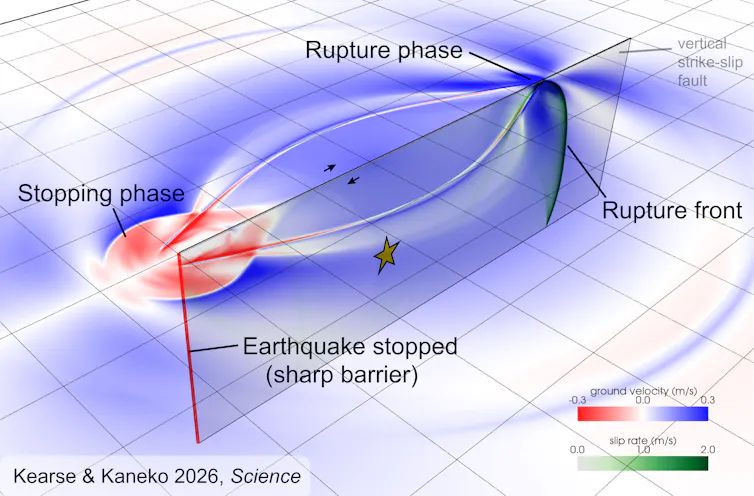
As the stopping phase arrives at the Earth’s surface from depth, the ground can change direction in a fraction of a second, and move up to a metre or more backwards.
Because it occurs close to the fault and over such a short time, this process has not been recognised before. These signals are only becoming clear with increasingly dense modern seismic monitoring networks.
We simulated earthquakes using numerical models and were able to reproduce the stopping phase observations only when the rupture stopped suddenly. When the model forced a rupture to slow down gradually, the signal disappeared.
Do all earthquakes stop like this?
This research focuses on large strike-slip earthquakes – events where the ground moves sideways along near-vertical faults, rather than up and down.
Because near-fault observations are so rare, the science is severely data limited. Strike-slip faults provide the best opportunity to study these processes because they often rupture all the way to the Earth’s surface, where instruments can capture ground motion close to the source.
Abrupt arrest may also occur on other types of faults, such as subduction zones where one tectonic plate slides beneath another.
But we need further research to confirm whether this process is common to all earthquakes or only strike-slip fault systems such as the San Andreas Fault running along the coast of California in the US or New Zealand’s Alpine Fault.
The domino effect of cascading rupture
Large strike-slip faults are made up of a series of segments, linked together end to end.
To become large events, earthquakes that ride these fault networks must break multiple segments in one go.
In the seismic data from one such event in Turkey-Syria in 2023, we found stopping phases were recorded both at the end of the earthquake and at the edges of internal segments.
This stop-start behaviour during a single event means an earthquake rupture comes to an abrupt halt at the end of one fault segment, before triggering a slip on its neighbouring segment, like a cascade of falling dominoes.
How this helps people living near fault lines
Stopping phases help pinpoint where earthquake shaking may be most intense.
Our research shows these signals occur near the ends of ruptures and at boundaries between fault segments – places where earthquakes are most likely to stop.
This means the strongest and most complex shaking is likely to occur at the edges of fault segments, rather than their centres.
For strike-slip fault systems, this is particularly useful because fault segments and ends can be mapped before an earthquake happens.
This allows scientists and planners to identify locations where damaging ground motions are expected to occur.
Incorporating stopping phases into hazard models will improve how we anticipate shaking for cities near faults, such as New Zealand’s capital Wellington.
– ref. Seismic ‘whiplash’ – new research shows what happens when earthquakes stop suddenly – https://theconversation.com/seismic-whiplash-new-research-shows-what-happens-when-earthquakes-stop-suddenly-280846