
Source: The Conversation (Au and NZ) – By Nicole Townsend, Lecturer in War Studies, UNSW Sydney
110 years ago this week, Anzac Day was held for the first time. It has been observed annually ever since.
Today, Anzac Day has emerged as an unofficial national day. But what do Australians think about the most significant event in the national commemorative calendar?
Anzac Day important, but engagement levels lag behind
Last year, the War Studies Research Group conducted a national survey, examining public attitudes towards military history. The survey involved 1,500 people and was completed in late February and early March 2025.
Anzac Day remains deeply contested. Academics have shown how critics argue the occasion glorifies war and obscures its more challenging aspects, including veterans’ health issues.
At the time of the Gallipoli centenary in 2015, questions were raised about “centenary fatigue” — the idea that the Australian public would grow tired of commemoration after four years of centenary activities, and disengage from Anzac Day. Reporting has since highlighted differing opinions among young Australians, and studies have identified reduced turnout at Anzac Day services.
Despite these concerns, our survey found the Australian public overwhelmingly believes in the day’s importance within contemporary society. Nearly 90% of respondents said Anzac Day was important to Australians today.
When it comes to engaging with Anzac Day activities, however, responses were more varied. Around two thirds had attended an Anzac Day service at least once. More than half also regularly engaged with the Anzac Day-related activities.
Yet almost a quarter said they don’t regularly engage with Anzac Day activities, and 35% admitted they had never attended an Anzac Day service.
This tracks with other research, which shows that the number of Australians attending Anzac Day dawn services between 2015 and 2019 dropped by 70%.
Younger Australians consider Anzac Day important
Our survey didn’t look at the reasons for engaging (or not), but lagging participation in Anzac Day events has been linked to “broader community disinterest”, particularly among younger Australians.
Yet our survey found younger Australians overwhelmingly consider Anzac Day important. About 85% of those aged under 40 responded favourably – not much lower than older Australians.
The youngest Australians (18–29) in our study were also only marginally less likely than their older counterparts to have attended an Anzac Day service at least once: 72%, compared with around 75% of those aged 60 or over.
Under-40s are also the most likely to engage regularly with Anzac Day activities. This is likely influenced by the fact they are more likely to be physically capable of participating, compared with older Australians.
Veterans crucial to keeping memory alive
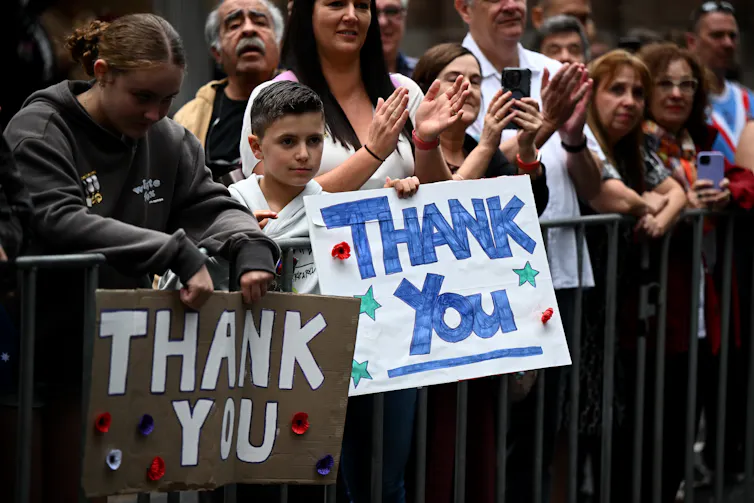
Veterans have long been the cornerstone of Anzac Day, whether at the dawn service or Anzac Day marches – and Australians consider them crucial to commemoration.
Our research showed 85% of Australians supported their role in keeping the memory of past conflicts alive. Nearly 70% also found it easier to remember past conflicts when veterans are alive to tell their stories.
This opinion was shared across age groups, genders and locations. It also tracks with some of the broader findings in our survey, including that Australians are most interested in personal stories of war.
While Australians believe in veterans’ role in keeping the memory of their experiences alive, this doesn’t mean they receive a great deal of information about military history from them.
Just under half of Australians trust veterans and veterans’ associations as sources of information on military history, but only 15% said most of their knowledge came from them.
There were also notable age-related differences in this regard. Around a quarter of Australians aged 60 or over identified veterans or their associations as a key source of information on military history. By contrast, only 8% of those aged 30–39 said the same, along with 13% of those aged 18–29.
Crucially, veterans and veterans’ associations were not in the top three sources of military history knowledge for any age group.
The challenges that lay ahead
This raises questions about the role of veterans in increasing public awareness of their contributions and experiences.
Others have emphasised the risk posed by the loss of “tangible connections” to veterans of past conflicts, both distant and recent. In 2025 it was estimated there remained around 1,000 second world war veterans in Australia. The last Australian veteran of the first world war died in 2009.

This means we are now reliant on recorded interviews and written testimony for personal insights into both world wars. Still, both world wars benefit from significant exposure in popular culture and the dominance of the world wars in history.
For more recent conflicts, the challenge is greater. Public awareness of recent conflicts is lacking compared to the world wars, and unlike the second world war, they rarely feature in popular culture. The Anzac legend of the “exceptional digger” also fails to reflect the professional soldier of the modern Australian Defence Force and recent conflicts.
Whether it is distant or more recent conflicts, the voices of veterans are important in maintaining the memory of past conflicts. It is important we ensure their voices are heard now, and recorded for future generations.
– ref. After 110 years of Anzac Days, new research shows Australians remain convinced of its importance – https://theconversation.com/after-110-years-of-anzac-days-new-research-shows-australians-remain-convinced-of-its-importance-281012