
Source: The Conversation (Au and NZ) – By Ximena Nelson, Professor of Animal Behaviour, University of Canterbury
Bruce the kea is missing his entire upper beak. Yet he is the alpha bird of his circus (the apt collective noun for a group of New Zealand’s famously playful alpine parrots).
As our latest research shows, Bruce achieved his alpha status not despite his disability, but because of it.
In a remarkable example of behavioural innovation, he has developed a novel technique to fight his opponents.
Bruce essentially weaponised his disability by using his sharp lower beak to joust other kea, propelling himself forward with such vigour that he nearly topples over, but not before the other birds jump back in a flurry of orange and green feathers.

Like other kea, Bruce will also kick to establish dominance, but the other birds simply can’t match his secret weapon because their intact upper beaks curve over the bottom beak, rendering this spear-like weapon unusable.
It is his jousting behaviour that has enabled Bruce to win every one of his contests and become the undisputed king of the circus.
So effective is this novel behaviour that Bruce seldom has to fight, making him more relaxed than the other birds over whom he reigns supreme.
Bruce’s origin story
In 2013, Bruce was found in the mountains of the South Island of New Zealand – the kea’s usual habitat. Missing his upper beak, he was brought into captivity at Willowbank Wildlife Reserve in Christchurch where it was believed he would have a better chance of survival.
Bruce was so small he was initially mistaken for a female and called Kati before genetic testing revealed he was male. How he lost his beak remains a mystery, but Bruce has used the intelligence for which these parrots are known not only to survive, but thrive.
We studied the dominance hierarchy of 12 captive kea at the wildlife reserve by observing all aggressive encounters between the birds, and measuring who displaced who and how often.
As is typical of kea, this circus is not a linear hierarchy, but rather one with some fluidity about ranks – except for Bruce, who never lost a fight and had sole access to food at feeding time, with other birds only coming in to eat once Bruce had his pick.

Curious about how stress hormones (corticosterone) mapped onto the circus hierarchy, we collected faeces from all birds and found that Bruce, contrary to our predictions, had the lowest level.
This was possibly because he was so dominant he simply did not need to scrap for position as much as the other troupe members.
Behavioural innovation
The beak of a parrot is like a third limb. It is used to dig for food, to climb, to grasp objects and to pry things open.
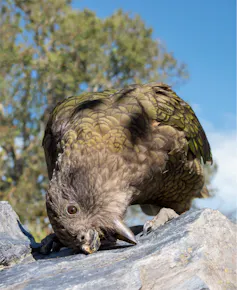
Without an upper beak, Bruce‘s disability should put him at a disadvantage. But necessity is the mother of invention and Bruce has developed many novel behaviours to compensate for the loss.
He uses sharp stones he carefully selects from within his enclosure as tools to help preen himself. Being the alpha male, he also solicits and receives grooming from subordinate males. This includes them carefully cleaning out food stuck in his lower beak.
Instead of masticating with his upper beak, Bruce also uses rocks, fence posts, human feet and any number of handy objects in his enclosure to grind food to a fleshy edible pulp.
Animal minds have much to teach us
Kea don’t typically use tools in nature, but they are known to be exceptional problem solvers, comparable to primates. This is possibly because they need to find food such as tubers buried underground or dig for grubs in rotting logs.
It is this very attribute of cleverness that suggests well-meaning humans who might otherwise attach a prosthetic to a disabled animal may actually be doing them a disservice. Bruce’s disability has forced him to overcome problems and flourish in doing so.
Perhaps the ability to innovate behaviours is restricted to animals with complex cognition and the capacity to overcome a disability through invention may be limited to very smart species.
However, recent research shows many animals – including a cow named Veronika that uses a stick to scratch herself – astonish us in developing new behaviours. I would not be surprised if we have further revelations ahead, not only from Bruce the kea or Veronika the cow, but from many animals, including bumblebees and possibly other invertebrates.
– ref. How Bruce the half-beak kea weaponised his disability to become the alpha bird – https://theconversation.com/how-bruce-the-half-beak-kea-weaponised-his-disability-to-become-the-alpha-bird-280993