Source: The Conversation (Au and NZ) – By Bamo Nouri, Honorary Research Fellow, Department of International Politics, City St George’s, University of London
Ceasefires are often presented as moments of relief – pauses in violence that open the door to diplomacy. But sometimes they reveal something more consequential: who has actually gained from the war. The emerging ceasefire between the US, Israel and Iran may be one of those moments.
On the surface, all sides are claiming success. Donald Trump has declared a “total and complete victory”, presenting the agreement as evidence that US objectives have been met. Meanwhile, Iran’s leadership has framed the ceasefire as a strategic achievement, with its Supreme National Security Council formally endorsing the deal on the condition that attacks stop.
But beneath these competing narratives lies a deeper reality: the content and structure of the ceasefire suggests that Iran may have emerged not weakened, but strengthened. While much of its senior leadership has been assassinated during the conflict, the regime’s ability to rapidly appoint replacements and maintain cohesion points to institutional resilience rather than collapse.
The ceasefire was not imposed by decisive military defeat. It was negotiated – and shaped – around Iranian conditions, delivering gains it previously did not have, with Tehran’s ten-point plan serving as a starting framework for negotiations rather than a finalised agreement being imposed on Iran.
Tehran’s proposals went beyond ending hostilities. They include sanctions relief, access to frozen assets, reconstruction support and continued influence over the Strait of Hormuz. They also include effective US withdrawal from the Middle East – and an end to Israeli attacks on Lebanon.The Strait of Hormuz, through which roughly one-fifth of global oil transits, has been reopened under Iranian oversight, a clear signal of where leverage now lies. Control over Hormuz is not just strategic but economic. Iran has reportedly proposed continuing the charging of transit fees it begin during the conflict – creating a potential revenue stream at precisely the moment reconstruction is needed.
In effect, a war that involved sustained bombing of Iranian infrastructure may now leave Iran with new financial mechanisms to rebuild and potentially expand its regional influence.
The logic is paradoxical but familiar. Military campaigns are designed to degrade an opponent’s capabilities. But when they fail to produce decisive political outcomes, they often create new opportunities for the targeted state. Iran entered this war already adapted to pressure. Years of sanctions had forced it to build resilience by diversifying networks, strengthening institutions and developing asymmetric strategies.
What the war appears to have done is accelerate that process. Rather than collapsing, Iran has demonstrated its ability to disrupt global energy markets, absorb sustained strikes and force negotiations on terms that include economic concessions.
Illusion of victory
This is where the dissonance in US messaging becomes most visible. The US president may have framed the ceasefire as a “complete victory” but, tellingly, while the ceasefire deal will involve the temporary reopening of the Strait of Hormuz, which has been the US president’s main demand in recent days, talks will centre on Iran’s ten-point plan rather than the original US 15-point plan, which centred on dismantling Iran’s nuclear and missile capabilities.
The shift suggests an American search for an off-ramp. At the same time, Iran has maintained a consistent position: rejecting temporary arrangements unless they deliver structural outcomes such as sanctions relief and security guarantees.
Read more: Iran war: the search for an ‘off ramp’
For Washington the ceasefire halts escalation and stabilises markets. For Tehran, it aims to consolidate the leverage offered by its control of the Strait of Hormuz. This asymmetry suggests the ceasefire is not a neutral pause, but a moment that could lock in a shift in regional power.
The most decisive dimension of this shift is economic. The war has destabilised global markets – with oil prices fluctuating sharply in response to disruptions of supply. But the ceasefire introduces a new dynamic. If sanctions are eased, Iran gains access to global markets at a time of sustained energy demand. Combined with potential transit revenues and reconstruction flows, this creates the conditions for a significant economic rebound.
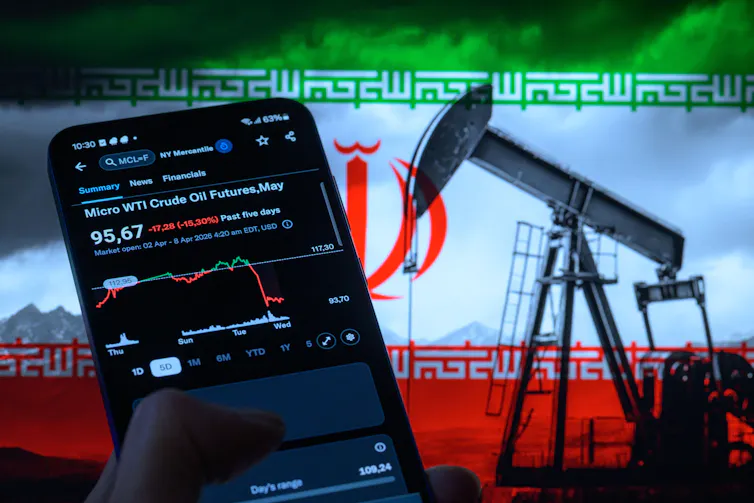
In effect, the war risks producing the opposite of its intended outcome. Rather than weakening Iran economically, it may instead have strengthened it.
A stronger Iran, a weaker order?
This raises a larger question: what does this ceasefire reveal about power itself? For decades, US influence in the Middle East has rested on military dominance and economic pressure. This conflict suggests both are under strain.
Militarily, the US and Israel have demonstrated overwhelming capability, yet without decisive outcomes. Iran has retained its core capacities, maintained cohesion and leveraged its position to shape deescalation.
At the same time, US and Israeli legitimacy has eroded. The war’s contested justification, civilian toll and lack of broad international support have weakened their standing, even among allies. American soft power – long central to its global leadership – is diminished. Trump’s increasingly abusive social media posts have certainly alienated even its closest allies, most of whom stayed silent in face of US threats.
Economically, Iran’s ability to influence – and potentially monetise – global energy flows gives it a form of structural power that force alone cannot neutralise. The result is a paradox: a war intended to contain Iran may have reinforced its strength.
It is still early. Ceasefires can collapse, negotiations can fail, and conflicts can reignite. But if this agreement holds – even temporarily – it may mark a turning point. Not because it ends the war, but because of what it reveals about how wars are now won and lost. Victory is no longer defined by battlefield dominance alone, but by outcomes that are economically sustainable, politically legitimate and strategically durable.
On those measures, Iran appears well positioned. The US and Israel may have demonstrated military superiority. But Iran has demonstrated something different: the ability to endure, adapt and convert pressure into leverage.
That’s why this ceasefire matters; not just as an end to a phase of conflict, but marking the moment when a war intended to weaken Iran instead left it stronger – and exposed the limits of the power that sought to contain it.
– ref. Middle East conflict: this ceasefire may have made Iran stronger – https://theconversation.com/middle-east-conflict-this-ceasefire-may-have-made-iran-stronger-280164