Source: The Conversation (Au and NZ) – By Adam Hartland, Adjunct Associate Professor in Freshwater Biogeochemistry, Lincoln University, New Zealand
The Waikato is New Zealand’s longest river, central to the identity and practices of Waikato River iwi and a source of drinking water for nearly half of the country’s population.
It is also becoming a case study in what happens when very different environmental pressures hit the same system faster than authorities can respond.
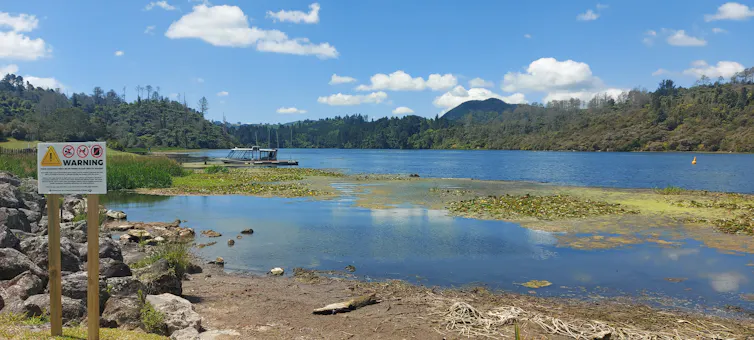
A recent RNZ investigation documented worsening toxic algal blooms in hydro lakes in the upper Waikato. Communities around Lake Ohakuri describe water so green it resembles the “Incredible Hulk”, dogs becoming violently ill and mats of toxic slime covering the surface.
These conditions are a long way from Te Ture Whaimana o te Awa o Waikato, the legislated vision for a river safe for swimming and gathering food.
Otherwise, interventions risk missing the mark. The Waikato cannot afford misdirected effort.
The location of the worst blooms is a clue. Lake Ohakuri sits right next to the Ohaaki-Broadlands geothermal field, where decades of extracting hot fluids for power generation have caused the ground to sink by nearly seven metres.
That geothermal activity releases heat, carbon dioxide (CO₂) and mineral-rich fluids into the water, all of which promote the growth of cyanobacteria. This includes iron, a nutrient toxic algae need to thrive.
Whether decades of fluid extraction have altered the rate of influx of CO₂ and iron remains untested, but the proximity to geothermal fields is striking.
Tracking downstream effects
Until now, no one has measured how much of the geothermal CO₂ actually dissolves in the river or how far downstream it travels.
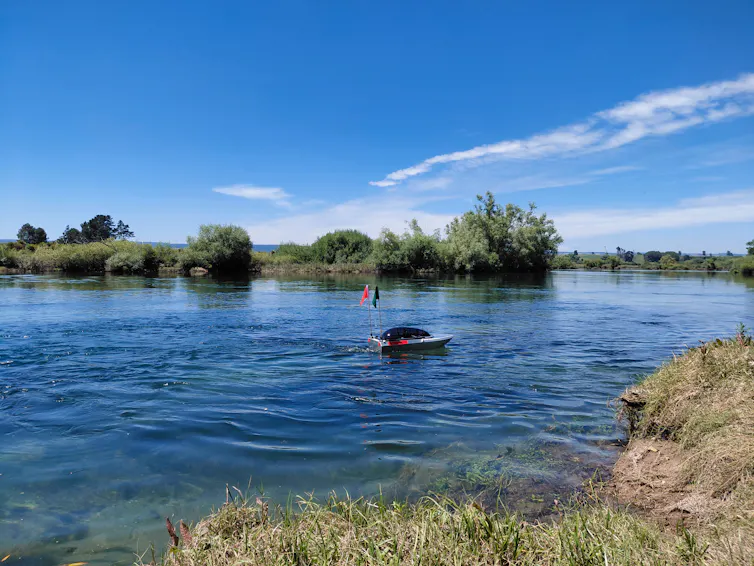
During our recent field campaign, we deployed a mobile sensor along the upper Waikato and a technique known as stable isotope analysis to fingerprint the carbon and start filling this gap.
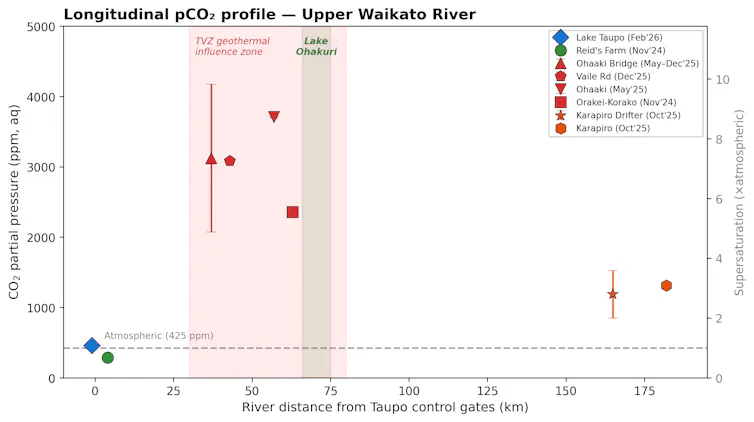
The results are stark.
Carbon dioxide concentrations in the geothermal zone reach ten times the background level and the isotopic signature confirms the source as volcanic, not biological.
Huge quantities of dissolved CO₂ escape into the atmosphere as the river passes through the hydro lake chain. The water does not return to background levels even by the time it reaches Lake Karāpiro more than a hundred kilometres away.
That lingering excess CO₂ could be feeding algal growth well beyond the volcanic zone.
The gold clam factor
The geothermal zone is not the only pressure point. The invasive gold clam (Corbicula fluminea) has rapidly colonised the Waikato since its detection in 2023.
The clams have now been confirmed as far upstream as Lake Maraetai, directly downstream of Ohakuri.
Our research, currently under review, shows the clams are stripping roughly 14 tonnes of calcium carbonate from the river every day, disrupting the water chemistry treatment plants rely on and releasing arsenic in forms that could slip through conventional treatment processes.
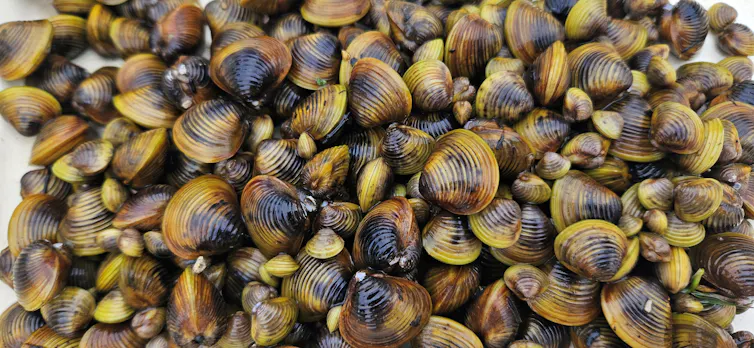
As the clams breathe, they pump carbon dioxide into the water and consume oxygen, tipping the river’s balance away from a system driven by plant-like photosynthesis (which produces oxygen) and toward one dominated by respiration (which releases CO₂).
Multiple pressures, compounding risk
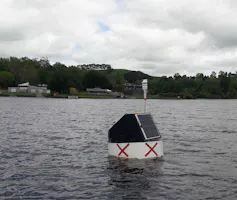
In January 2026, our monitoring buoy in Lake Karāpiro recorded oxygen near the lake bed dropping rapidly toward levels that would suffocate aquatic life.
What prevented a crisis was not management action but weather. Severe storms physically overturned the water column and mixed oxygen back in.
This near miss, averted by luck, is a warning, not a reassurance.
Two very different stressors are now converging on the same river. Geothermal CO₂ enriches the water from below, sustaining conditions that help toxic algae grow far downstream.
The clams, spreading upstream into the geothermal reaches, add a second source of CO₂ through their breathing, while depleting oxygen and stripping calcium.
What this double pressure will mean for algal blooms – when they form, how long they last and how severe they become – as clam populations continue to expand, is an open and urgent question.
Current monitoring cannot answer it. Toxic algae are sampled monthly at four hydro lakes, with results taking days to return. This is not a criticism of any single agency; national monitoring protocols now predate the compound pressures the river faces.
The gap between knowing and acting
The local community called for ultrasonic algae-killing buoys, webcams and flushing the lakes. This reflects an understandable desire for visible action, but without understanding the underlying drivers of blooms at these specific locations, we risk treating symptoms rather than causes.
Two million people drink water from the Waikato. Thousands swim in it, fish from it and gather mahinga kai (traditional food gathering) along its length. Iwi have obligations to it that stretch across generations.
The science is telling us, in real-time sensor data, that the system is moving toward thresholds we do not want to cross. The monitoring and governance architecture we have inherited was not designed for the compound pressures now acting on the river.
The question is whether we can build the governance and data-led operational protocols to match the pace of change, before the next bloom or near miss becomes the event we failed to prevent.
– ref. Toxic blooms and invasive clams are forcing a rethink on the Waikato River – https://theconversation.com/toxic-blooms-and-invasive-clams-are-forcing-a-rethink-on-the-waikato-river-279560