Source: The Conversation (Au and NZ) – By Peter Layton, Visiting Fellow, Strategic Studies, Griffith University
The Royal Australian Air Force (RAAF) is off to another Middle Eastern war, which is likely a surprise to many given how contentious the country’s involvement in the Iraq war was.
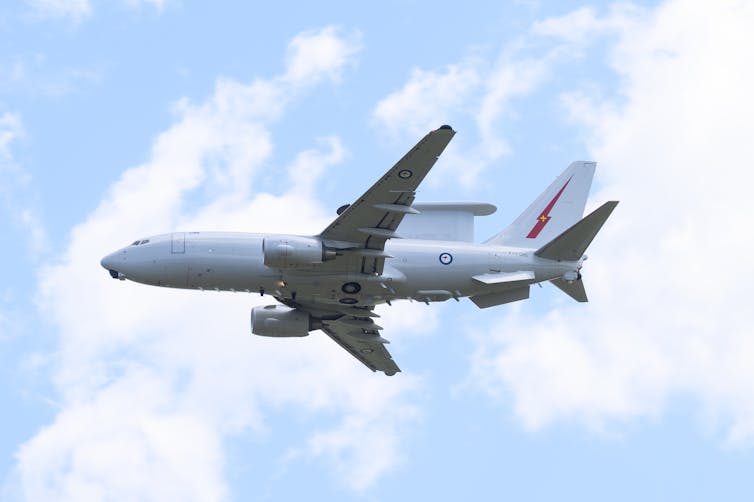
The Albanese government has decided to send a RAAF E-7A Wedgetail surveillance aircraft to the United Arab Emirates (UAE), along with 85 personnel and a supply of air-to-air missiles capable of shooting down drones.
Wedgetail aircraft have been sent on similar operations before, not just to the Middle East but most recently to Europe as part of the NATO mission to help Ukraine.
Australia recently agreed to an economic strategic partnership with the UAE, but this military deployment appears to be part of a defence cooperation agreement that dates back to 2007.
So, does this mean Australia is now entering the war by sending military assets, including personnel, to the region?Defensive role
The deployment, while doubtless agreeable to the Trump administration, is not intended to be part of the Israeli–US air offensive against Iran.
Rather, the E-7A Wedgetail will help the UAE defend itself after some ground-based, long-range air surveillance radar systems were damaged in attacks from Iran. The gap in surveillance coverage will be partly filled by the RAAF aircraft.
The aircraft is fitted with a high-performance air surveillance radar system and will be able to provide early warning of approaching air attacks, most likely from Iran’s Shahed drones.
The aircraft will do this by providing digital tracking data of incoming hostile aircraft and drones to the UAE’s surface-to-air missile systems and fighter aircraft, so they can respond.
The UAE has a very sophisticated air defence system that so far has intercepted over 1,000 Iranian ballistic missiles, cruise missiles and drones.
This extraordinarily large number of interceptions means its large stockpile of interceptor missiles is gradually being depleted. As a result, Australia is also transferring some of its AIM-120 advanced medium-range, air-to-air missiles (AMRAAM) to the UAE to help it intercept drones.
Australia placed a replenishment order to the United States for more of these missiles last year. The missiles now going to the UAE are probably older versions that have been in Australia’s stock for many years.
South Korea is rushing Cheongung-II interceptors to the UAE to help it defend against ballistic missiles, as well.
A history of air support in the region
The E-7A Wedgetail aircraft will presumably be deployed to the Al Minad airbase, some 40 kilometres south of Dubai. The Australian Defence Force has operated there since 2003. It maintains a small permanent presence at the base to support ADF operations across the Middle East.
Last week, the Albanese government announced it was deploying a C-17 large transport aircraft and a KC-30A air-to-air refuelling aircraft to the region. These planes are now assumed to be at Al Minad, too.
The RAAF previously deployed E-7A Wedgetail aircraft to the region from 2014–20 to support the US-led military operations against Islamic State in Iraq. The RAAF personnel going there now, therefore, will be quite experienced in operations in the region and the dangers involved.
The Al Minad airbase has already been hit by Iranian missiles and drones, but these had little effect.
Nevertheless, there is still a risk the E-7A Wedgetail could be damaged while parked at the air base.
Possible issues that could arise
This deployment does not mean Australia is entering a combat role in the war. It will instead have an enabling role – bolstering the UAE’s air defence.
Even though the E-7A Wedgetail has a clearly defensive purpose, the deployment could still be seen from the Iranian perspective as support for the US-Israeli air offensive.
In an indirect way, it could help the US. The RAAF deployment will reduce the need for the US to help defend the UAE, potentially freeing up US forces to strengthen its attacks on Iran. The Australian government’s messaging appears aimed at trying to avoid people drawing this conclusion.
More worryingly, Australia could potentially become enmeshed in other operations now that it has assets there.
For example, Iran has effectively shut down the Strait of Hormuz to shipping traffic, disrupting the flow of oil and gas to the world.
If the US Navy takes military action to forcibly open the strait, it is possible Australia could be called on to support this, initially using the E-7A Wedgetail already in place.
French President Emmanuel Macron has said his country and its European allies are preparing a “purely defensive” mission to escort ships through the strait once the “most intense phase” of the war ends.
Australia could be asked to join this effort, as well, putting its aircraft at risk of attack from Iran. Given Australia’s oil supplies and fuel costs are greatly impacted by the closure of the strait, the government would find it difficult to say no.
The deployment of the E-7A Wedgetail may then be an early warning that Australian military involvement in the Middle East is about to escalate as it did with the wars in Iraq and Afghanistan, and against Islamic State.
Like the Persian Gulf nations, Australia could become trapped and dependent on decisions that will be “mutually” taken by US President Donald Trump and Israeli Prime Minister Benjamin Netanyahu.
– ref. Australia is sending an aircraft and personnel to the Middle East. Does this mean we are entering the war? – https://theconversation.com/australia-is-sending-an-aircraft-and-personnel-to-the-middle-east-does-this-mean-we-are-entering-the-war-277958