Source: The Conversation (Au and NZ) – By Nick Bisley, Dean of Humanities and Social Sciences and Professor of International Relations at La Trobe University., La Trobe University
Australia faces a more complex and dangerous world than at any time since the threat of Japanese invasion during the second world war.
The global economy is being scrambled by the Trump administration’s weaponisation of the trade regime, rising protectionism and efforts to reduce supply chain vulnerabilities. The United States has soured on old alliances, threatened takeovers of neighbours and withdrawn from global institutions.
And it’s just started another war in the Middle East that threatens to engulf the entire region.
In response to US President Donald Trump’s recent actions, Canadian Prime Minister Mark Carney has made a full-throated appeal for middle powers to build a better global order in the face of the current “rupture” of the old ways.
Australia’s leaders, by comparison, have been circumspect – conservative even – about the challenges we face. Wittingly or not, Australia’s words and deeds embody a strategy of cautious incrementalism that is at odds with an era of radical change.
The world order has “ruptured”, Canadian Prime Minister Mark Carney has warned – so it’s time for countries like Australia and New Zealand to forge a new, less US-reliant future. In this six-part series, we’ve asked top experts to explain what that future could look like – and the challenges that lie ahead.
Hitching our wagon to a diminishing power
It some respects, this should not surprising. Inertia is strong in Australian politics. The electoral incentive for bold foreign policy is not.
And the relationship with the United States was so good for so long.
It is hard to imagine a better partner for Canberra than the US, as it once was. The two shared liberal values, cultures and core interests. Washington provided security backed by its world-leading military, technology and intelligence advantages. The US has long been a top trade and investment partner. And it once underpinned a rules-based and open economic order.
Australian leaders organised their foreign policy on the assumption the US would always remain the region’s dominant power and would always follow the same basic path in its international policy.
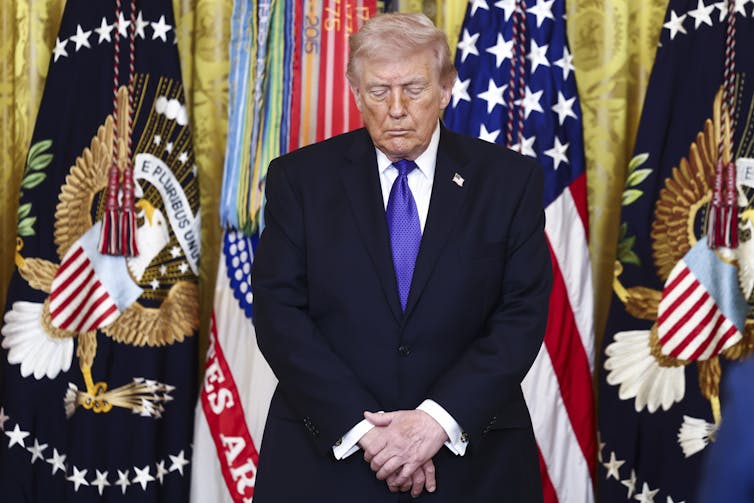
We can no longer afford this complacency. Washington has definitively turned its back on a liberal approach to trade. Trump’s White House is contemptuous of rules, and views agreements and alliances as “deals” that can be leveraged or suddenly discarded. The restraint and respect that had been central to its foreign policy has been junked.

The domestic sources of this illiberal turn have deep roots and will remain central to US politics long after Trump has left the stage. Trump is not a short-term problem that can be waited out.
Perhaps less well recognised is the fact the US will soon have fewer advantages than before. Over the coming years, it will be a less dominant power on every conceivable measure. From hard military power and cutting-edge technology to global output and soft power, China (and others) are fast catching up. In some areas, the US has already been surpassed.
By attacking its universities and research institutions and making foreigners unwelcome, the Trump administration is further undercutting its advantage.
Allies and partners will be bound to a diminished, less globally engaged and less interested America. Carney realises this. Australia should, too.
3 steps towards a new path
How should Australia begin to navigate this new world?
Foreign Minister Penny Wong is fond of saying Australia needs to know what it wants in the world and be confident in its abilities.
The country’s core interests remain a stable and favourable balance of power in Asia, the international rule of law overseen by multilateral institutions, and an open and rules-based global economy.
The problem for Australia is the US no longer shares these interests in the same way. We need to think about different ways to achieve these goals.
This begins with an honest recognition of the changing direction of US policy, stated plainly and directly.
This does not mean a provocative belling of the Trumpian cat. Australia has an enduring alliance with the US and it makes no sense to break with that entirely. But it also benefits no one to profess in public the beliefs that everyone knows are not held in private.
Australia needs to develop what I have called a “US plus one” foreign policy. This means we advance our international interests while diversifying the risks of a newly transactional relationship with the US.
There are three immediate priorities for Australia to focus on.
1) Avoid isolationism
The first is to resist the temptations of protectionism and work with others to buttress liberal and rules-based settings for international trade.
When the first Trump administration tried to hobble the World Trade Organization (WTO) by blocking new appointments to its appellate body in 2017, members who valued the benefits of impartial dispute settlement created a new body. It has helped many nations resolve their trading differences.
This an example of the kind of creative diplomacy Australia should lead.
2) Revitalise international institutions
Australia should develop a coalition of multilateral-minded states to reinvigorate the institutions that give the majority of the world’s middle and small powers a voice in setting the rules.
The bulk of the current institutions, such as the WTO, the International Monetary Fund and the United Nations, have ossified. The current crisis is precisely the kind of catalyst needed to prompt urgent action.
3) Build resilience
Australia also needs to develop greater resilience in its military and economy. This is not a call for protectionism but an emphasis on the need to be able to do more for ourselves and have as much strategic flexibility as possible.
This includes developing a military that is not only more capable, but built from more diverse suppliers. It also entails developing a framework for economic resilience that is shaped by Australia’s vital interests.
This is a generational task, but it must begin immediately.
Being clear about a vision
Australia has become too dependent on the idea of the US as the guarantor of the international order. We failed to recognise that Trump’s rise to power in 2016 was not an accident – the country on which we had pinned our future had changed.
It is time for Canberra to acknowledge this and take confident steps to chart our own course and reduce our dependence on others.
It is important our leaders articulate a clear vision for Australia’s place in the world. The challenge we face is epochal in scale and the public must understand what confronts us.
– ref. Australia can no longer be complacent about Trump’s America. It’s time to chart a new course – https://theconversation.com/australia-can-no-longer-be-complacent-about-trumps-america-its-time-to-chart-a-new-course-276530