Source: The Conversation (Au and NZ) – By Jonathan Tonkin, Professor of Ecology and Rutherford Discovery Fellow, University of Canterbury
In the summer of 2022, extreme heat and unprecedented drought drove parts of the world’s third largest river, the Yangtze, to dry up.
The impacts for hydropower, shipping and industry in China were severe, immediate and well-documented. Less visible were the ecological consequences for the many species that depend on the river.
The Yangtze is not an exception. Around the world, rivers are no longer changing gradually.
Rather, they are being increasingly transformed by extreme climatic events such as floods, droughts and heatwaves. Our newly published global review finds these events are pushing ecosystems beyond their limits and eroding biodiversity and core functions.
In bringing together global evidence, our research sets out a roadmap for how science and management can respond to these mounting ecological pressures.When impacts cascade
Because rivers are connected systems, impacts rarely remain localised. Extreme climatic events can send impacts cascading through entire river networks, affecting communities far from where they begin.
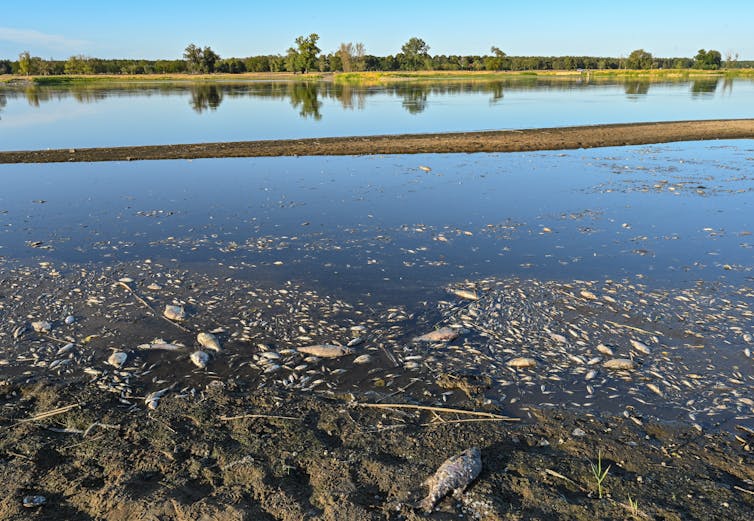
A drought in headwaters can disrupt downstream processes for months, and when flows return, built-up material can trigger oxygen crashes and fish kills far downstream.
Recovery is often uneven and incomplete, with some species lost and communities permanently changed, especially where rivers are fragmented and species cannot escape to refuges or are lured into traps.
The consequences can be profound: extreme events can push ecosystems past tipping points, after which full recovery is unlikely and systems may follow new paths instead of returning to their past states.
In some cases, even the most ambitious restoration efforts of recent decades may struggle to reverse biodiversity loss if the frequency of extremes continues to rise.
Our review also shows that when extreme events happen together or in sequence – known as compound events – their impacts can be catastrophic for people and river biodiversity.
Whether that’s a flood following a drought, a drought and heatwave operating in unison, or a flood falling on saturated ground, the impacts of these compound events can multiply.
The Yangtze drought and heatwave collapsed plankton communities, while in New Mexico in 2011, wildfire followed by heavy rain damaged water quality in the Rio Grande far downstream. Repeated extremes were shown to have altered invertebrate communities in Alaska’s Wolf Point Creek for more than a decade.
In Europe’s Rhône River, a major heatwave in 2003 brought an increase in invasive species, which was amplified by damaging floods that followed. In California’s Klamath River, a wildfire and intense rain in 2022 led to widespread river failure and a long fish kill zone.
These impacts are often made worse by existing pressures such as pollution, land-use change and water withdrawals – as seen in the 2022 Oder River disaster in Germany and recent repeated die-offs in Australia’s Murray-Darling Basin.
Importantly, the severity of ecological impacts aren’t always proportional to that of the event that causes them. Instead, it is the order of events and existing stresses that often drive outsized impacts that are hard to predict and manage.
Moving from reactive to proactive
While extreme events are stretching the resilience of river ecosystems, they are also exposing gaps in the science needed to design lasting ecological solutions.
Right now, studying the effects of these events is challenging for researchers because they tend to strike without warning. As a result, the evidence base remains limited and also unevenly spread around the world.
For water managers, this creates real uncertainty about how to prepare river biodiversity for extreme events.
One common idea is to protect safe havens, such as cold streams, deep pools or shaded tributaries, which can offer species short-term relief from heat and drought.
Because of this, safeguarding these refuges is widely seen as a key part of river management. Nevertheless, questions are emerging about whether these refuges will persist or remain viable during extreme events.
Simply put, compounding extreme heatwaves and drought not only warm rivers, but also undermine the processes that create thermal refuges for freshwater species.
Engineered thermal refuges, such as via groundwater pumping or gravel trenches, are starting to show promise in early trials.
But better preparation for extreme events will require more proactive approaches, guided by adaptive frameworks such as the widely-used “resist-accept-direct” strategy.
This can mean building river resilience through habitat restoration, better connectivity, giving rivers more room to move and protecting or creating cold-water refuges at a catchment scale.
A mix of nature-based solutions and hard engineering will be needed. Approaches that restore connectivity and protect groundwater recharge zones are increasingly seen as some of the most effective ways to tackle the linked ecological challenges ahead.
Whatever tools are used, the bigger shift must be from local, reactive fixes to catchment-scale, resilience-focused strategies that anticipate extreme events rather than respond to them after the fact.
Rivers support billions of people but remain among the least protected parts of the natural world, and we urgently need to prepare them for a more extreme future.
– ref. Extreme weather is transforming the world’s rivers. We need new ways to protect them – https://theconversation.com/extreme-weather-is-transforming-the-worlds-rivers-we-need-new-ways-to-protect-them-276358