Source: The Conversation (Au and NZ) – By Danusha Jayawardana, Research Fellow in Health Economics, Monash University
Where kids are born in a family can be important. But it is not just about who gets more grown-up privileges or parental pressure.
Research tells us firstborn children, on average, tend to do better on a range of outcomes. This includes doing better at school and being more likely to be top managers when compared to those born later.
In our new study, we looked at what impact birth order might have on how children spend their time. Both on their own and with their parents.
This revealed differences in terms of screen use and time spent enriching their intellectual development.
Our research
In our study, we used survey data from around 5,500 Australian children aged two to 15. The data comes from the Longitudinal Study of Australian Children, a nationally representative survey.
This included detailed 24-hour diaries, which recorded how children spent their time from waking up to going to sleep. They specified if activities were done with parents or independently.
We grouped activities into “sleep”, “school time”, “enrichment activities”, “screen time” and “physical activities”.
Enrichment activities are outside of school activities that help intellectual development. For example, reading, homework, playing board games or learning a musical instrument.
We then compared the diaries of firstborn children to later-born children from different families born in the same year, living in the same neighbourhoods, with similar socioeconomic backgrounds. All families had two or three children.
There is no similar data (such as time use records over years) available on siblings within the same family to capture and compare what siblings were doing at the same age.
Other studies looking at different outcomes (such as academic achievement) have shown birth order comparisons within a family are extremely similar to birth order comparisons across different families, once you adjust for family size, as we have done in our study.
So, it is likely our results would be similar to actual sibling comparisons within a family.
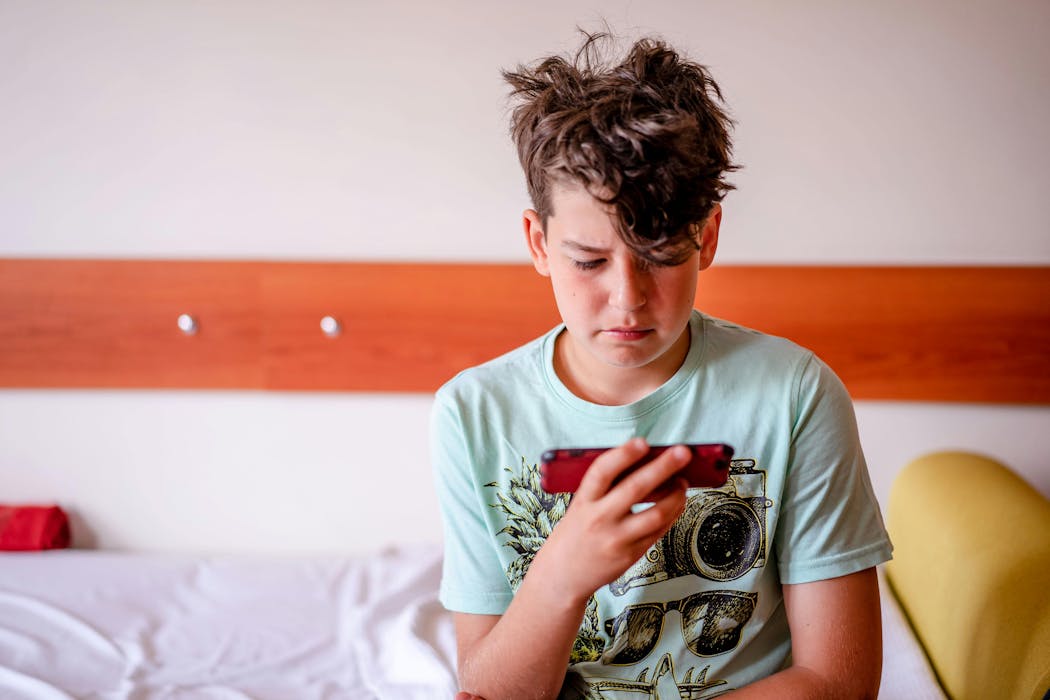
Younger kids get more screens
When compared to firstborn children, second- and thirdborn children spend an extra nine and 14 minutes, respectively, per day having screen time.
While this may sound modest, it represents a 7–10% increase compared to the average daily screen time of firstborns. Over the course of a week it is between about one and 1.5 hours.
This extra screen time also comes at the cost of other activities. In particular, later-born children spent 11 to 18 minutes less per day on enrichment activities, an 11–20% reduction compared to older siblings in the study.
We found no consistent differences between older and younger siblings when it came to time spent on other activities, such as school, physical activity or sleep.
Looking across age groups, the effects are generally greater for 10–14-year-old children. This suggests early adolescence is a period where particular attention is needed.
To check whether these patterns extend beyond Australia, we repeated the analysis using time-use diaries from a sample of children in the United States. The results were similar.
Why is this happening?
One common explanation for differences between first and subsequent children is parental time. As families grow, parents have less time and attention to foster subsequent children’s development.
However, this may not be the whole story. Our study showed later-born children did spend less time on enrichment activities with their parents. But about half of the difference comes from later-born children spending less time on enrichment activities on their own.
Screen time shows a similar pattern. The increase among later-born children is largely explained by activities they do alone, rather than with parents or siblings.
So this also reflects differences in children’s own choices or opportunities, not just direct parental involvement. For example, a younger sibling may have more freedom to choose to play video games rather than do their homework.
Of course parenting may still play an important role here. Our study shows later-born children face fewer rules around screen use, such as limits on programs or time, and are less likely to feel their parents expect them to follow rules. This may in part reflect parents’ desire for fairness in allowing similar use of screens for siblings at any given time, rather than at specific ages.
What does this mean?
The differences we find may seem small on any given day.
But they can add up over time. As our 2024 study showed, spending more time on screens and less time on reading, homework or other learning activities can lead to gaps in academic skill development over childhood, as measured by lower NAPLAN test scores.
The increase in solo screen time for later-born children is particularly concerning, because it may expose children to inappropriate content online.
What can we do?
First, recognising later-born children on average spend more time on screens and less time on enrichment activities than firstborns can be helpful for informing parenting strategies.
Second, it shows spending quality time with later-born children, actively encouraging enrichment activities, and keeping consistent rules around screen time all matter.
Finally, this suggests broader policies, such as the social media limits for under 16s, could help equalise opportunities for later-born children to learn and grow.

Gawain Heckley receives funding from the Swedish Research Council for Health, Working Life and Welfare (dnr 2023-01128).
Nicole Black receives funding from the Australian Research Council.
Danusha Jayawardana does not work for, consult, own shares in or receive funding from any company or organisation that would benefit from this article, and has disclosed no relevant affiliations beyond their academic appointment.
– ref. Our study shows younger siblings spend more time on screens than big sisters and brothers – https://theconversation.com/our-study-shows-younger-siblings-spend-more-time-on-screens-than-big-sisters-and-brothers-273904