Source: The Conversation (Au and NZ) – By Serena Love, Honorary Research Fellow in Archaeology, The University of Queensland
In ancient Egypt, what was the Sphinx all about? – Effie, age 8, New Plymouth, New Zealand.
One of the most mysterious and iconic monuments of ancient Egypt is the Great Sphinx of Giza.
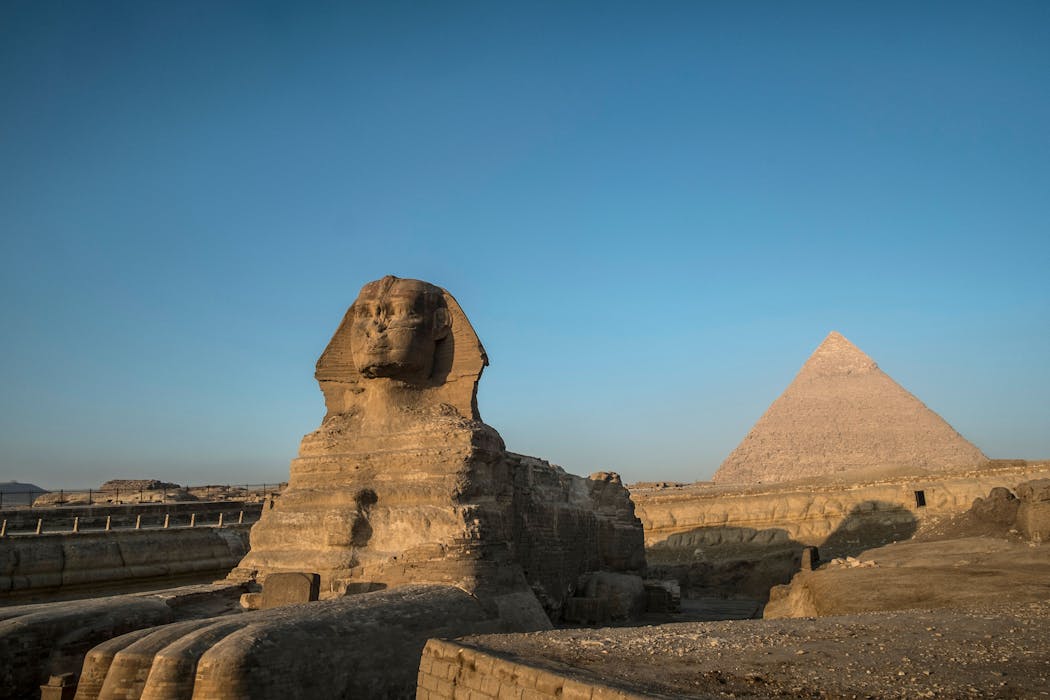
You’ve probably seen pictures of it — a huge statue with a lion’s body and a human head, sitting proudly near the Great Pyramids.
But what is the Sphinx? Why was it built? And what does it mean?
What is the Sphinx?
The Great Sphinx is a giant stone statue carved from the limestone bedrock.
It lies on the Giza plateau, on the west bank of the Nile River, near Cairo in Egypt.
The Sphinx is enormous — about 73 metres long (that’s longer than a football field!) and 20 metres tall, roughly the height of a five-story building.
It was carved around 4,500 years ago during the time of the Old Kingdom, the earliest days of ancient Egyptian civilisation.
The word “sphinx” itself comes from ancient Greek, but the Egyptians had another name for it.
They called it “shesep-ankh”, which means “living image”.
This name gives us a clue to what the statue meant to the people who built it. They saw the Sphinx as a living symbol of something powerful and divine.
The face of a pharaoh
If you look closely at the Sphinx, you’ll notice its face looks human.
Most Egyptian experts believe the face was carved to look like a real person — a pharaoh named Khafre. But there is some strong evidence to suggest it might have been started by his father, Khufu.
Pharaohs were the rulers of Egypt, considered half-human and half-god. They built great monuments to show their power and to help their souls live forever in the afterlife.
Pharaoh Khafre built the second of the three pyramids at Giza.
The Sphinx sits right next to his pyramid complex, which makes many historians think it was built to watch over his tomb.
The Sphinx, then, may show the pharaoh as a guardian — strong like a lion, but wise and godlike like a human.
The body of a lion
The body of the Sphinx is that of a lion, an animal the Egyptians admired for its strength and courage.
Lions were seen as protectors and symbols of power. They watched over sacred places, palaces, and tombs. So, when the ancient sculptors shaped the Sphinx from bedrock, they combined the mind of a pharaoh with the strength and power of a lion.
This mixture created a super powerful guardian creature — one that could protect Egypt and its kings for eternity.

Photo by KHALED DESOUKI/AFP via Getty Images
Guardian of the horizon
Some ancient texts call the Sphinx “Hor-em-akhet”, which means “Horus of the Horizon”.
Horus was one of the most important gods in Egypt, often shown as a falcon who ruled the sky. Calling the Sphinx “Horus of the Horizon” suggests it was seen as an image of the rising sun — a divine protector connected to light, kingship, and rebirth.
If you stand in front of the Sphinx at sunrise, you can see how it faces directly east, toward the rising sun. This was likely no accident.
Ancient Egyptians carefully aligned their temples and monuments with the stars and the sun because they believed these heavenly bodies connected their world to the gods.
The Sphinx was part of a sacred plan linking earth, sky, and eternity.
The changing Sphinx
Over thousands of years, wind and sand have changed the way the Sphinx looks.
Its nose and beard are missing, parts of its headdress are damaged, and its body has been worn down by the desert.
But pieces of the Sphinx’s beard have been found and are now in museums. Some even say the statue was once brightly painted — red on the face, blue and yellow on the headdress.
Many Egyptians and travellers continued to visit and protect the Sphinx long after it was built. Pharaohs and priests repaired it many times.
One famous story tells how a young prince named Thutmose IV took a nap in front of the buried Sphinx, which had been buried up to the neck by drifting desert sands. In a dream, the Sphinx spoke to him, promising that if he cleared away the sand and restored the statue, he would one day be king.
The prince did as he was told — and he did become pharaoh! To honour the Sphinx, he placed a large stone tablet, or “stela”, between its paws. That inscription still stands there today.
A symbol of mystery
Even after all this time, the Sphinx keeps many secrets. We still don’t know exactly how long it took to carve, why its features were chosen, or if we have interpreted the symbolism correctly.
Some legends say the Sphinx guards a hidden chamber or treasures buried beneath it. Archaeologists haven’t found a treasure room, but modern scans have revealed small cavities and tunnels inside the bedrock — proof that the Sphinx still has more stories to tell.
Today, people travel from all over the world to see the Sphinx. It teaches a powerful lesson: even thousands of years ago, people were dreamers, builders, and artists. They asked big questions about life, death, and eternity — just like we do today.

Serena Love does not work for, consult, own shares in or receive funding from any company or organisation that would benefit from this article, and has disclosed no relevant affiliations beyond their academic appointment.
– ref. Curious Kids: in ancient Egypt, what was the Sphinx all about? – https://theconversation.com/curious-kids-in-ancient-egypt-what-was-the-sphinx-all-about-268182