Source: The Conversation (Au and NZ) – By Yanyan Hong, Adjunct Fellow in Communication, Media and Film Studies, Adelaide University
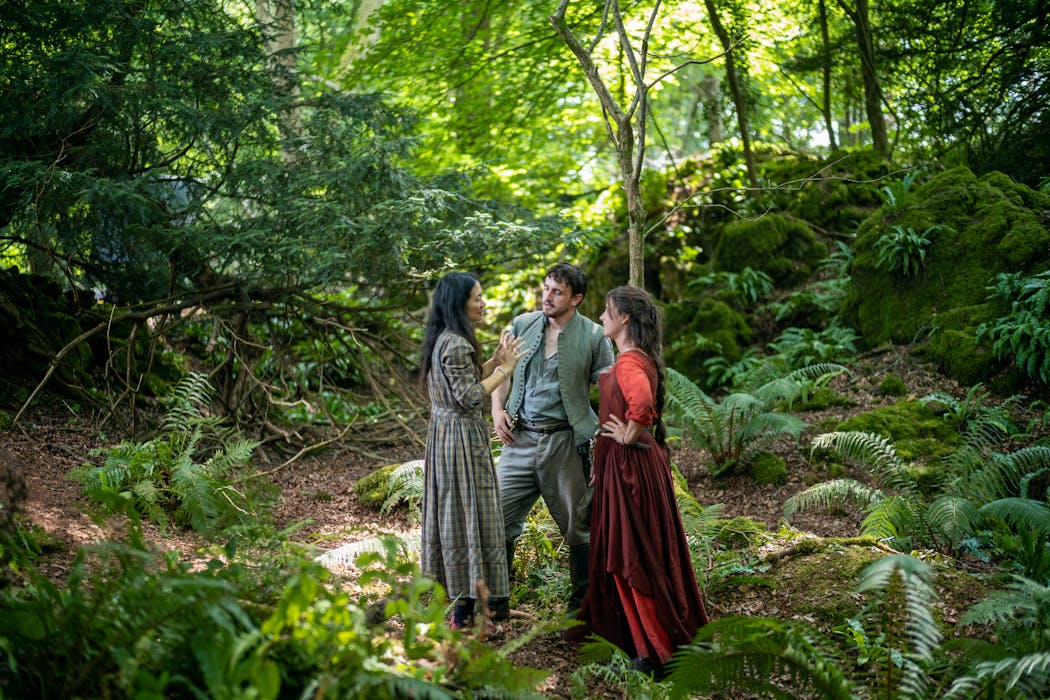
In Hamnet, Agnes Hathaway (Jessie Buckley) asks William Shakespeare (Paul Mescal) to introduce himself by telling her a story. It is her way of seeing who this man really is.
Here, storytelling becomes a mirror held up to the heart. Are we, as human beings, moved by the same things? Are our hearts shaped from the same material?
Chloé Zhao knows how to make people feel. Hamnet sees a new phrase in her artistry, turning a Western literary classic into a quiet meditation on grief, love and the enduring power of art.
From Beijing to the world
Born in Beijing in 1982, as a child Chloé Zhao (赵婷, Zhào Tíng) loved manga, drawn to Japanese Shinto ideas, where every object carries a spirit.
She wrote fan fiction, went to movies and fell in love with Wong Kar-wai’s Happy Together (1997), a life-changing film she still rewatches.
At 14, she was sent to a boarding school in England, speaking almost no English. The isolation forced her to look beyond language. “A smile is a smile, a touch is a touch,” she later told the BBC. That attentiveness to gesture and silence became a signature of her filmmaking.
Allured by Hollywood, Zhao moved to Los Angeles for high school, then studied political science at college. She eventually found her way to cinema at New York University, where Spike Lee encouraged her to trust her own voice.
Open landscapes to inner lives
In 2015, Zhao started directing small-scale, slow-burn features set in the American heartland.
Songs My Brothers Taught Me (2015) and The Rider (2017) capture the vast, lunar beauty of South Dakota’s badlands and the dignity of the people who live there. She often used non-professional actors, achieving a documentary-like naturalism.
Nomadland (2020), her third film, brought this style to a global audience. The story is about a stoic, hard-working widow in her early 60s who loses everything in the Great Recession and finds a new life on the road.
Receiving the Oscar for best director, she quoted a classic Chinese text teaching Confucian morality, history and basic knowledge: “people at birth are inherently good (人之初,性本善)”.
By focusing on nomads, cowboys and Indigenous communities, her first three films make space for those who are rarely seen.
“I’ve spent my whole life telling stories about people who feel separated, who feel they don’t belong,” she said, linking that to her own experience as “an outsider”.
With Hamnet, that sensibility turns inward. The immense skies and wide-open landscapes are replaced by forests, quiet rooms and the raw inner world of parental grief.
Through East and West
That Shakespeare, the wellspring of Britain’s national mythology, is being reinvented by an Asian director is striking.
Zhao initially turned down adapting and directing Hamnet, as she neither grow up with Western reverence for Shakespeare nor felt a cultural connection to his grief-filled family life. But after reading Maggie O’Farrell’s book, she felt something intimate and universal that drew her in.
Her approach to demystifying that feeling reflects a sensibility shaped equally by Eastern and Western philosophy.

Agata Grzybowska © 2025 Focus Features
From the Chinese practice of qi (气, life force), Zhao shows life flowing through wind, breath and Agnes’s bond with the forest, where she gives birth to her first child.
From the Hindu Tantra, she blurs the line between the actors and their surroundings, showing the world as an extension of the self.
From the ideas of Carl Jung, she explores opposing forces within the self, guiding the actors to reveal both masculine and feminine qualities in Agnes and William.
All three of these philosophies talk of accessing deeper wisdom within the self and the symbolic nature of creation.
Zhao also assigns chakra colours to Hamnet’s protagonists. In Hindu and Buddhist traditions, chakras are energy centres in the body, each linked to a colour and connected to physical, emotional and spiritual wellbeing.
In Zhao’s telling, Shakespeare often appears in blue, echoing the colour of throat and third-eye chakras, which symbolises openness, clarity and intuition. Agnes appears in red, reflecting the root chakra: the beating heart of the earth. This visual language also draws from Taoist philosophy, which understands humans as existing within nature.
Like Ang Lee, Zhao brings an East Asian sensitivity to interiority and emotional restraint. Both filmmakers have bridged art-house cinema and mainstream Hollywood, achieving rare critical recognition while remaining deeply focused on human experience.
The deeply human
Hamnet imagines the world surrounding Shakespeare and his wild-hearted wife, Agnes, and the tragic death of their 11-year-old son from the plague.
In the final sequence of the film, we watch the first performance of Hamlet. Their son returns on stage as the prince, speaking lines Shakespeare has written out of loss.
As Hamlet is poisoned, the audience inside the theatre – nobles and labourers alike – break into tears. They do not know the child behind the character, but they feel loss all the same.

Focus Features
Among them stands Agnes. Through her eyes, we see how art turns personal sorrow into something others can share. She alone recognises that the story being told is a memory. The woman history remembers merely as “Shakespeare’s wife” becomes the very soul of Hamnet.
Hamnet, in Zhao’s retelling, is not an escape from pain but a way of living with it. Buckley’s stirring performance feels not only Oscar-worthy, but emblematic of Zhao’s humanist cinema.
Her cinema reminds us of what cannot be automated: the deeply human capacity to feel, to grieve and to love.

Yanyan Hong does not work for, consult, own shares in or receive funding from any company or organisation that would benefit from this article, and has disclosed no relevant affiliations beyond their academic appointment.
– ref. Shakespeare reinvented: how Chloé Zhao blends East and West philosophies in Hamnet – https://theconversation.com/shakespeare-reinvented-how-chloe-zhao-blends-east-and-west-philosophies-in-hamnet-273352