Source: The Conversation (Au and NZ) – By David Larkin, Senior Lecturer in Musicology, University of Sydney
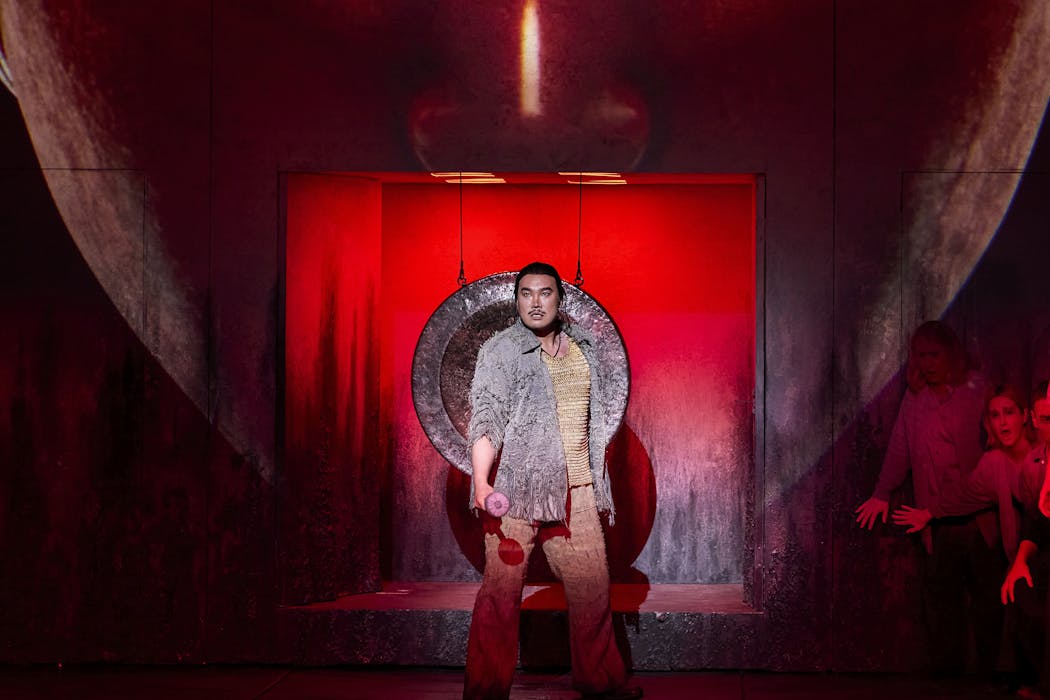
Were operas to be identified like episodes of Friends, Turandot would be “the one with Nessun Dorma”.
This beloved tenor aria has achieved a life of its own away from its parent opera. Consequently, it is often front and centre in the marketing for performances of Puccini’s final work. Even Ann Yee, the director of the new Opera Australia production of Turandot, claims in her program note not to have known anything else from the opera before 2022.
We have to wait until act three for the killer number, even though Puccini provides a kind of teaser for it late in act two – as if to reassure patrons it’s worth coming back after the interval.
Given all this build-up, it is a relief to report on opening night, Young Woo Kim absolutely nailed it, bringing a heady mixture of power and sensitivity to his portrayal of the character of Calaf.
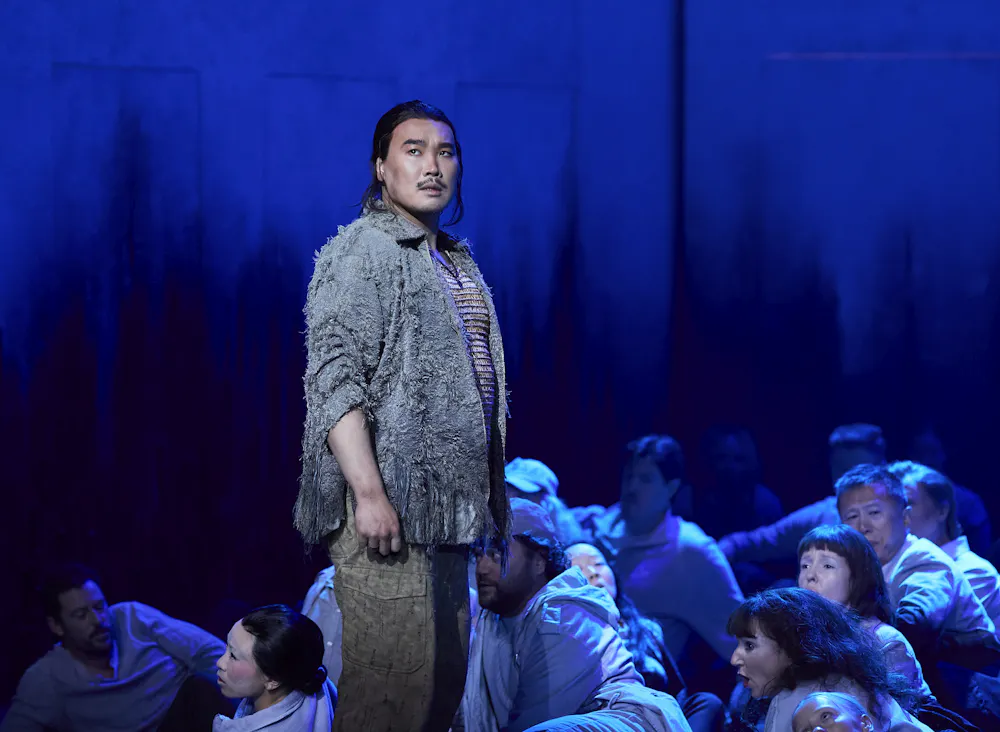
Opera Australia © Keith Saunders
A tale of trauma
Nothing else in the production quite comes up to this level, although there are other good things about both staging and singing.
Yee’s intriguing take on the opera focusses on the notion of intergenerational trauma. In Turandot’s big number, In questa reggia (In this kingdom) we learn of the rape and murder of her ancestor, Lou-Ling. The memory of Lou-Ling has determined Turadot’s cruel practice of executing would-be suitors who cannot answer her riddles.
Unusually, here this ancestor is turned into an actual character on stage, danced by Hoyori Maruo. Before a note is heard, we see Maruo mime the attack on the ancient princess, writhing, hurling herself acrobatically around the stage, and finally sinking into Turandot’s arms, blood pouring from her mouth. Thereafter she returns periodically, visible only to Turandot, her succesor.

Opera Australia © Keith Saunders
Perhaps to avoid initiating another round of trauma in the audience, this production dispenses with the torture of Liù, the young slave girl. Instead, the principals stand far apart from each other in this scene.
Thematically, this renders Turandot less of a monster than in other productions. Dramatically, it makes Liù’s anguished cries and suicide seem unmotivated and faintly ridiculous.
Understated design and performances
Set design by Elizabeth Gadsby is somewhat bare, even drab – at least when compared to the likes of Franco Zeffirelli’s sumptuous visual feast, still being revived at the Met nearly 40 years after it premiered.
Most striking is the enormous stylised mask of Turandot herself, projected onto the back wall (video designer Andrew Thomas Huang). This changes colour, dissolves and reappears as necessary, before symbolically breaking into pieces after Calaf correctly guesses the answer to the third riddle.

Opera Australia © Keith Saunders
Costumes (David Fleischer) are again deliberately understated. Turandot is in black almost throughout; the Emperor looked like Chevy Chase cosplaying as Mao Zedong; the crowds were factory workers in two-tone garb.
The presence of dancers clad in sparkly blue seaweed during the riddle season is a puzzle. The persistent use of choreographed gesture from these and other non-singers during solo numbers becomes a little tedious after a while, speaking to a lack of confidence in the power of the music and acting to retain the audience’s interest.
In the title role, Rebecca Nash conveys well the sense of historical pain that guides her actions and her transition in the final scene from despairing tyrant to newly awakened lover is convincing. Vocally she came through well, although up top things were a little vague courtesy of a generous vibrato.

Opera Australia © Keith Saunders
Maria Teresa Leva as Liù really comes into her own in act three after a less-than-stellar Signore, ascolta in act one.
Richard Anderson is secure and pathetic as the blind Timur; Shane Lowrencev a solid Speaker; and Gregory Brown an underpowered Emperor – perhaps a deliberate choice, given the character’s heart attack during the closing seconds of act two. The chorus and orchestra under new conductor Henrik Nánási were solid all night, with the children’s chorus worthy of special commendation.
A reinterpretation
When Turandot was put on at the Sydney Opera House in 2022, it aroused some controversy for its alleged use of “yellow face”. That production, a revival of Graeme Murphy’s classic from the 1990s, has now been replaced by this new, firmly de-orientalised version.
The trigger point four years ago was the costuming of Ping, Pang and Pong (the grand chancellor, general purveyor and chief cook, respectively), a largely indistinguishable trio providing comic relief.
There are no obvious changes in the sung text, but here their names are rendered in the surtitles as P1, P2 and P3. Instead of flowing robes and exaggerated facial hair, they are tech assistants sporting fanny packs and walkie talkies.

Opera Australia © Keith Saunders
As these characters, Luke Gabbedy, John Longmuir and Michael Petruccelli provide chuckles and sound ensemble singing, particularly at the start of act two, where they are positioned high up on a wall of circuitry and screens.
But the tenor Kim is the undoubted star of the show, with his powerful, burnished notes soaring effortlessly across the orchestra all evening. “Vincerò!” (I will be victorious) he sings at the end of Nessun Dorma: the applause which followed told him he had already won.
Turandot is at the Sydney Opera House for Opera Australia until March 27.

David Larkin does not work for, consult, own shares in or receive funding from any company or organisation that would benefit from this article, and has disclosed no relevant affiliations beyond their academic appointment.
– ref. In a new production of Turandot, Opera Australia has found a star vehicle for Young Woo Kim – https://theconversation.com/in-a-new-production-of-turandot-opera-australia-has-found-a-star-vehicle-for-young-woo-kim-271301