Source: The Conversation (Au and NZ) – By David Bowman, Professor of Pyrogeography and Fire Science, University of Tasmania
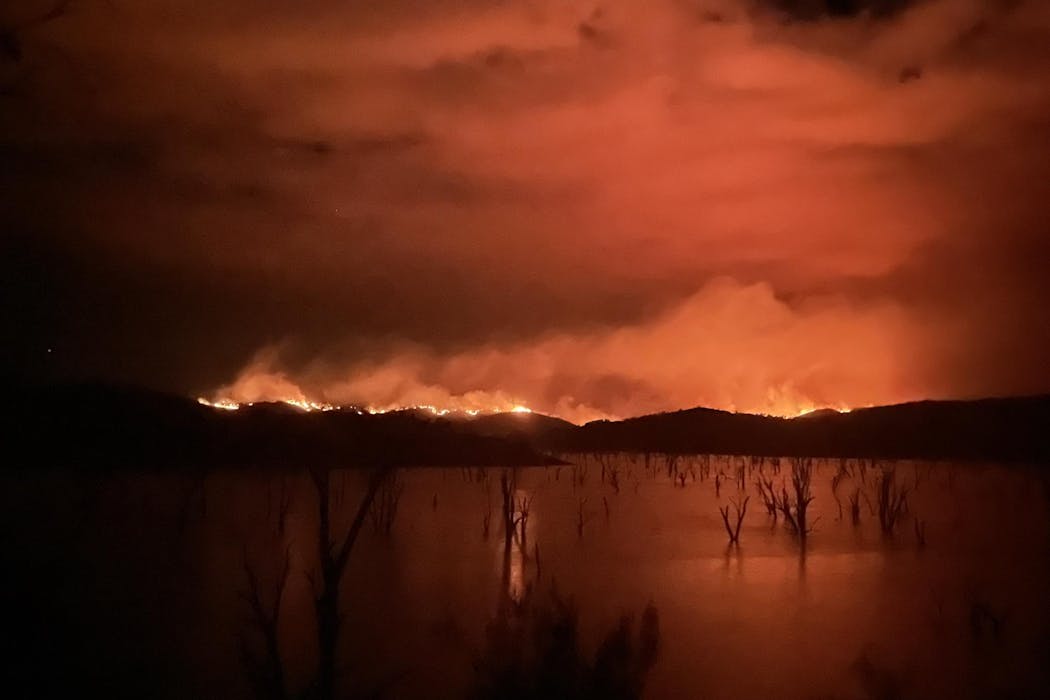
After a weekend of extreme heat and windy conditions, more than 30 blazes were still burning in Victoria and New South Wales as of Sunday evening, including major fires in the Otways, near the town of Alexandra in central Victoria, and on the NSW-Victoria border near Corryong.
How the Longwood fire has spread
And in northern Australia, Cyclone Koji brought heavy rain and fierce wind gusts as it crossed the coast Sunday into north Queensland.
What role does climate change play in supercharging extreme weather conditions, such as these? The evidence shows it not only turns up the thermostat, it also makes the climate system more erratic.
One emerging aspect of such climate change is “hydroclimatic whiplash” – sudden and often frequent transitions between very dry and very wet conditions. It can feel like the climate system is toggling between lots of different states: floods one minute, bushfires the next.
Australians are familiar with the El Niño Southern Oscillation (ENSO), the climate phenomenon in the Pacific Ocean with El Niño (warm) and La Niña (cool) phases that significantly impact global weather. But climate change means our weather is now operating in new and novel ways.
The forecast for this fire season was not as calamitous as it is proving to be. That’s not a criticism – we have to expect the unexpected. Rather than using the term climate change, which implies a steady and predictable shift, I now prefer the term “climate instability”.
On track for worsening fires
We’ve had soaking rains in some parts of south-eastern Australia but now the landscapes are drying out and heatwaves are coming. Don’t be fooled by recent, relatively benign summers. In the longer term, we are on track to experiencing worsening fire seasons and worsening fire weather.
In my home state of Tasmania, for example, in September we weathered the effects of Sudden Stratospheric Warming – rapid warming over either pole, in our case in Antarctica. These are extremely rare in the Southern Hemisphere, with only two other major previous events documented in the past 60 years — one in 2002 and the other in 2019.
On the ground, Tasmania endured strong southerly then westerly winds for months. These winds caused uncontrolled fires in Dolphin Sands and 19 homes were lost. Firefighting aircraft could not be used because of the winds. The temperatures were not extraordinarily hot and the vegetation wasn’t extremely dry, but the winds were so intense they drove uncontrollable fires.
How do heatwaves contribute?
A heatwave is like switching on a hot plate and heating up the landscape. It makes a lot of fuel available to burn. If we get sequences of heat waves this summer, it will take time for the landscape to cool down again between each one.
When we talk about landscape fires, we often talk about fuel. But it’s also useful to think about energy. We need to focus on the energetic nature of the fuels. In a heatwave, the very same vegetation that might be moderately flammable on a cooler day burns at a fever pitch.
This vegetation can release so much energy that it creates thunderstorms that behave, in energetic terms, like small nuclear bombs or volcanoes. A lot of Australian trees, particularly eucalyptus, are adapted to fire. But even they can’t cope with such extreme temperatures.
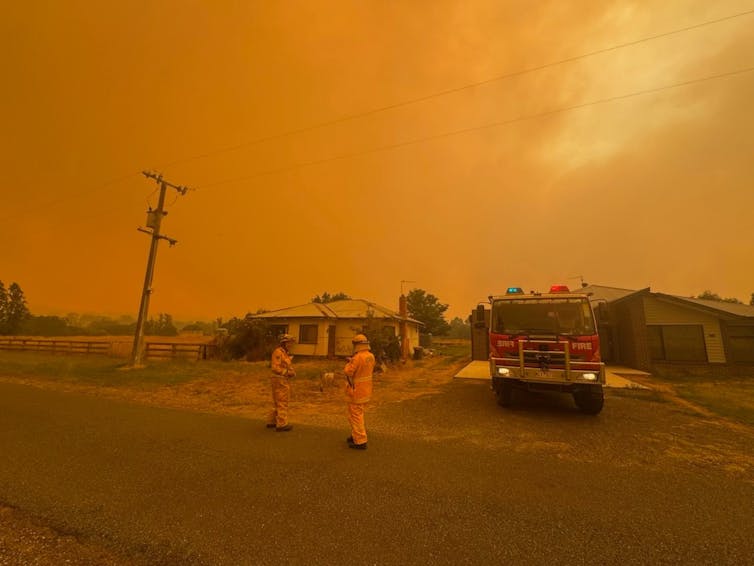
Sassafras/Ferny Creek Fire Bridgade/Facebook
Why is there so much dry lightning?
Dry lightning is a signature of instability in the atmosphere. There’s enough energy to cause convection, the process which drives the formation of thunderclouds, but not enough water vapour to deliver much rain.
As the storm passes over it brings lightning to a landscape that is as flammable as petrol. But the amount of rain is minimal, there’s no deep, soaking rain. There is emerging evidence that as the energy in the atmosphere increases globally, there is more lightning. It’s a diagnostic sign of a hotter and more unstable climate.
How should we respond?
We’re not going to be able to stop climate instability and associated dangerous wildfire weather, so we need to adapt. The worst thing we can do is get frightened or angry. I use the analogy of road safety: people were dying on roads, and we used our intelligence and our laws to drastically reduce the road toll.
We can do the same with bushfires as we adapt to climate instability. There needs to be much better public information about bush fires, and greater investment in education on how to adapt. We also need to build buffers between flammable bushland and towns and suburbs, and have safer gardens.
We have to stop thinking aircraft or firefighters can solve this problem. People are being exposed to very grave risks fighting these fires. We also can’t lazily assume the insurance industry can pick up the pieces.
The key point is there are going to be lots more fires. We can’t resent the administrative and financial effort it will take to make our landscapes safer.

David Bowman is an Australian Research Council Laureate Fellow and also receives funding from the New South Wales Bushfire and Natural Hazards Research Centre, and Natural Hazards Research Australia.
– ref. Rain one minute, heatwave the next. How climate ‘whiplash’ drives unpredictable fire weather – https://theconversation.com/rain-one-minute-heatwave-the-next-how-climate-whiplash-drives-unpredictable-fire-weather-273104