Source: The Conversation (Au and NZ) – By Kit MacFarlane, Lecturer, Creative Writing and Literature, University of South Australia
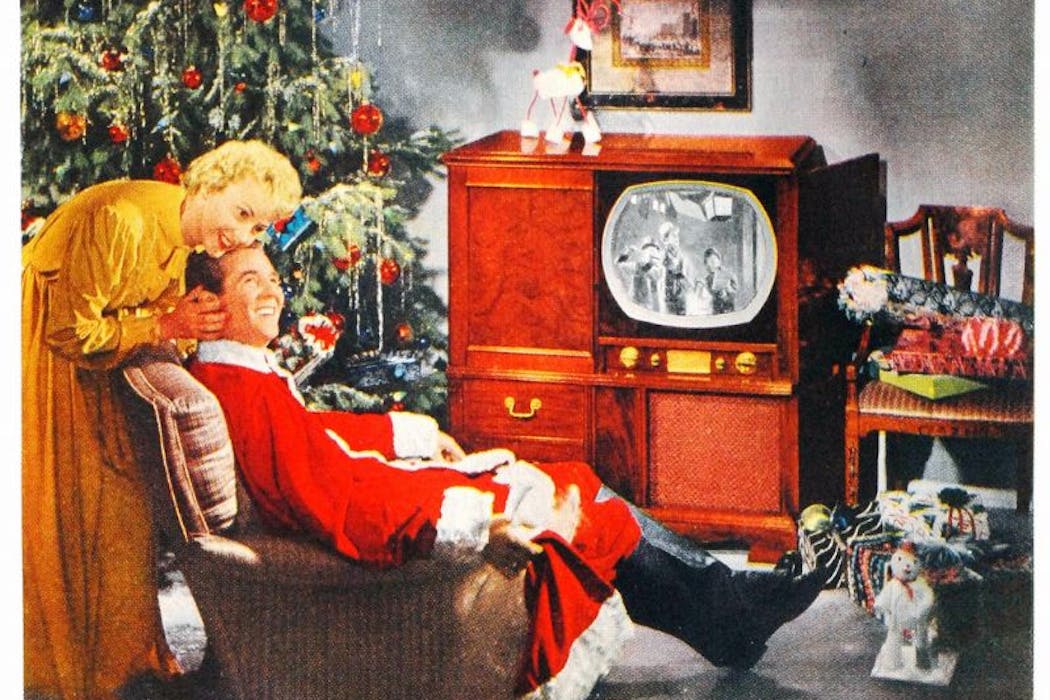
Television has been part of people’s homes and lives for decades. And that makes it an intriguing part of everyday life and cultural history – even if you don’t think there’s anything on worth watching.
So what was TV sending into Australian homes and lives 65 years ago, on Christmas Eve in 1960? And why is it still such an interesting night of television today?
Christmas crime, cowboys and comedy
Plenty of the usual 1960 shows were still on the schedule for those who, as the Australian Women’s Weekly put it,
are agin [sic] Christmas and want to suffer without the sound of a carol or joy bell.
Unsurprisingly, many were from the United States, and many of those shows give early glimpses of future pop culture icons.
Schedules varied considerably from region to region, although with some shared content.
GTV9 in Melbourne aired shows like jazz-detective series Johnny Staccato (an episode featuring a pre-Bewitched Elizabeth Montgomery) and Mickey Spillane’s Mike Hammer. HSV7 shows included Hawaiian Eye (an episode with a pre-Star Trek George Takei) and ABV2 had undercover agent series Tightrope.
You couldn’t count on timely viewing, though. According to The Age’s schedule, future independent filmmaking legend John Cassavetes wouldn’t wish Melbourne viewers a very awkward merry Christmas on Johnny Staccato until New Year’s Eve.
Westerns were a TV staple in 1960, but Christmas Eve was a fairly light evening. Melbourne’s HSV7 had Rawhide (with Clint Eastwood) and Wanted: Dead or Alive (starring Steve McQueen).
Among the comedies providing relief from gunplay was The Donna Reed Show on ABV2. Melbourne’s scheduled episode, Just a Housewife, shows some of the series’ focus on gender roles.
Music and variety shows
Christmas made its presence known more overtly in music and variety shows. Many of these aired in multiple regions.
Christmas Startime, shown in the US the previous year, included performances by Leonard Bernstein and US contralto and civil rights icon Marian Anderson.
The ABC’s offerings included Christmas carols closer to home from the ABC Adelaide Singers, where
Bushland scenes filmed at Rooty Hill and Galston Gorge are shown on film.
TV Week’s listings show Adelaide’s channel 7 battling the ABC Adelaide Singers with competing carols from the Adelaide Harmony Choir.
Most memorable today is the ABC’s Christmas Eve broadcast of legendary and controversial singer and political activist Paul Robeson.
Paul Robeson sings
Robeson’s activism and criticism of the US had led to his passport being revoked by the US government in 1950.
When it was restored in 1958, Robeson toured internationally, arriving in Australia in October 1960. A vocal supporter of unions, he famously sang to workers on the foundations of the in-progress Sydney Opera House.
Robeson’s media appearances while in Australia included ABC panel discussion show Spotlight and a reportedly censored Western Australian radio broadcast.
Before he left Australia, Robeson pre-recorded a Christmas Eve TV appearance for the ABC, including a performance of Silent Night.
The Australian Women’s Weekly said
This year TV has done television viewers proud. Not only is Marian Anderson singing [Silent Night], but at Channel 2 on Christmas Eve famous baritone Paul Robeson.
Uncomfortable histories
Particularly notable, and uncomfortable, is that Robeson’s Christmas Eve appearance was on Hal Lashwood’s Minstrel Show, an Australian variety series that featured performances in blackface.
Robeson – a fierce advocate for racial justice – made his appearance a message of inclusion and equality. In the segment, Robeson speaks and sings to six “kiddies of different nationalities”, telling them
this is a wonderful time where children of all groups and of all kinds get together from all sorts of people.
Robeson felt his work in Australia wasn’t done. The Tribune reported he declared the fact that Aboriginal people “are not given citizenship is indefensible and inexcusable”:
I am coming back to Australia as soon as I can and the first place I want to go is but amongst my black brothers, the Indigenous people of Australia.
A rapid decline in Robeson’s health meant he never returned to Australia. But his 1960 tour, capped off by his Christmas Eve TV appearance, has had an enduring cultural impact.
Why historical pop culture still matters
In many ways, a prominent activist for racial equality appearing on a series marked by damaging racial stereotypes demonstrates some of the tensions and contradictions historical culture can present.
Many of the US shows broadcast in Australia on Christmas Eve 1960 still exist and can be found on DVD or online. Unfortunately, that’s not the case for much of the Australian content.
We’re fortunate to have the National Film and Sound Archive and other archives. But support for preserving cultural history and ensuring access can be precarious.
There’s still so much of Australia’s media history that is lost, unavailable, inaccessible – or just ignored.
Whether it’s surprising or shameful, pop culture like television can tell us a lot about the past, and also help us form connections with the people who lived alongside it.
Christmas Eve 1960 is just one night of television. And every night of historical television has its own intriguing cultural story to tell.

Kit MacFarlane does not work for, consult, own shares in or receive funding from any company or organisation that would benefit from this article, and has disclosed no relevant affiliations beyond their academic appointment.
– ref. What did Australians watch on TV on Christmas Eve 1960? – https://theconversation.com/what-did-australians-watch-on-tv-on-christmas-eve-1960-267631