Source: The Conversation (Au and NZ) – By Alison Carroll, Senior Research Fellow, Victorian College of the Arts, The University of Melbourne
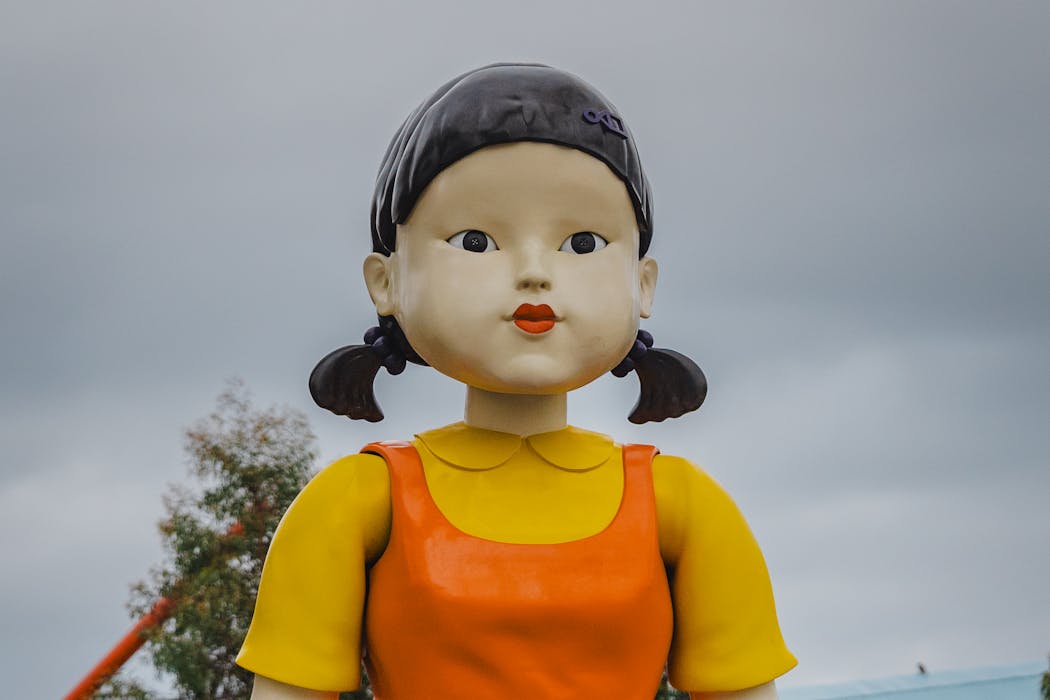
As a K-drama tragic I have long wondered what qualities it has that make me marvel so. K-drama and K-pop are the clearest manifestations of the Korean cultural wave sweeping the world, but it also includes fashion, food, beauty, film, art, webtoons and more – culture in all its forms.
The exhibition Hallyu!, named after the Korean phrase for Korean wave, was prepared by the Victoria & Albert Museum (V&A) in London. It is now in Canberra, and seems like fun, fun, fun – but it is much more than this.
The exhibition conveys the range possible within hallyu, from tightly controlled but dynamic visual and sound choreography to subtle emotion displayed by just a flicker of the eye or a tightened lip. These underlie the fast pace, brilliant colour and vibrant sound that attracts us so.
Those beautiful young singers and dancers seem like gossamer on the breeze – but they got there with years of relentless practice.

National Museum of Australia
Korean–Australian exchange
For centuries, Korea was a society run under strict Confucianism: top-down, highly controlled and restrained, with the group working together for the greater good.
This was followed by a stoic resistance to harsh Japanese colonial control from 1905 to 1945, and the country being split into North Korea and South Korea after the end of World War Two. The two countries spent three years of war in the early 1950s that nearly destroyed everything.
In post-war South Korea, four decades of military rule saw massive government support for the new industries seen as essential to turn one of the poorest nations globally into one of the richest.
From the late 1980s, government and business working together have had a major role in the support of cultural endeavours. The sprawling new National Museum of Modern and Contemporary Art was built for the 1988 Seoul Olympics, with the huge, 1,000 screen video tower by Nam June Paik in its centre.
It was a statement of centrally controlled intent.
Korea is very different from Australia but shares some experience in needing to be proactive on the edge of Euro-American cultural powerhouses, Australia also stretching its international cultural muscles from the late 1980s. An example is the only two new national pavilions at the Venice Biennale in the last 50 years being us in 1987 and Korea in 1995.
President Kim Young-sam, elected in 1992, was behind a push to promote Korean culture internationally. So too did Prime Minister Paul Keating put pressure on our institutions to look to Asia.
In 1993, I was asked by the Department of Foreign Affairs and Trade to do a report on opportunities for Australian art in Korea. The next ten years saw a new era of cultural exchanges, with 13 exhibitions going to and from Korea between 1993 and 2005 under the Asialink program, including the first Korean contemporary art show at the National Gallery of Victoria and the Art Gallery of New South Wales, Slowness of Speed in 1998–99.
The Asia Pacific Triennial invited Koreans to Brisbane from 1993. The Adelaide Festival included two Korean artists in 1994. In 2009 Asialink hosted a conference on contemporary Korean culture: Wave Korea Wave, inviting key Koreans to Melbourne.
The United Kingdom acknowledged Korean culture in this period too, helped by proactive Korean political figures and the might of Samsung funds. The V&A in 1992 and then the British Museum set aside some small areas for display of Korean traditional work. Curator Rosalie Kim, appointed to the V&A in 2012, pitched the idea of the Hallyu show in 2019 and it has gone on to great acclaim in the UK, the United States of America, Switzerland and now here.
‘Whiplash between comedy and grief’
The exhibition has a great depth of scholarship backing the most wonderful offerings of contemporary culture, set on a fast, filmic, dynamic stage. It will be liked by all.
You can learn Korean pop choreographic movements, admire beautiful clothes (contemporary hanbok or traditional costume), and marvel at the technical wizardry behind so many works.
But it is much more than this. In the museum’s journal Soo Hugh, the creative behind the TV series Pachinko (2022–24) has succinctly written about “the emotional intensity, the visual precision [and] the tonal whiplash between comedy and grief” of contemporary Korean creative projects.
Many will be familiar with this from the Oscar-winning film Parasite (2019). Sited centrally within the exhibition is a recreation of the bathroom in the film – a palpable symbol of desperation literally beneath prosperity.

National Museum of Australia
Before the 1990s, art from our region seemed naturally to come via Europe. I had asked a senior curator at the National Gallery of Australia about acquiring contemporary art from Vietnam, and he memorably replied: “if anything was going on in Vietnam my dealer in Paris would tell me”.
We have since worked in partnership directly with Vietnamese arts people on numerous projects, to everyone’s advantage. And the same for our relations with Korea.
Despite more recent history and now so many successful young Korean-Australian citizens it is cause for chagrin that Hallyu has come to us today, as in the past, mediated by others.
Hallyu! is at the National Museum of Australia until May 10.

Alison Carroll was director of Asialink Arts 1990–2010. She travelled to Canberra with the support of the National Museum of Australia.
– ref. Hallyu! rides the Korean wave. It’s a fun exhibition with depth – but misses the Australian story – https://theconversation.com/hallyu-rides-the-korean-wave-its-a-fun-exhibition-with-depth-but-misses-the-australian-story-271297