
Analysis by Keith Rankin.
Germany’s Deadliest Weeks since World War Two? – Spiralling Deaths in Germany
The four weeks ending 8 January 2023 have seen easily the most deaths in Germany of any four‑week period since 2015. The worst week was the week ending Christmas Day, with 28,481 deaths. While it’s hard to compare with pre-1990 years, due to the East Germany question, it may well be that this week last December had a greater percentage of excess deaths than any other week since the last world war.
Baseline weekly deaths for 2022 would have been just over 17,000; a baseline of 68,700 for four weeks, as shown in Table 1. Therefore, winter illnesses have raised peak deaths at the end of 2022 to 65 percent above what they would have been in a normal non-winter week.
| Table 1: Germany Epidemic Death Peaks from 2015 | ||||
| Deaths for 4 Weeks | Period End-Date | Worst Week Toll | Week End-Date | |
| 106,226 | 8/01/2023 | winter wave 2022/23 | 28,421 | 25/12/2022 |
| 100,738 | 10/01/2021 | 3rd classic wave [Covid19] | 25,554 | 27/12/2020 |
| 99,585 | 18/03/2018 | influenza ‘pandemic’ 2018 | 26,777 | 11/03/2018 |
| 94,499 | 19/12/2021 | delta wave [Covid19] | 24,185 | 5/12/2021 |
| 91,333 | 26/02/2017 | influenza ‘pandemic’ 2017 | 23,640 | 5/02/2017 |
| 91,259 | 15/03/2015 | epidemic influenza 2015 | 23,598 | 8/03/2015 |
| 85,418 | 30/10/2022 | autumn wave 2022 | 21,771 | 23/10/2022 |
| 84,634 | 3/04/2022 | omicron wave [Covid19] | 21,347 | 20/03/2022 |
| 81,742 | 10/03/2019 | epidemic influenza 2019 | 20,790 | 3/03/2019 |
| 80,947 | 14/08/2022 | summer wave 2022 | 20,952 | 24/07/2022 |
| 80,564 | 12/04/2020 | 1st classic wave [Covid19] | 20,662 | 5/04/2020 |
| 77,264 | 9/05/2021 | alpha wave [Covid19] | 19,555 | 2/05/2021 |
| 75,611 | 27/03/2016 | influenza peak 2016 | 18,971 | 20/03/2016 |
| 74,079 | 19/08/2018 | summer peak 2018 | 20,371 | 5/08/2018 |
| 72,182 | 23/08/2020 | 2nd classic wave, summer [Covid19] | 19,720 | 16/08/2020 |
| 70,060 | 11/08/2019 | summer peak 2019 | 19,630 | 28/07/2019 |
| source: ourworldindata.org/excess-mortality-covid “Deaths from all causes” | ||||
| ———————————————– | ||||
| Baselines, based on trend growth in deaths arising from an aging population: | ||||
| 2015 baseline 4-weekly deaths = | 63,000 | |||
| 2023 baseline 4-weekly deaths = | 68,700 | |||
While the December 2022 statistic is remarkable, it seems that most Germans themselves are not aware of this. Many people suffering individual tragedies will typically not be aware if their ‘micro’ tragedy is part of a much bigger ‘macro’ tragedy. This DW story (23 Jan 2023) The impossible task of calculating global pandemic deaths, only looks at 2020 and 2021, and gives no commentary on the Germany chart included. The best I can find on DW discussing the health situation in Germany last December is: Winter illnesses burden Germany’s intensive care units, 17 Dec 2022.
What is remarkable is that this latest winter toll comes very soon after three other periods of high peak mortality in 2022, listed in Table 1 as ‘autumn wave’, ‘summer wave’, and ‘omicron wave’. So, from the Grim Reaper’s point of view, the ‘low-hanging-fruit’ should already have passed.
These recent mortality waves compare unfavourably with the three ‘classic’ Covid19 death waves, each of which had weekly peaks in 2020. By ‘classic’ I mean the original ‘Wuhan’ coronavirus strain, before ‘variants’ and ‘vaccinations’ became a thing in 2021.
It is also noteworthy how high some of the pre-covid death peaks were. The influenza ‘pandemic’ of late 2016 to early 2018 was particularly pronounced. (I use single-quote-marks, because this actual pandemic was never granted pandemic-status by the World Health Organisation.) Germany’s two peaks for this influenza pandemic were in February 2017 and March 2018. We also note a particularly bad season of epidemic influenza in early 2015.
Refer to my Death Spikes and Covid Dissonance? Examples of Germany and Denmark for charts recently published, comparing Germany’s excess deaths with those of its neighbour, Denmark. The December 2022 mortality peak is reproduced to some extent in most (but not some eastern) European Union countries, and in the United Kingdom and United States. However, Germany’s year-of-death in 2022 is probably the most dramatic. (One other country which appears to have an equally problematic mortality, maybe worse, in 2022 is South Korea. I wait in hope for the eventual publication of South Korea’s complete dataset.)
Chart 1 below shows ‘excess deaths’ – as distinct from total deaths – for Germany, by age group.
Chart 1
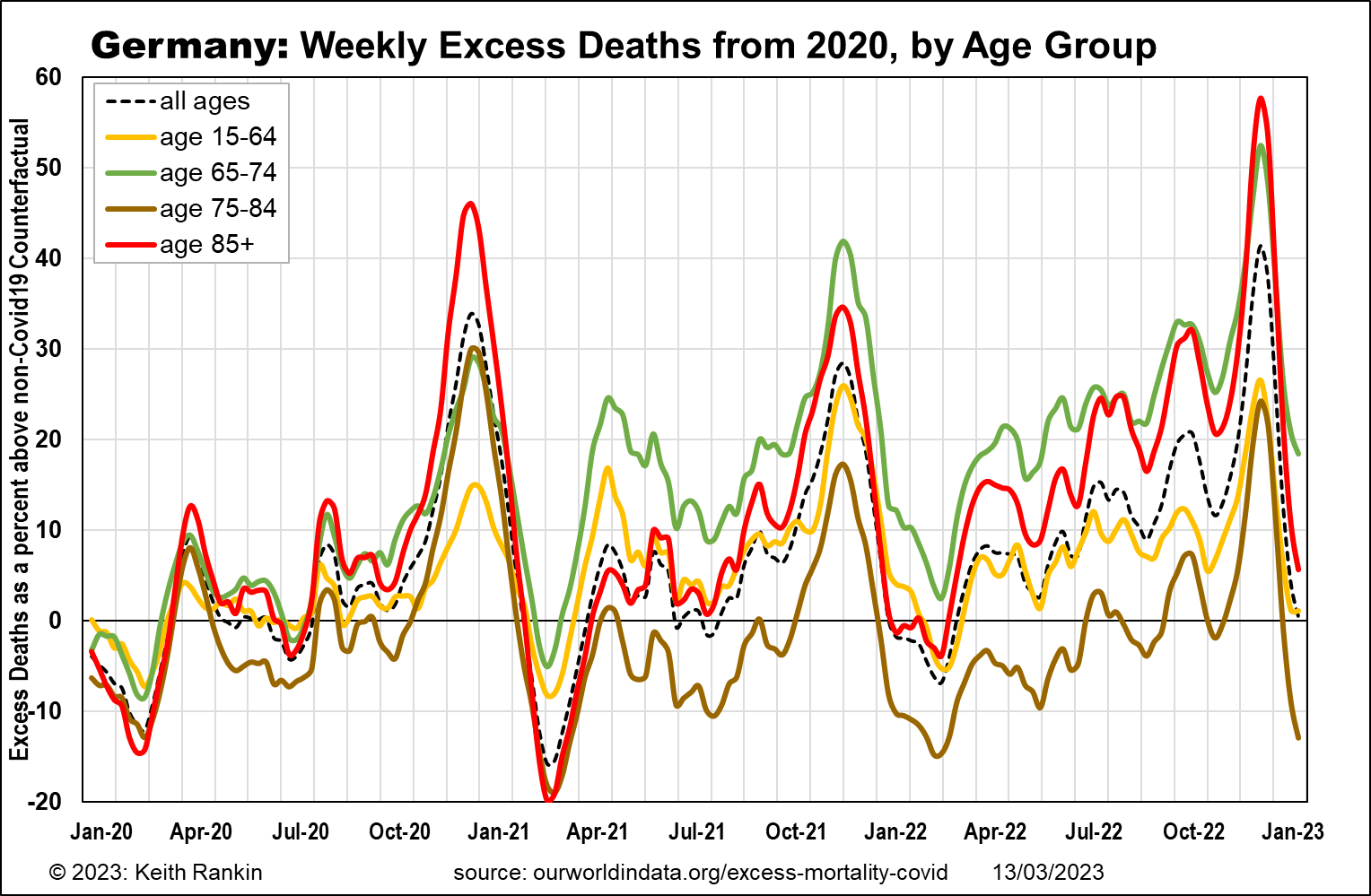
Germany’s demographics are unusual (but maybe not unusually unusual) on account of World War Two. The oldest Germans – shown in red – were all born before that war. The German post-war baby-boomers are shown in green. Germany shows disturbingly high rates of pandemic death for its baby-boomers, from 2021. (It should be noted that Covid19 deaths tended to peak from November to January, whereas epidemic influenza death tended to peak in February or March. Thus the big reductions in excess deaths each February and March are mainly due to high death-norms set by pre-covid influenzas.
Countries regarded as having pursued the best anti-Covid19 public health policies in 2020 have not had a good 2022. Germany is one of those countries. South Korea, Japan, Taiwan, Thailand, Singapore and China are others. So are Australia and New Zealand. Once having acknowledged the 2022 death statistics for what they are, terrible, the question is whether the problems of 2022 in these countries will extend into 2023. While my hunch is that new vaccinations could make a difference, in 2023 at least, I am concerned that societies have already passed a demographic turning point and that life expectancies are already declining from their peaks, and may continue to decline for decades.
*******
Keith Rankin (keith at rankin dot nz), trained as an economic historian, is a retired lecturer in Economics and Statistics. He lives in Auckland, New Zealand.